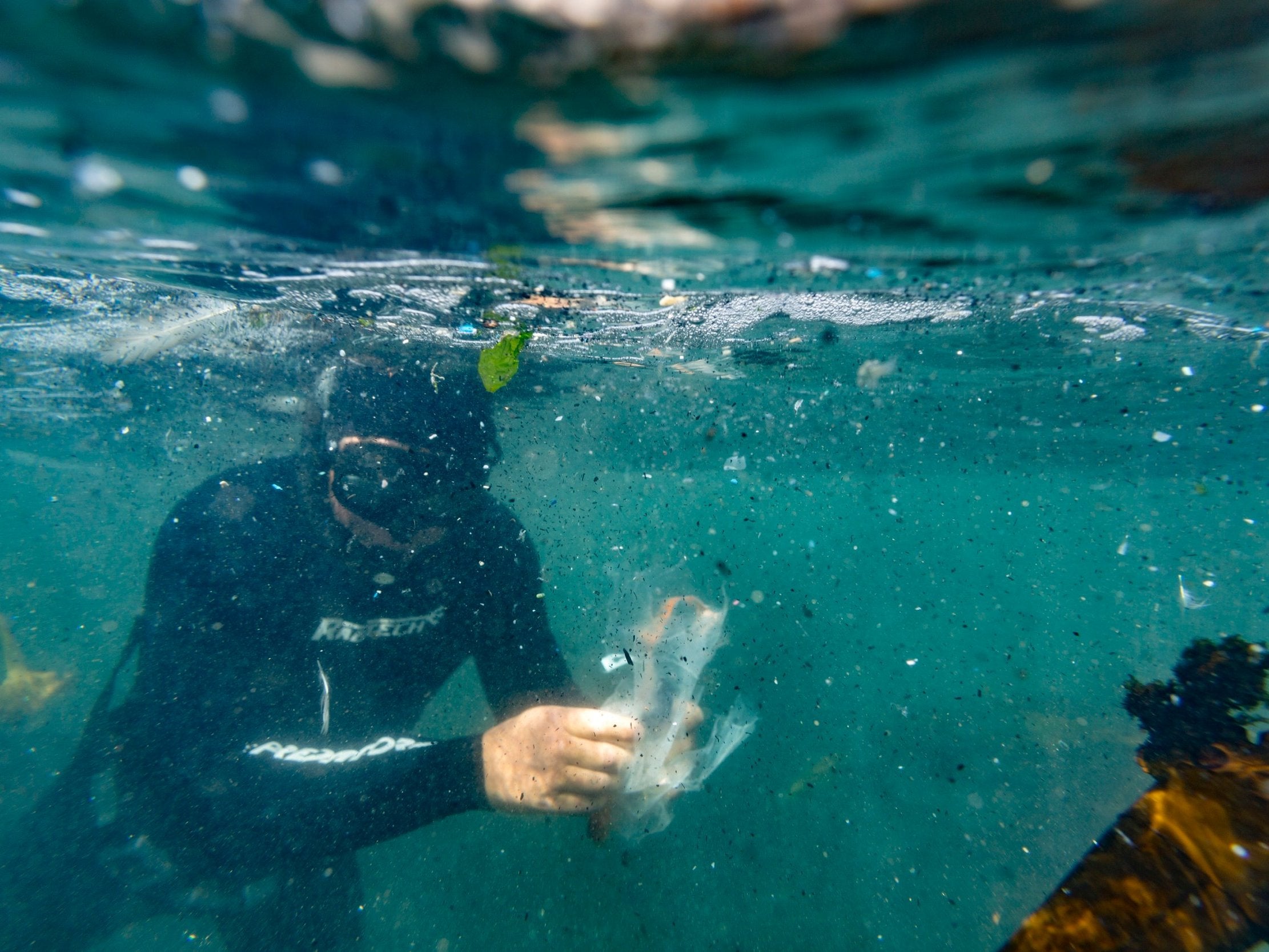
Plastic in the oceans is being turned into an even greater threat to small sea creatures than previously thought because bacteria are sticking particles of it together, scientists have discovered.
Glue-like substances secreted by bacteria are sticking tiny bits of plastic to form larger clusters that marine animals could mistake for food, experts fear.
They also worry that the clumping could divert the natural flow of food from the ocean surface to the seafloor, leading to deep sea creatures being starved.
Researchers at Heriot-Watt University in Edinburgh staged experiments with seawater, adding plastics in conditions simulating the ocean surface.
Within minutes, the minuscule pieces of plastic grouped together with bacteria, algae and other organic particles to form larger clumps.
The scientists are said to have been surprised to discover that large masses of biopolymers – molecules made by organisms – formed the bulk of the plastic clusters.
About eight million tonnes of plastic are thrown into the ocean each year, research shows.
Team member Stephen Summers said: “This is a first step towards understanding how nanoplastics interact with natural biopolymers throughout the world’s oceans.
“This is very important, as it is at this small scale that much of the world’s biogeochemistry occurs.”
The clumps became visible to the naked eye.
“The fact that these agglomerates become large enough to see raises concern, as they are likely to be seen as a food source by small marine animals,” he said.
Tony Gutierrez, the microbial ecologist who led the study, said deep-sea ecosystems could become starved of food if plastics of different densities affected the food flux from the upper to lower reaches of the ocean.
Additional reporting by PA