As 3I/ATLAS starts its long, lonely journey into the cold depths of interstellar space, it leaves behind a trail of data that has set the scientific world on fire. This celestial nomad is the third confirmed visitor from another star system, and it has turned out to be anything but ordinary.
'Oumuamua and Borisov were strange enough, but 3I/ATLAS has given us a geometric puzzle that is hard to explain: three perfectly symmetrical jets that have made even the most stoic astronomers look twice. When the comet reached its closest point to the Sun on Oct. 29, 2025, it was moving at an incredible 68 kilometers per second.
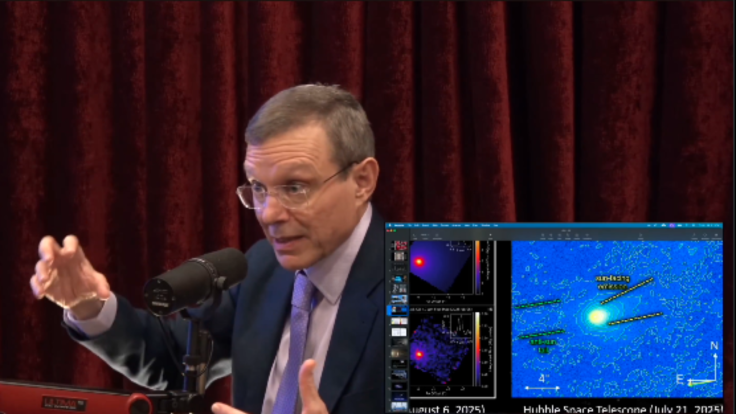
Harvard astrophysicist Avi Loeb, a man no stranger to cosmic controversy, has become the leading voice documenting these anomalies. Analysing fresh imagery from the Hubble Space Telescope, Loeb has pointed to a 'puzzling' configuration of jets erupting from the comet's nucleus.
Unlike the chaotic, uneven outgassing typically seen in our own solar system's comets, 3I/ATLAS appears to be operating with a precision that seems almost mechanical. Loeb has even noted that the gas plume surrounding the object contains a nickel-to-cyanide ratio that is orders of magnitude higher than thousands of known comets, a chemical signature more reminiscent of industrially produced alloys.

A Natural Freak or Something More?
The heart of the mystery is in pictures taken by Hubble on Nov. 30, Dec. 12 and Dec. 27, 2025. The comet has a huge 'anti-tail', which is a plume of dust and gas that points directly at the sun. Hubble's Wide Field Camera 3, on the other hand, showed three smaller jets closer to the nucleus.
These jets aren't just random bursts; they are spaced out at 120-degree angles, making a near-perfect trifecta around the object's axis. The sunward anti-tail is the biggest of the three jets, which are only about 10,000 kilometers long. One of the jets points away from the sun, while the other two are at +/-120 degrees.
'The equal angular separations of 360 degrees divided by three among these three jet axes is puzzling,' Loeb wrote in a recent Medium post. He noted that while jets are common — driven by sunlight warming buried ice — the sheer mathematical perfection of this layout warrants intense scrutiny. For the jets to remain so perfectly aligned while the nucleus rotates suggests either a highly specific arrangement of ice pockets or, as Loeb suggests, a system that could be interpreted as a technological signature.
He compares the central anti-tail to the 'beam of a lighthouse', wondering how such stability is maintained over vast distances. Furthermore, Loeb calculated that the probability of the comet's trajectory being aligned within 5 degrees of the ecliptic plane by chance is a mere 0.2%, suggesting the path might have been intentional.

Radio Silence in Search for Technosignatures Near Avi Loeb and 3I/ATLAS
As the visual data grew more complex, radio astronomers stepped in to see if the visitor was 'broadcasting' its secrets. On Dec. 18, just one day before the comet's closest approach to Earth at a distance of 270 million kilometres (1.8 AU), the Breakthrough Listen programme trained the massive 100-metre Green Bank Telescope on the object. The goal was simple: look for narrowband radio signals that would prove, once and for all, that 3I/ATLAS was an engineered craft rather than a mountain of ice.
The results, detailed in an arXiv preprint by Ben Jacobson-Bell, were a masterclass in 'radio silence'. Despite an initial processing run that flagged hundreds of thousands of candidate hits, every single one was eventually dismissed as human-made interference from Earth. The team reported a 'nondetection' down to the 100-milliwatt level — roughly the power of a dim torch or a mobile phone handset. For now, the 'alien probe' theory remains strictly in the realm of speculation.
Yet, the silence has not dampened the debate. In a New Year's Day post for The Times of Israel, writer Rafi Glick argued that 3I/ATLAS serves as a 'wake-up call' for humanity. He called for a coordinated global strategy, perhaps overseen by the United Nations, to handle future interstellar guests. For the broader astronomical community, the baseline remains that 3I/ATLAS is a natural, if extreme, example of cometary physics.
But as the visitor fades into the dark, the question lingers: is it a natural wonder of the cosmos, or a billion-year-old message we aren't yet clever enough to read? With the comet currently drifting through the constellation Leo, scientists estimate they have only a few hundred more days to capture data before the 11-billion-year-old visitor vanishes forever.