Australian men, so the cliché goes, are not averse to a drop of the amber nectar, and often fancy themselves as larrikins. Sure enough, the annals of Australian Test cricket are littered with men who conform to such stereotypes, and whose behaviour occasionally came uncomfortably close to thuggishness. And like any other Test team, Australia has been far from immune to selectorial howlers, poaching players from other countries, and picking biffers whose athleticism was far from obvious. Our team of the unlikeliest Aussie Test players ever is a motley bunch – but would have been thrilling to watch.
1. David Boon
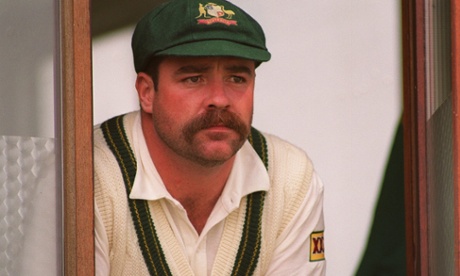
The pulverising, extravagantly moustachioed batsman would, one suspects, have struggled with modern day bleep-tests – “stocky” was the kindest way to describe his ample frame. And off the pitch, he was a world-class boozer, having famously achieved the record for most cans of Victoria Bitter consumed on a flight from Sydney to London: 52, in 1989. He may have been a tad unreconstructed, but remains one of the greatest and most respected batsmen ever to step up to the crease – as demonstrated by his possession of an MBE – with 7,422 Test runs at an average of 43.65 to his name.
2. Kepler Wessels
Aussies love taunting Englishmen for including a stream of “plastic Brits” over the years – many with South African backgrounds. Yet they had their own South African opening the batting for years, in the form of the talented left-hander Kepler Wessels. Wessels entered the Australian team at the height of the apartheid years, in the wake of the destruction wrought by Kerry Packer’s World Series Cricket, and eventually retired in 1986. However, when apartheid crumbled in 1991, he found himself captaining the newly reconstituted South Africa team between 1992 and 1994, presiding over a famous victory over Australia in Sydney in January 1994.
3. Ricky Ponting
The man nicknamed Punter is one of Test cricket’s greatest captains and batsmen, with 13,378 Test runs – second in the all-time list behind Sachin Tendulkar – and countless Test and One-Day International records. Now, as a genial Sky Sports commentator, he is one of cricket’s highest-profile role models. But Ponting had a tough childhood in Launceston, Tasmania, one of Australia’s least affluent towns, saying in his autobiography: “Launceston is divided by the Tamar River: one side was middle class and nice, and the other was where we lived.” His early years in the Australian Test team were marred by hell-raising and controversy. Fined after a fracas in a Calcutta nightclub in 1998, he was dropped after an incident at the Bourbon & Beefsteak club in Sydney in 1999, during which he sustained a black eye (and of which he admitted he had no recollection).
4. Clem Hill
Making his Test debut in 1896, batsman Clem Hill was one of the pioneers of Australian cricket. But he is also surely the only Test captain ever to have punched a selector in the face. In 1912, following a long-running dispute over selector Peter McAlister’s refusal to pick Charlie Macartney, Hill responded to McAlister’s repetition of his assertion that Hill was: “The worst captain I have ever seen” by punching him; the ensuing brawl was so violent and protracted that onlookers feared the pair would fall out of a window. Remarkably, Hill played in the next Test.
5. Andrew Symonds
In a parallel universe, the extravagantly talented, enormously strong all-rounder might have played for England, the country of his birth. He was selected for an England A tour in 1995, but plumped for Australia. England might see that decision as a bullet dodged: Symonds turned out to be one of cricket’s baddest-ever bad-boys. In 2006, he was sent home after turning up drunk for a match against Bangladesh; in 2008 he was dropped for missing a team meeting because he was fishing. Later that year, he was involved in a brawl in a Brisbane pub, and in 2009 he was dispatched from the ICC World Twenty20 for boozing, just a few months after being dropped and assigned a psychologist following remarks made in a radio interview. Plus, in 2008, he was at the centre of a full-blown diplomatic storm, after India’s Harbhajan Singh allegedly called him a “monkey”.
6. Rodney Marsh
The great wicketkeeper-batsman and current chairman of Australia’s selectors is a towering figure in the cricketing world these days, but wasn’t so well regarded when he made his Test debut. Indeed, his wicketkeeping was deemed to be so bad that he was universally known as Iron Gloves. But he worked hard and became a fine technician. A big lad, he also faced question marks about his fitness, perhaps exacerbated by his fondness for a drop – before David Boon, he held the Sydney-London record of 45 cans of beer consumed, but unlike Boon, ended up being wheeled through Heathrow unconscious on a luggage trolley.
7. Billy Midwinter
Having emigrated to Australia from England aged nine, Billy Midwinter played for Australia in the first ever Test match, held in Melbourne in 1877. Then he returned to England, to play for WG Grace’s Gloucestershire, famously being “kidnapped” by Grace when about to play for Australia at Lord’s, and taken to the Oval to play for Gloucestershire. He played four Tests for England in 1881/82 then emigrated back to Australia, for whom he played six more Tests before bowing out of the game as perhaps the most nationality-confused cricketer ever.
8. Merv Hughes
“Merv the Swerve” remains one of Test cricket’s great characters. A burly figure – to put it politely; his nickname was “Sumo” – he looked more like a 17th century pirate than an international sportsman. And his bizarre run-up, routinely described as “mincing” added another layer of incongruity. Nevertheless, he was a highly skilful and effective bowler, who bagged an impressive 212 Test scalps. And sported the most impressive moustache in the history of Test cricket.
9. Jeff Thomson
The great 1970s bowler still features in the debate about who was the fastest bowler ever – in 1975, early speed-gun attempts clocked him tantalisingly close to 100mph. Yet, as was evident every time he ran up to bowl, he didn’t start off as a bowler, but a javelin-thrower, which bred an unconventional action that would have looked more at home on an athletics track. Thommo was so quick that he didn’t need to bother with niceties like swing, once memorably describing his technique thus: “Aw, mate, I just shuffle up and go wang.”
10. Michael Beer
The retirement of Shane Warne led to some increasingly desperate Australian selections in the spin department – none more so than that of Michael Beer. When he made his Test debut in 2010, the slow left-armer had just five first-class games under his belt. His two tests yielded three wickets with the ball and six with the bat. Australia’s own Darren Pattinson-style selectorial howler.
11. Bert Ironmonger
Curiously, disabilities in real life can be a positive advantage in cricket – as demonstrated by the wonderfully monickered Bert Ironmonger. A left-arm spinner, Ironmonger lost the forefinger of his bowling hand as a boy, in an accident on the family farm. Nevertheless, he was a hugely effective bowler – in 1924-25 he took a hat-trick against the MCC. And if the current Ashes team get fed up with being called a Dad’s Army, they can cite Ironmonger: he made his Test debut at the age of 45.