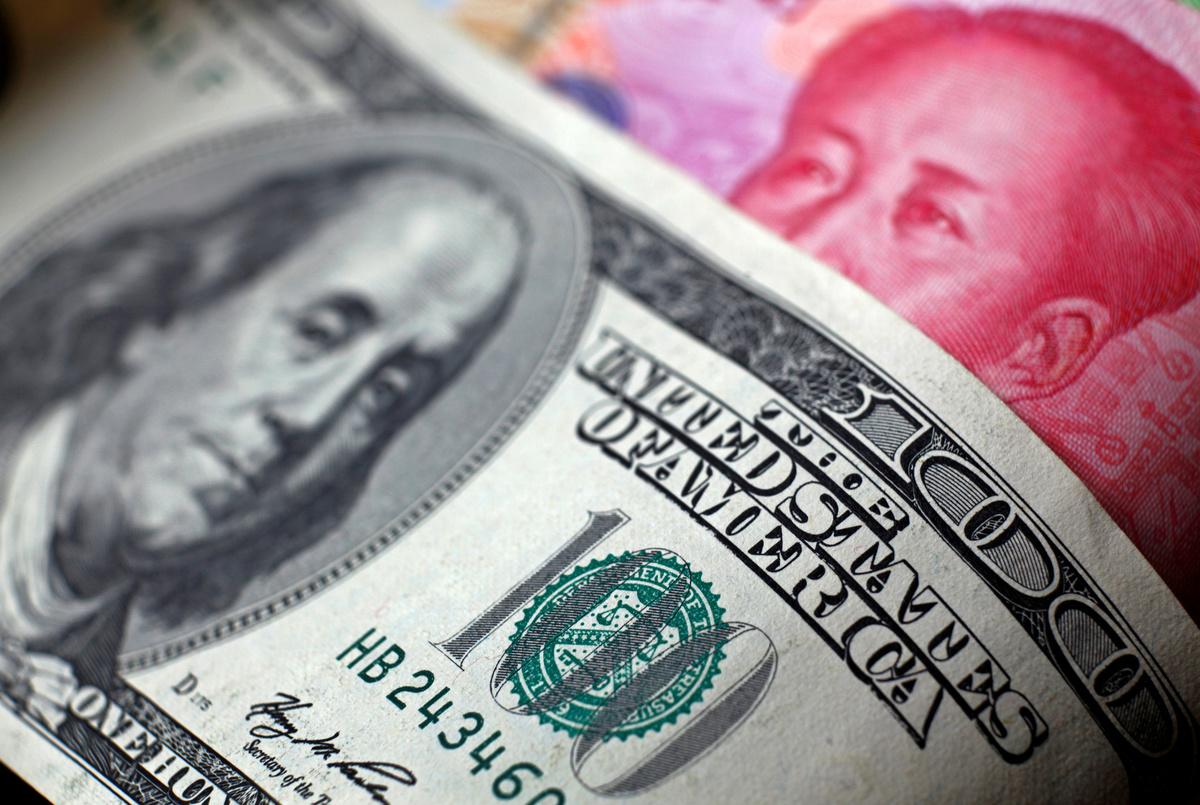
NEW YORK (Reuters) - The U.S. dollar index was flat on Friday morning, with the offshore Chinese yuan headed toward its biggest monthly decline in 25 years as the two countries prepared for the implementation of new retaliatory tariffs on Sunday.
The index <.DXY> was 0.02% lower at 98.483, closing the month virtually unchanged after having been whipped around by trade headlines. Against the dollar, the offshore yuan <CNH=> was 0.2% weaker at 7.157, set for a 3.6% fall in August, it's biggest monthly drop since 1994.
An additional 5% tariff on $125 billion of goods from China is slated to kick in on Sunday, affecting consumer items from smart speakers to sneakers. Investors fear the intensifying trade dispute could lead the U.S. economy into recession.
But on Friday, trade fears were subdued after the two countries on Thursday discussed upcoming face-to-face negotiations in September and China declined to comment on whether it would respond in kind to President Donald Trump's latest round of tariffs.
The U.S. dollar has remained afloat amidst the trade war.
"Regardless of what the Trump team wants for the buck, it will continue to rise as long as the global economy sinks. That is a natural function of currency markets to pull money back into the U.S. when the global economy is reeling. Capital flows are mobile, and the primary source of USD demand is not foreigners - it's U.S. investors cutting exposure outside the U.S.," said Mark McCormick, global head of foreign exchange strategy at TD Securities.
Also supporting the dollar was a report on Friday that U.S. consumer spending increased solidly in July as households bought a range of goods and services. But while that may allay some recession fears, the strong pace of consumption is unlikely to be sustained amid tepid income gains.
The Japanese yen was last up 0.34% and is on track for its biggest monthly gain in three months, as safe-haven assets have been buoyed by the U.S.-China conflict. The gains were partly fueled by a global rally in government debt, with yields in major developed markets pushing deeper into negative territory.
The "trade war thus far caused lower rates, not recession," wrote Bank of America Merrill Lynch strategists.
Elsewhere, the pound <GBP=> stabilized despite the growing probability that Britain will exit the European Union on Oct. 31 without a deal.
The Canadian dollar <CAD=> strengthened against its U.S. counterpart on Friday after data showing stronger-than-expected GDP growth, but analysts doubted the Bank of Canada would become more optimistic about the economy's outlook at next week's policy announcement.
(Reporting by Kate Duguid in New York and Olga Cotaga in London; Editing by Steve Orlofsky)