

A train of solar storms is barreling toward Earth, with three coronal mass ejections (CMEs) expected to hit in the coming days. Any potential impact could trigger impressive auroras in northern skies and possibly even at mid-latitudes.
Multiple CMEs launched from sunspot region AR4246 between Oct. 11 and 13 are forecast to reach Earth between Oct. 15 and 17, according to the National Oceanic and Atmospheric Administration's (NOAA) Space Weather Prediction Center.
The strongest disturbances are now expected late on Oct. 16, when geomagnetic storming could reach G2 (moderate) levels before easing back to minor (G1) on Oct. 17. On NOAA's five-point space weather scale, a G1-G2 storm can cause weak to moderate power grid fluctuations, minor satellite impacts and northern lights visible as low as New York and Idaho.
Scientists say the effects could last for days. "NOAA's model run shows the first storm hitting early to mid-day October 14 UTC time. Storms 2–4 arrive starting midday on October 15. We could be dealing with their effects until early October 17, assuming the sun does not send us any other Earth-directed storms!" space weather physicist Tamitha Skov, wrote on her Patreon page. Skov also shared an annotated NASA model showing the four eruptions racing toward Earth.
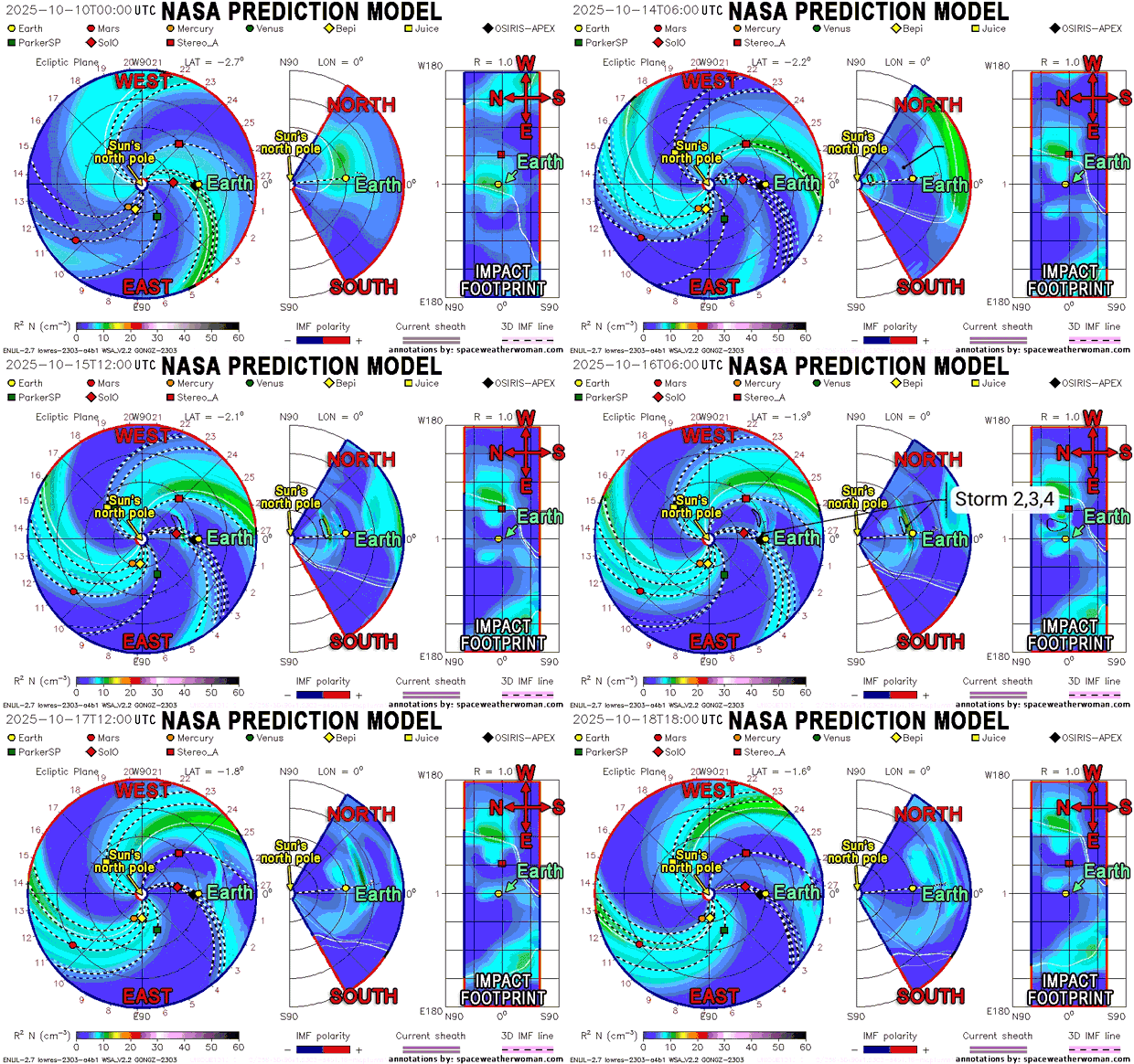
Skov added that the first CME is likely to bring only a "mild disturbance," but warned that the following three are "pancaked together," potentially amplifying their effects when they arrive in quick succession.
NOAA and the U.K. Met Office both expect the most significant space weather activity to occur around Oct. 16, when the combined impact of the CMEs could trigger minor-moderate (G1-G2) geomagnetic storms. This means the northern lights could make a brief return for skywatchers in northern Scotland, Canada, and northern U.S. states, provided skies stay clear and the solar magnetic field tilts favorably toward Earth.
In her latest forecast, issued Oct. 15, Skov says Earth has already been struck by a "warm-up pitch" ahead of the main impacts, with three more storms and a fast solar wind stream expected to follow.
Solar activity has been running high this week. Region AR4246, a large and magnetically complex sunspot group, has produced several M-class flares, including an M2.7 flare on Oct. 13 associated with one of the current CMEs.
CMEs are colossal bursts of magnetized plasma from the sun that can buffet Earth's magnetic field, producing auroras when charged particles collide with atmospheric gases. While these upcoming storms are expected to be moderate, their timing and clustering make them particularly exciting for aurora hunters.
Keep those eyes on the skies and those cameras charged. We could be in for quite the treat!
Editor's note: This article was updated at 04:00 a.m. EDT (0800 GMT) to include new commentary from space weather physicist Tamitha Skov and the latest NOAA and U.K. Met Office forecasts, which now predict G1-G2 geomagnetic storming and elevated aurora chances through Oct. 17.