It’s pretty safe to say that there won’t be any documentaries commemorating this round of the NBA playoffs, which ended on Wednesday night when the Golden State Warriors eliminated the Houston Rockets in Game 5 of the Western Conference finals. That was the more competitive of the two series: the Cleveland Cavaliers completed their sweep over the Atlanta Hawks in the Eastern Conference finals on Tuesday.
The conference finals weren’t completely forgettable affairs. In the West, the battle between the two players who led the NBA MVP voting – Golden State’s Steph Curry and Houston’s James Harden – made for an entertaining subplot, particularly back in Games 1 and 2 when it looked like Harden had a chance to swing the series. There were a lot of scary injuries, although thankfully nothing career-threatening. The Hawks managed to stage a comeback in game 3 of the Eastern Conference Finals, before a visibly exhausted LeBron James snuffed it out in overtime.
And that’s about it. While the games may have been more competitive than the W-L record indicates, there’s no escaping the fact that the losing teams combined to win exactly one game: Houston’s 128-115 victory in Monday’s game 4. And that game wasn’t remotely entertaining for anyone who wasn’t a Rockets fan.
For the Rockets and the Hawks, it’s probably for the best that these series ended up being forgettable, because that’s not how these two teams should be remembered. Years from now, no one will remember how this series went for the Rockets, but they’ll remember how they got there.
The Rockets had no business even making it this far. It was only a few weeks ago that the Rockets were down 19 points in the third quarter of an elimination game against the Los Angeles Clippers. The Rockets, of course, pulled off a near miraculous rally to steal that game, setting up a Game 7 at home where they easily vanquished a stunned and demoralized Clippers team.
That’s how this entire season has gone for the Rockets. Houston spent last offseason trying and failing to find a third star player to go along with Harden and Dwight Howard. Instead, Carmelo Anthony and Chris Bosh stayed with their old teams. If anything, the Rockets seemed to have taken a step back after losing Chandler Parsons to their in-state rivals, the Dallas Mavericks. Meanwhile, Harden opened himself up to ridicule by declaring himself the “best basketball player alive” in an interview with ESPN.
The Rockets were expected to have a tough time competing in the increasingly talent-rich Western Conference. Instead they entered the postseason as the second seed and made it past the second round of the playoffs for the first time since 1997. At times, Harden really did look like the best basketball player alive.
Unfortunately for him, so did Steph Curry, who beat Harden out for league MVP. Which brings us to the main reason that, despite the deflating ending, the Rockets should count this season as a success: the Rockets were the victims of bad timing. Houston ended up having their best season in decades at the exact same time that Curry and the Warriors were possibly having one of the best seasons than any NBA team has ever had.
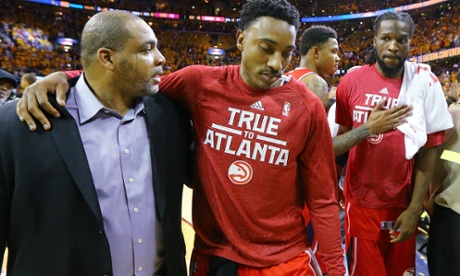
There is no need to use the words “maybe” or “possibly” regarding the 2014-15 Hawks, this was the franchise’s most successful season since moving to Atlanta in 1968. They went undefeated throughout the entire month of January, sent four out of five starters to the All-Star Game and won a franchise record 60 games in the regular season.
Yes, Atlanta’s season ended when they got swept in the conference finals by a Cavaliers team that was playing without Kevin Love, and with only like 40% of Kyrie Irving. Their series ended in blowout fashion in Tuesday’s 118-88 loss. That’s burying the lede here though. This was the first time in their history the Hawks had even made it to the Eastern Conference finals.
Plus, it wasn’t like the Hawks were that much healthier than the Cavs. Kyle Korver suffered a postseason-ending ankle injury in Game 2 against the Cavaliers, the same game where DeMarre Carroll took a scary-looking spill in the series, which also saw Kyle Korver suffering a postseason-ending ankle injury. Meanwhile, Paul Millsap and Al Horford were limited by injuries that sapped their effectiveness.
The Hawks’ most dramatic injury happened away from the basketball court. Right before the playoffs, key bench player Thabo Sefolosha was injured by the NYPD in the aftermath of a nightclub altercation that didn’t even involve him. Atlanta’s postseason plans could very well have been seriously altered by what some say was a racially motivated incident of police violence.
The Sefolosha injury was a surreal, but somehow fitting, end to the Hawks’ improbable regular season. Last summer, reports of racially insensitive remarks forced out Hawks co-owner Bruce Levenson, who stepped down, and GM Danny Ferry, who was and remains suspended. At the time, the consensus was that these scandals, and their up-in-the-air ownership status, would pose a challenge for the Hawks.
Of course, just the opposite happened. The Hawks put together their most successful campaign in team history when nobody was really sure who was in charge. Ferry, the individual who probably deserves the most credit in putting this team together, had been all but exiled just a few months before.
Maybe this whole Hawks campaign should be a cautionary tale of assuming that players themselves are affected all that much by whatever is going on with ownership and the front office. Or maybe the chaos helped, the team started to struggle right around April when a group led by Antony Ressler ended up buying the team for $850m. Perhaps they should have held off on the sale for another two months.
There’s a school of thought among a certain segment of fans that anything short of making the NBA finals counts as a failure. It’s a ridiculously unfair standard to hold: it would mean 28 NBA teams fail every year. Yes, things ended badly for the Hawks and Rockets but only one team per season earns a truly happy ending. It shouldn’t take away from what these teams accomplished.