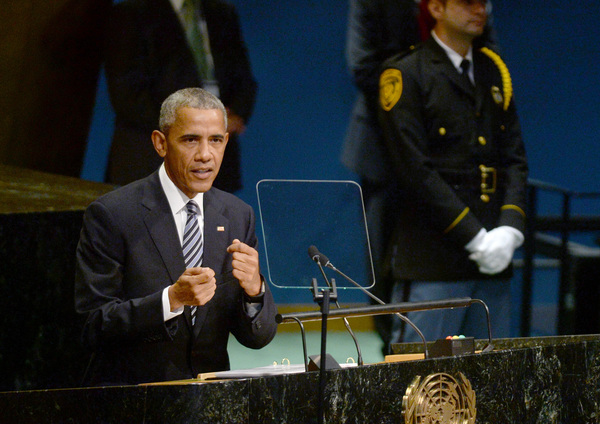
A leader who burst onto the world stage peddling hope and change warned Tuesday that the bonds that keep Western civilization from descending into chaos are on the verge of "fraying."
President Barack Obama's final United Nations General Assembly address was a sober assessment that forces such as income inequality threaten to force conflicts "in and among" countries _ and not just ones in the developing world. He warned of an intensifying "contest" between liberal democratic systems and authoritarianism.
As more and more wealth in developed and developing countries flows to the wealthiest "1 percent," resentment builds, meaning "it's no wonder some say the future favors the strongman, the top-down model," Obama said.
He called on other world leaders to enact new policies to quell inequality, predicting the current course will lead to strife at home that could spill into other countries.
Obama long has supported and encouraged policies that further globalization. But on Tuesday he warned those very "forces of integration" have widened "fault lines" in the world order _ from the Middle East to Europe and beyond. About the long-troubled Middle East, Obama suggested things have gotten even worse during his tenure, saying "basic order has broken down."
Republican lawmakers and officials in the region have long complained the president elected largely to end the Iraq war and untangle America from the Middle East has overcorrected, leaving a vacuum filled by chaos and extremists.
Obama painted a grim picture with exactly four months left in his tenure, talking of potential state-on-state wars, worsening internal strife, increased refugee migrations, weakened workers' rights, governments and groups stepping up efforts to use social media to "prey" on the young and the "muzzling" of journalists.
World leaders must grapple with a "paradox," which he described as a world more stable and prosperous 20 years after the Cold War's end _ but one in which many societies are teetering on the edge of strife. Countries must choose between improving cooperation and integration, or retreating into a world divided along religious and other lines, Obama said, warning the latter would increase the likelihood of conflict around the globe.
The tone of the speech was much different than the first one he delivered at the U.N. as president. Then, he talked of "the hope that real change is possible, and the hope that America will be a leader in bringing about such change."
On refugees, Obama's message was concise but clear: Many more countries must do more to welcome those displaced by conflicts in places like Syria. That goes double, he said, for countries "blessed" with great wealth and favorable geography. And he pressed leaders to do so even when the politics are difficult at home.
Obama's Syria policy is mostly nonexistent, say his critics, including many Republican lawmakers. Many, including Senate Armed Services Chairman John McCain, R-Ariz., have called for him to use the U.S. military to create safe zones to help displaced citizens there. These lawmakers and some experts say doing so could help slow the wave of 4.8 million refugees who have headed north, including many who have fled to Europe, where countries have struggled to assimilate them.
Obama's remarks came several weeks after the White House announced it had met a 2016 goal of taking in 10,000 Syrian refugees after months of speculation it would miss that target. The Obama administration intends to increase that number dramatically next year, an issue that has become a major issue on the presidential campaign trail.
GOP presidential nominee Donald Trump has called for a temporary ban on anyone entering the United States from countries that have been affected by Muslim extremist groups. In the wake of bombings by a Muslim-American man in New York and New Jersey over the weekend, Trump and his campaign have reiterated his position.
In a Monday evening tweet, Donald Trump Jr., compared refugees to poisoned candy: "If I had a bowl of Skittles and I told you three would kill you, would you take a handful? That's our Syrian refugee problem."
The president took swipes at Russia and Trump. He told Russia to resist trying to re-emerge as a world power by using force. He also quipped that "mosquitoes don't respect walls," a jab at the GOP nominee's vow to build a massive wall to end immigrants crossing the U.S.-Mexico border.