During the PGA Championship at the Aronimink Golf Club, Scottie Scheffler and Rory McIlroy led a chorus of players who questioned the PGA of America’s setup of the nearly century-old Donald Ross layout.
To quickly recap, after his second round, Scheffler called some of the pin positions “absurd” and the most difficult he’s seen in his seven years on the PGA Tour. McIlroy called the bunched leaderboard a “sign of not a great setup.” Before the tournament started a fair amount of the conversation had been about the perils of tree removal. “In the back of my mind, they planted those trees with the future vision of having those trees in play, said Jon Rahm, “and now you’re taking them all out?”
Players complain and test boundaries with architects, rules officials and course setups. They complain the loudest when they feel a setup is unfair or doctored to make the best players in the world look bad. Among incredibly pampered professional athletes, golfers are particularly burdened, agitated, perplexed and gracious to the forces of the wind. They rebuke it as if they can make a biblical command for it to be still. The PGA of America’s intentions at Aronimink were debatable, but what’s certain is that its master plan didn’t include its winner shooting 20 under par over 72 holes or controlling Mother Nature.
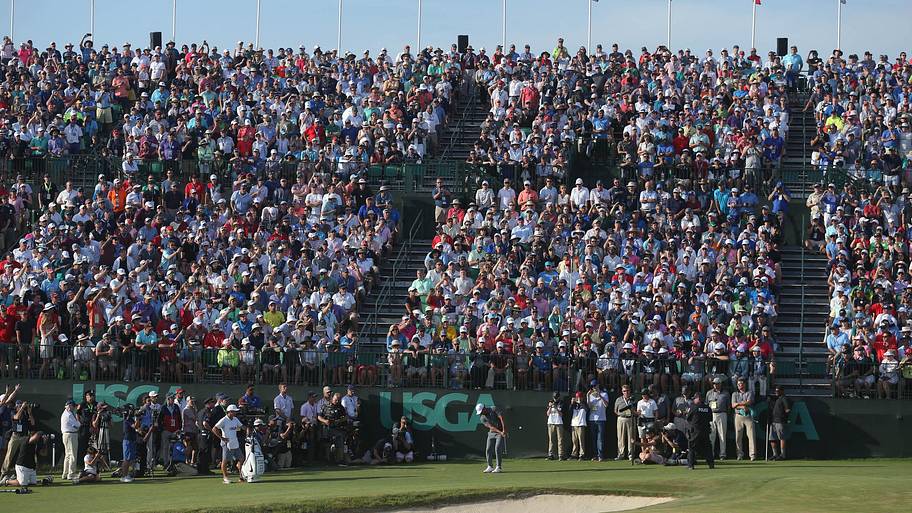
The USGA won’t have to do much tinkering to instigate protests from players over Shinnecock Hills Golf Club for next month’s U.S. Open. Since the championship came back to the east end of Long Island in 1986 after a 90-year hiatus, Shinnecock Hills has been one of the stiffest tests in major championship golf. Retief Goosen’s 4 under par in 2004 is the course’s lowest winning total for the championship. At the 2018 U.S. Open, Brooks Koepka won with a 1-over-par total.
That year, during the brutally difficult third round when gusty winds and firm conditions led to an average score of 75.3, the players were unflinchingly honest in their appraisal of the course. “We’re not on the edge,” said Zach Johnson, who shot a third-round 2-over-par 72. “I thought we could be on the edge, but we’ve surpassed it. It’s pretty much shot, which is unfortunate, because it’s, in my opinion, some of the best land and certainly one of the best venues in all of golf, specifically in this country. Unfortunately, they’ve lost the golf course.”
It was hard and even harder to watch Phil Mickelson earn a two-stroke penalty at the 13th hole on that Saturday for hitting his ball while it was still moving to keep it from rolling off the green after a miserable first putt. The embarrassing situation was for Mickelson a concession to tormenting conditions and the naked desire to not slow up play on his way to shooting an 80. Even Mike Davis, then the USGA’s executive director, had to concede that the setup had gone overboard.

Come the start of the U.S. Open on June 18, don’t be surprised to hear a litany of complaints from players at Shinnecock Hills about everything from the green speeds and pin positions, to the height of the rough, the pace of the play, the suffocating Hamptons traffic and—of course—the weather. They will complain about practically everything that they can’t control with the same exactitude as the spin rate on their drivers.
I was at Shinnecock Hills in 2004 when the maintenance crew watered the 7th green between groups to make it playable and help stop the barrage of players from five-putting. The greens had been taken to the edge and many of them had died in the process. The USGA won’t let that kind of catastrophe occur again, but we can count on the weather delivering a level of unpredictability at Shinnecock Hills that is a sure reminder that golf is a game played outdoors and not in the perfect conditions of a simulator room.
The course, built by the neighboring Shinnecock Indians in 1891, doesn’t have many trees to protect it from the coastal sea breezes that sweep across the William Flynn-designed layout. The USGA can place the pins in the most favorable places on these fast, sloping greens, but approach shots will still find their way down the tightly shaved runoffs. The coastal winds will dry out the greens, increasing their speed and influencing strategies with club selections.
If Scheffler and McIlroy thought they had stuff to complain about at Aronimink, they will have plenty to debate about Shinnecock Hills.
They can protest all week the choices of the USGA, but these are largely man-made decisions about the length of the rough and the fairways and the total yardage of the course. The setup will be informed by the forecast, but mostly the weather will have a mind of its own to confound the players.
That’s the spirit of the Shinnecock Hills Golf Club. That’s something you can’t change no matter how much you complain.