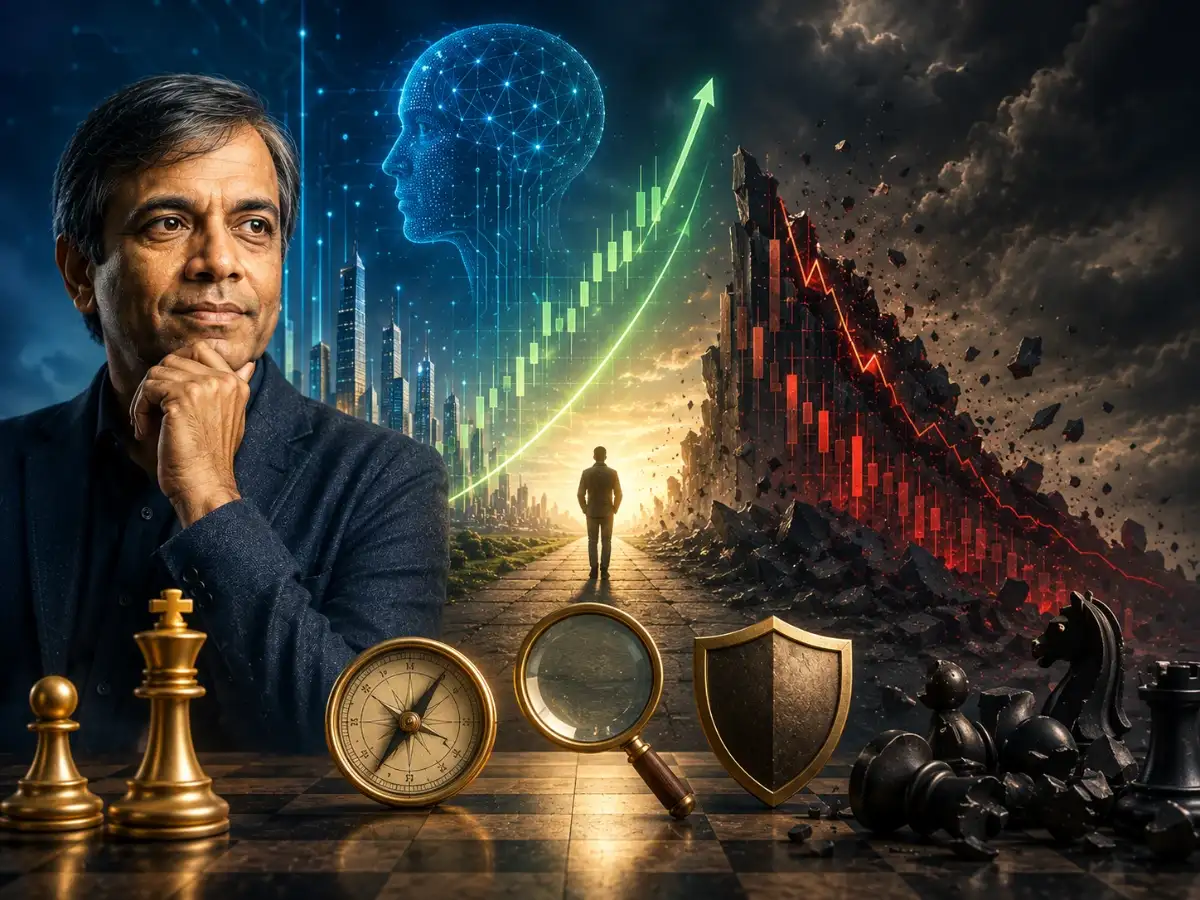
The rise and fall of former OpenAI researcher Leopold Aschenbrenner’s hedge fund, Situational Awareness, illustrates the collateral damage that can result from strong investment convictions, according to Aswath Damodaran, widely known as the ‘Dean of Valuation’. He also shared lessons investors can learn from the episode.
Aschenbrenner's fund, Situational Awareness, grew to as much as $45 billion at the beginning of July before suffering significant losses, CNBC reported, citing sources. The fund began seeing heavy losses in recent weeks as its heavyweight AI holdings, including SK Hynix, plunged, while its short positions in software companies such as Adobe moved sharply against it, the report added.
The losses have grabbed headlines as Leopold Aschenbrenner had once positioned himself as a prophet of the coming age of artificial superintelligence.
In a long blog post, Aswath Damodaran said the AI hedge fund was built entirely around a bet that AI would pay off big time and near term, buying companies in the AI orbit and selling short on the businesses (especially software) that AI would disrupt. It had been able to raise billions of dollars, and had posted eye-popping returns, up almost 450% through late June.
"Success of that magnitude needs no nitpicking, but it is worth remembering that there is nothing that markets enjoy more than cutting inflated egos and reputations down to size,” he said, adding that in case of Situational Awareness, the fall from grace was precipitous, and over the course of four weeks.
Leopold Aschenbrenner’s core belief that AI would win the battle with the status quo in most businesses, and that the win would be decisive and quick, was not unique, and not only are there other investors who shared that view, but there are also companies that are investing in AI capex, Damodaran noted. “That said, to get from that view to a hedge fund built entirely around buying AI winners and selling AI losers requires that the belief to be deeply set and using debt to magnify those returns suggests strong conviction,” he added.
What lessons can investors learn?
Damodaran hopes Aschenbrenner can come back as a fund manager, as he seems to be an original thinker who is willing to take a stand, which both are scarce qualities among active fund managers. He shares three lessons that investors can learn from the entire episode.
1) Investment actions inconsistent with investment conviction risk ruin
The valuation guru explained that he has no issue with Aschenbrenner’s story that artificial intelligence will win big in the near-term, and subsequently buying the winners and selling the losers. “My concern with Situational Awareness, as a fund…is that combining a macro story about AI winning with maximal leverage creates a time bomb,” he said.
Damodaran believes that the AI story has multiple obstacles to overcome, some linked to business economics and some to politics and regulation. It is a risky bet, and it makes no sense to fund it with significant amounts of debt. “I know that there are defenders who will point to the fact that the fund, even after its markdown, was up substantially from its inception date, but the fact that leverage cut the fund's life short only strengthens the case that if it had been run with less debt, it would have had a bad month in July, but lived to tell the tale and perhaps even deliver on its AI promise,” he added.
2) Momentum is a wild card in every investment strategy
It is a well-established finding in stock markets that momentum is one of the strongest forces moving markets and that it can overwhelm the best planned strategies of most investors, Damodaran said, adding that if one looks at the composition of Situational Awareness portfolio through much of its rise and fall, the long positions were primarily in companies that benefit from the build-up of AI architecture, and the short positions were in software and other businesses that would likely be disrupted by the rise of AI.
“With both groups, Situational Awareness was taking bets that were in line with what the market was pricing in already, albeit in a more concentrated and leveraged form. While market observers were quick to link both the rise and fall of Situational Awareness to the AI story, you can make just as strong a case that much of that happened at the fund over its brief existence can be explained by momentum, with leverage acting as a super charger; continued momentum generated the outsized return though June 19, and the market reversal in July caused the correction,” he added.
3) Humble money beats smart money
Lastly, the ‘Dean of Valuation’ believes that humble money beats smart money in the market. Investors who are smarter than the rest, with access to information and capital that others do not possess, deliver supersize returns for themselves and those that they invite into their inner circle. Leo Aschenbrenner joined that group of smart investors.
“The problem with smart money is that its self-regard makes it susceptible to attributing more precision to its own convictions, than merited by the circumstances, and that, in turn, results in over-reach (portfolios that are much too concentrated or levered),” he wrote.
Damodaran hopes that Aschenbrenner has learned some lessons, especially on humility and restraint, for his next go around, and that he adopts a fee structure that gives his investors a chance of beating the market in the long term.
(With inputs from agencies)
(Disclaimer: Recommendations, suggestions, views and opinions given by the experts are their own. These do not represent the views of The Economic Times)