Imagine waking up every morning, not to check your phone or make coffee, but to begin a four-hour round trip on foot just to bring home drinking water. This was the life of women in the Aït Baâmrane region of Morocco, a strip of villages on the edge of the desert in the south-west of the country. Each woman carried nearly 50 pounds of water balanced on her head. Girls missed school to help. The walk laid the foundation for days.
It didn’t need to be a headline to be a crisis. It just had to be a life.
A net, a mountain, Atlantic fog
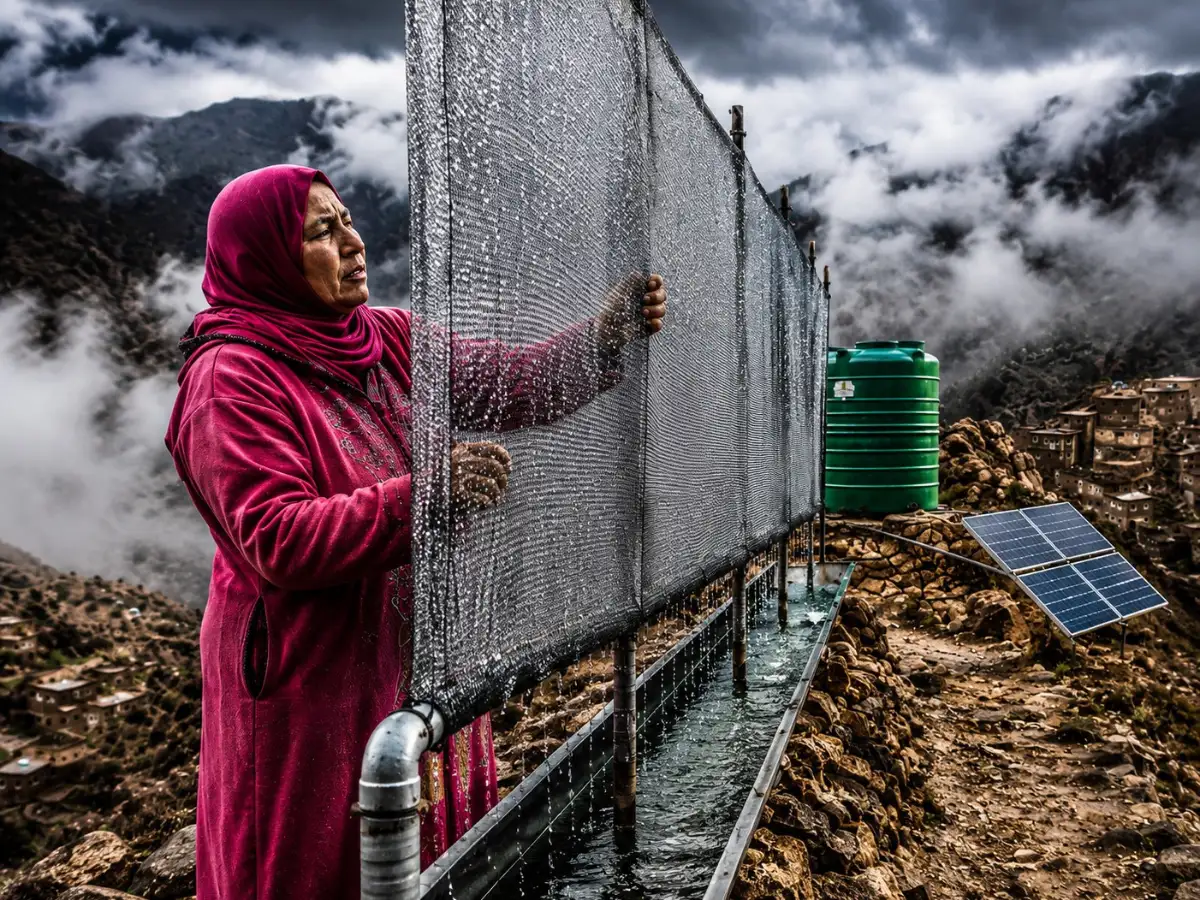
The fix, when it happened, seemed almost too simple. Fog rolling in from the Atlantic Ocean began to be caught by giant polymer mesh nets strung between steel poles more than 4,000 feet up Mt. Boutmezguida. Then the moisture sticks to the mesh, and drips into collection channels and gravity-fed pipes to village taps, no pumps, no wells, no complicated machinery.
The system, built by the Moroccan NGO Dar Si Hmad, now brings clean drinking water to households more than 10 kilometers away that previously had no access to it. It was cited as a working model for climate adaptation in 2026 by the UN climate body, the UNFCCC.
What makes it more than a feel-good story is the engineering behind it. A 2023 review in the International Journal of Low-Carbon Technologies (Oxford Academic) finds that improvements in fiber coating, hole sizing, and mesh material have resulted in fog-collection efficiency improvements of up to 500% compared to older designs. A modern net can pull as much as 17 gallons of water from a square yard in 24 hours. The 600-square-meter installation on Mt. Boutmezguida is powered by solar panels and made with materials that local people can repair themselves, something fog collection projects in Eritrea and Chile couldn’t claim.
What this unlocks, and why it matters for Americans
Here’s a figure that should make you sit up and take notice. Women in Africa spend some 40 billion hours a year fetching water. This is the equivalent of the entire French workforce working for a year just to walk to get water, according to UN Women. Women and girls have to make that walk in nearly three-quarters of homes without access to tap water.
This isn’t only a humanitarian problem. It's an economic one. Every hour spent carrying water is an hour not spent at school, not spent working, not spent building. The pipeline in Morocco was lit up for the first time, and girls began to go to school regularly. This isn’t a metaphor. That’s a clear, measurable result.
For decades, the US has spent vast sums of money on foreign aid and development programs. The Morocco fog project is a good reminder that the best solutions are often those designed with communities, not dropped on them. Dar Si Hmad also ran a water school for local women, teaching them conservation and basic literacy, because a woman who can’t read the numbers on her phone can’t report a broken pipe.
There are real limits to this; it's not magic
Now, fog harvesting isn't going to work everywhere, and it's worth being clear about that. It takes the right mountain, the right elevation, and a good fog pattern. Arid coasts without foggy peaks need desalination plants. Saudi Arabia recently spent $7.2 billion on one.
Places like coastal mountain ranges in Morocco, Chile, Eritrea, Peru, and parts of California that are suitable for fog harvesting are precisely the ones that have no infrastructure for anything more expensive. This is where this technology comes in.
What a fog net can teach us about climate solutions
As aquifers are drained and droughts get longer, the world will need a portfolio of water solutions, not a silver bullet. Fog harvesting is one of such things. It is cheap, low-energy, and repairable by local people. It does not require a power grid or a government contract to operate.
The nets on Mt. Boutmezguida have been running long enough to show they hold. The women who used to go walking in the morning don’t go anymore. Their granddaughters are in school. The water, which some villagers once doubted because it never touched the ground, is now ‘l’eau du brouillard,’ fog water, with a kind of pride.
Sometimes the most radical infrastructure is the kind that looks like almost nothing at all from a distance.