

At least once a year, my dad likes to jokingly remind me that, had I not had a meltdown on a tennis court in a Tenerife resort at age three, I might’ve made it big as a child model.
Instead, as a patient photographer tried to capture a shot of little me poised to hit a perfect forehand, I yelled, “BUT I CAN’T PLAY TENNIS”, between fat sobs.
Gentle clarification that I didn’t actually have to play tennis to feature in what was probably a promotional magazine for the hotel apparently failed—as too did offering me an ice cream for my efforts. I didn’t know how to write my name or tie my shoelaces yet, but I had already acquired an aversion to sports that I’d inadvertently nurture for decades to come.
At school, I feigned illness and injury to evade PE lessons—classes I couldn’t wrangle my way out of triggered all-consuming anxiety. And, regrettably, I stopped watching and enjoying football with my Dad. The overarching feeling was that my sports skills and knowledge were both so lacking that it simply wasn’t for me—and I know that many other millennial women had a similar experience.
Fanbases Are Flourishing

Thankfully, the landscape of women’s sport looks a lot different today. Games are more frequently broadcast on television. Female athletes are more visible and influential than ever before. And viewership is soaring. The Women’s Rugby World Cup 2025 final drew a record-breaking 82,000 spectators, making it the most attended women’s rugby game in history. In football, several WSL teams now play all of their home games at their respective club stadiums, including Arsenal, who have an average attendance of 35,000 at Emirates Stadium.
Research commissioned by the BBC earlier this year confirmed that the fanbase is flourishing. 24 million people in the UK now identify as women’s sports fans, up from 18 million in 2021—an increase of 33% in five years. Just last month, a report by Nielsen Sports revealed that women’s football is on track to become one of the world’s top five sports by 2030.
Women’s sport has never been more accessible, for athletes and fans alike. And yet, we’re haemorrhaging young talent because fewer girls are dreaming of becoming professional athletes than ever before.
Falling "Dream Rates" Juxtapose Rising Viewing Figures
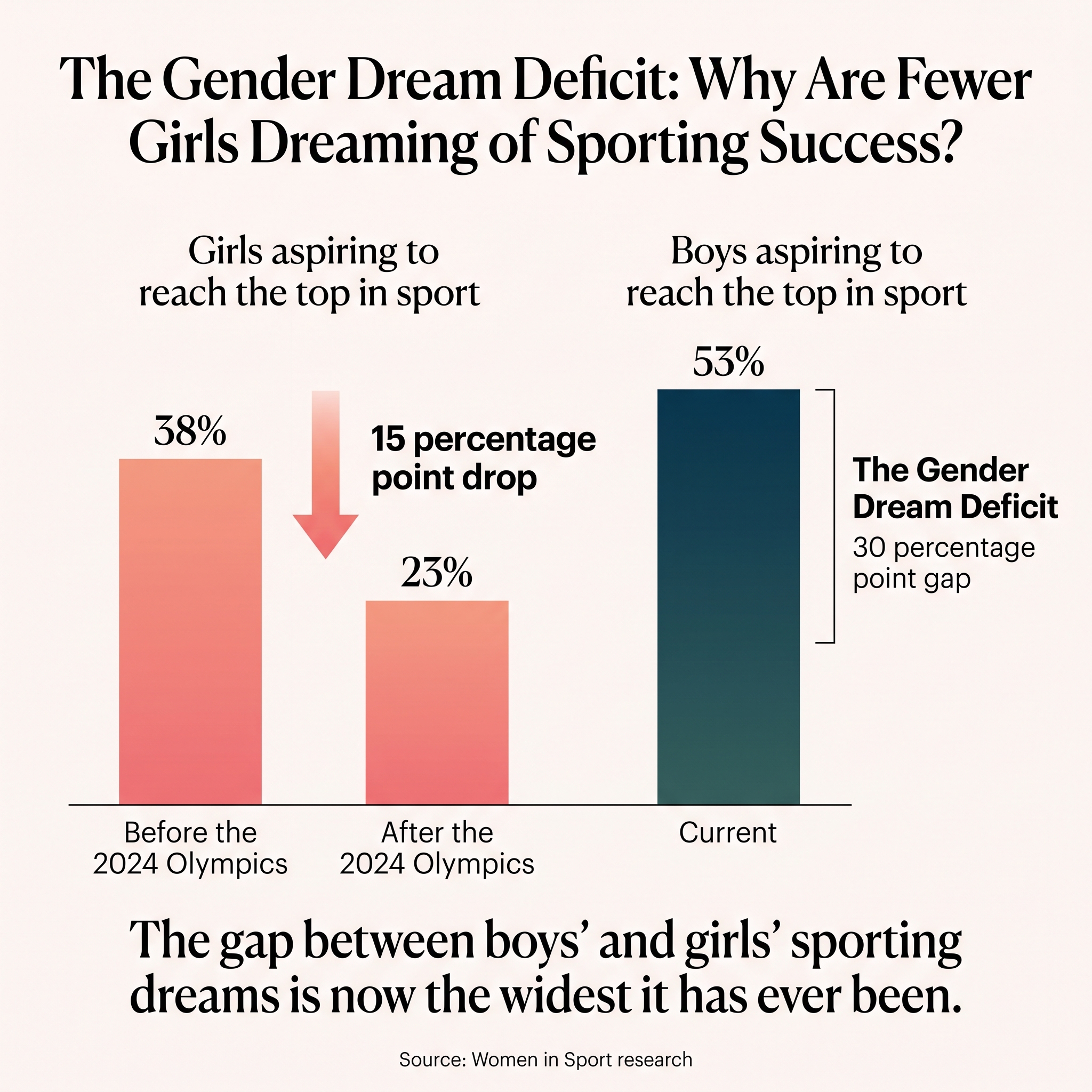
That’s according to research by the charity Women in Sport, which revealed that the number of girls aspiring to reach the top in sport has nosedived from 38% to 23% since the 2024 Olympics. Meanwhile, boys’ dream rates are stable at 53%. This means that there is a 30% gap in the number of boys and girls with athletic aspirations – the highest it has ever been—which Women in Sport have called the "Gender Dream Deficit."
The research shines a light on how much girls feel that they belong in sport in 2026. It also reveals the underlying reasons that girls are dreaming less. “In this year’s research, the girls we spoke to expressed a stronger demand than ever for more local opportunities, more single-sex spaces, greater diversity and choice of sport, and better representation—not just in the media, but on the pitch and the sidelines,” says Women in Sport policy manager Rachel Williams.
While rising visibility has undoubtedly inspired some, it has also highlighted the adversity that still comes with being a female athlete. “It casts light on just how hard it is for girls to reach the top of sport and the obstacles female athletes must navigate once they are there, from underfunding and lower pay to the lack of professional pathways and support,” says Williams.
Girls’ falling dream rates demonstrate that, while advancements in women’s sport are worth celebrating, there’s still work to be done. “Visibility on its own is not, and will never be, enough to get more girls into sport,” Williams says.
So how do we address the Gender Dream Deficit? Frustratingly, many of the changes needed fall outside of the scope of what’s possible for the individual, according to Williams. “There are systemic changes that need to happen to create more opportunities for girls, fund them properly and, ultimately, tackle the societal stereotypes that tell women and girls that sport is not for them.”
Perhaps, were these barriers dismantled 30-odd years ago, I might’ve been confident – or at least curious – enough to participate in sports much sooner. Instead, in a turn of events that feels very full circle, I completed my first tennis lesson just last week—sans sobbing.
If it all feels a bit hopeless, Williams stresses that we mustn’t underestimate the impact that parents can have on their children's aspirations. “Our research has consistently shown that girls from sporty families are more likely to love sport themselves, and parental support and encouragement are some of the key things that support girls to be active,” Williams says. “Many girls (48%) say their mum is one of the key role models that encourages them to be active.”
It might seem like a big responsibility to shoulder, but child psychologists assure that the simplest strategies are often the best. Below, they share their best advice for encouraging your children to build a healthy relationship with sport.
Visibility on its own is not, and will never be, enough to get more girls into sport
Rachel Williams
1. Make Women’s Sport More Visible in Your Home

“One of the most powerful things parents can do is make women's sport visible,” says registered psychologist Dr Carolyne Keenan. This could involve watching games together on the television, attending local matches where possible and actively celebrating female athletes.
“Social learning theory suggests that seeing women compete and succeed at the highest level helps girls believe that sport is something they can do too,” explains sports psychologist Lucy Ballinger. “Additionally, when parents take the time to sit and watch women’s sport with their child, it sends a message that they value women’s sport.”
2. Encourage Your Child to Try Lots of Different Sports
Sometimes, the issue isn't a lack of ability or interest, according to Keenan; it's simply that a child hasn't yet found the environment within sport where they feel they belong. “The more opportunities girls have to explore movement, competition and teamwork in different ways, the more likely they are to find something that feels like a good fit,” she says.
Unsure how to initiate the conversation without applying too much pressure? Ballinger advises encouraging exploration over commitment by saying something like: ‘Let’s give it a go and see what you think’. “This lets your child know that their enjoyment is important and that they don’t have to continue if they don’t enjoy it or if it is not the right fit.”
3. Focus on Enjoyment and Effort, Rather Than Performance or Results

“Enjoyment is one of the biggest factors in whether girls continue participating in sport,” says Ballinger.
When performance outcomes are prioritised over enjoyment or effort, children can begin to feel under pressure, Ballinger warns. “They may experience anxiety and low confidence, increasing the risk of them dropping out of sport,” she says. “But when the emphasis is on having fun, developing friendships and learning, children can develop a genuine love of sport that encourages lifelong participation.”
A post-sport debrief usually presents a good opportunity to shift the focus away from performance outcomes. Instead of asking ‘did you win?’ or giving unsolicited technical feedback as a conversation opener, Ballinger suggests asking questions such as: ‘did you have fun?’, ‘what did you enjoy?’, ‘What did you learn?’
4. Let Your Children See You Being Active
“Children learn through observations, so when they see their parents are active themselves, this sends the message that being active is a normal, enjoyable part of life,” says Ballinger.
She recommends:
- Letting your child see you enjoying exercise, rather than treating it as punishment.
- Scheduling activities to do as a family, such as going for a walk or swimming.
- Talking about what you get out of engaging in physical activity and how it makes you feel – stronger, more energetic, less stressed, and so on – rather than focusing on appearance.
- Showing them that there are different ways to be active.
5. Challenge Gender Stereotypes
Don’t let gender stereotypes go unchecked when they arise.
“If a child says, 'boys are better at football' or 'girls aren't as sporty,' parents can respond with curiosity and conversation rather than criticism,” says Keenan. “Asking questions such as 'what makes you think that?' or sharing examples that challenge those assumptions can help children think more critically about the messages they are absorbing.”
Bottom line? This isn’t just about sports, Keenan says. “It's about helping girls develop the belief that they are allowed to take up space, pursue ambitious goals and participate fully in areas that have not always felt designed with them in mind. That's a lesson that extends far beyond the playing field.”