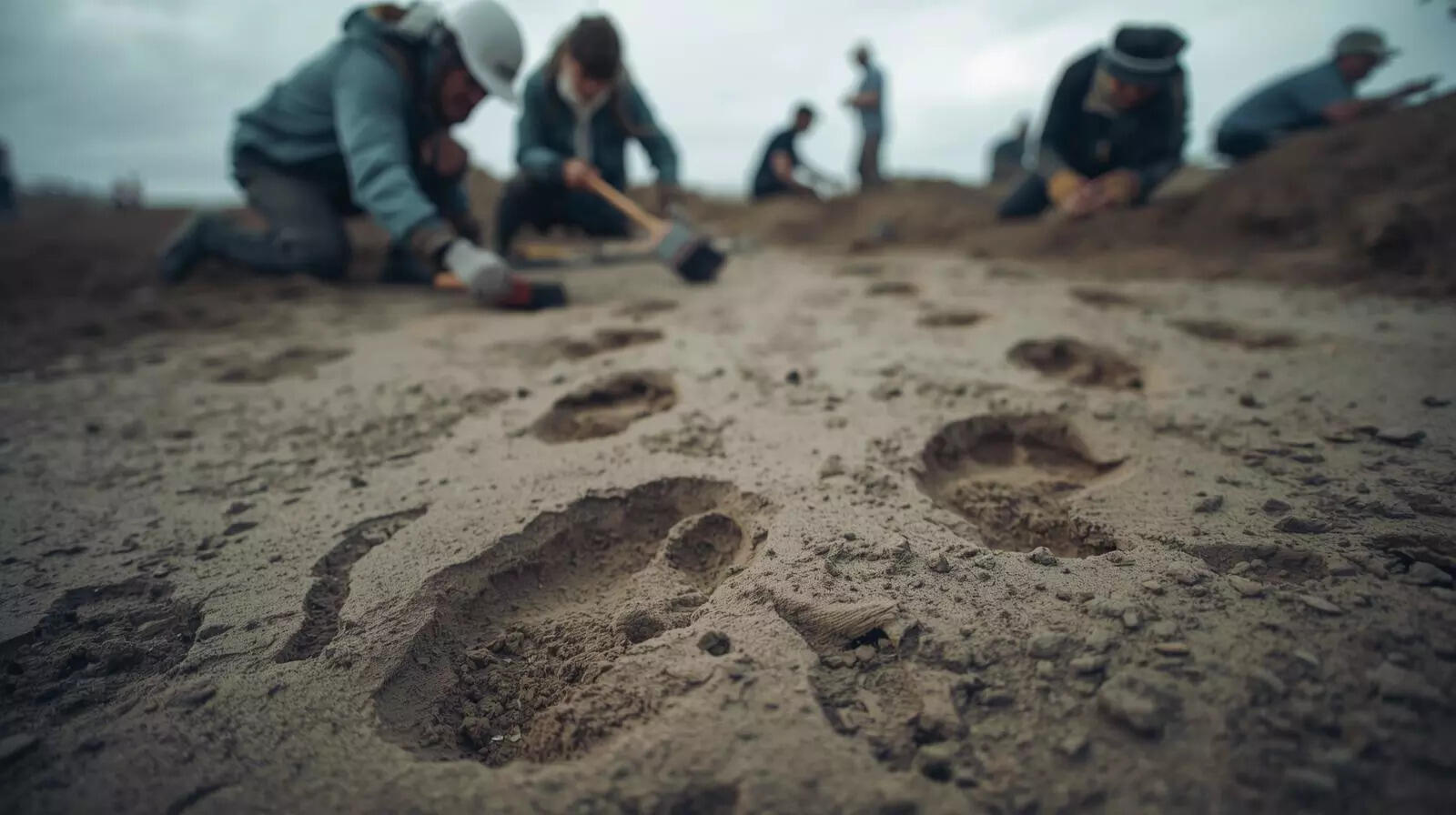
A brief period of low tide along a tranquil coastline in eastern England revealed an uncommon sight in Europe. A series of human footprints emerged on a Norfolk beach, momentarily exposed by shifting sands and pressed into ancient mud. The impressions were fleeting and fragile, yet they were sufficiently distinct to be captured prior to the sea's return. The impressions were subsequently verified by archaeologists to be approximately 800,000 years old, making them the oldest human footprints ever discovered outside of Africa. The site, located in close proximity to the village of Happisburgh, provides direct evidence that early humans resided in a much northern region than had been previously believed. The discovery provides physical detail to a profound period of human history that is typically only known through scattered stone implements and bone fragments.
The Happisburgh 800,000-year-old footprints mark the earliest human presence in northern Europe
The footprints were uncovered on the foreshore at Happisburgh on the Norfolk coast, an area already known for its early prehistoric remains. Researchers estimate the prints were made between one million and 780,000 years ago, during the Early Pleistocene. At that time, Britain was connected to mainland Europe by a land bridge, and the climate, while cooler than southern regions, could still support human groups.
According to the research article “Hominin Footprints from Early Pleistocene Deposits at Happisburgh, UK”, the impressions include prints from adults and children, suggesting a small group rather than a single individual. Their size and shape fall within the range expected for early human species living in Europe at the time.
Soft estuarine mud helped preserve the ancient footprints
Footprints rarely survive in the archaeological record. At Happisburgh, a specific set of conditions made preservation possible. The prints were formed in soft but stable estuarine mud, likely along the edge of a slow-moving river. Soon after being made, the surface was covered by layers of fine sediment, sealing the impressions before erosion could destroy them.
Over hundreds of thousands of years, coastal processes buried and later re-exposed the surface. Modern coastal erosion finally brought the prints back into view, though only briefly.
Digital recording captured the footprints before they vanished
The footprints were visible for only a short time before waves and wind erased them. Archaeologists worked quickly, using multi-image photogrammetry to create detailed three-dimensional digital models. These models remain the only permanent record of the footprints.
Through this method, researchers could identify heel marks, arches, and in one case, toe impressions. The orientation of the prints suggests the group was walking south across a muddy flat near the water’s edge.
Foot size estimates suggest a mixed age group
By measuring the length of the footprints, researchers estimated the individuals ranged from about one metre to nearly one point seven metres in height. This points to a group that included both children and adults.
Such evidence is rare for this period. Early human fossils from Europe are extremely scarce, especially in Britain. The footprints provide information about body size, movement, and group behaviour that bones alone often cannot.
The footprints align with evidence of Homo antecessor
No human fossils from this time period have been found in the UK. However, the footprints match the size range of Homo antecessor, a species identified from fossil remains in Atapuerca, Spain. Homo antecessor is currently the only known human species in western Europe from a similar age.
While the species cannot be confirmed without skeletal remains, the footprints are consistent with what is known from southern Europe.
Happisburgh sediments preserve a wider record of early life
The footprint surface sits within the Hill House Formation, a sequence of estuarine sands and silts laid down during a warm interglacial phase. These sediments have also yielded stone tools, animal remains, and plant evidence, building a picture of a landscape that early humans could inhabit.
Together, these finds show that early humans were capable of surviving in northern environments far earlier than once assumed.
The footprints offer a brief but direct human trace
Unlike tools or bones, footprints capture a moment rather than an object. At Happisburgh, that moment lasted only long enough to be recorded. The sea has since reclaimed the surface.
What remains is a quiet record of people moving across a muddy shore, long before Britain was an island and long before history left written traces.