Indigenous people of East Arnhem Land who gave blood samples for medical research have been commemorated at the Australian National University.
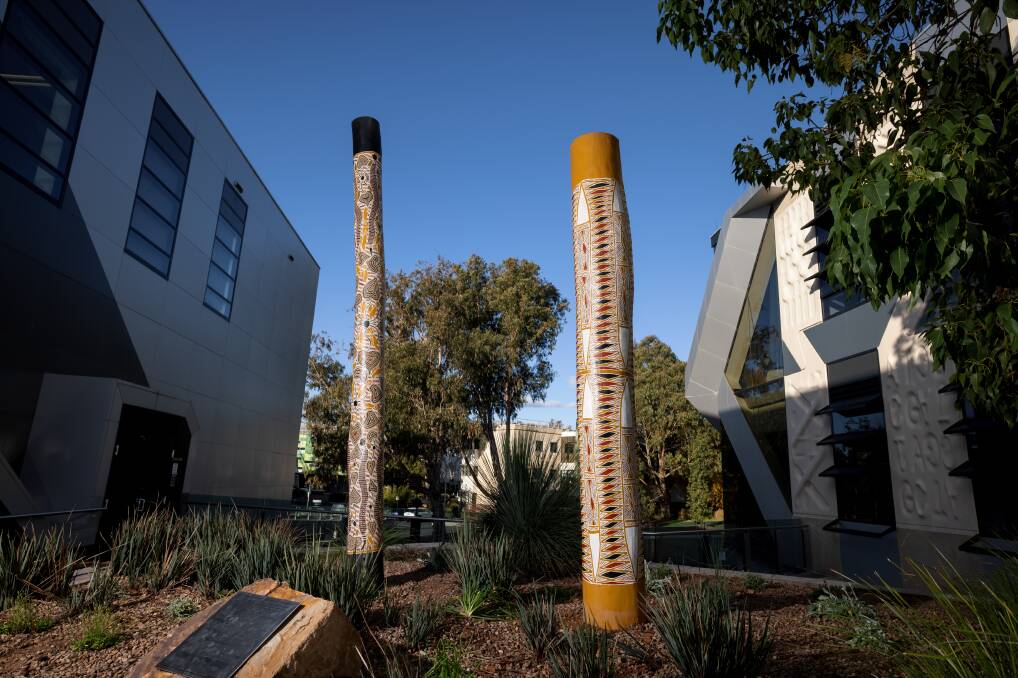
Traditional burial poles of the Galiwin'ku people have been erected between the glass and concrete walls that house the labs of John Curtin School of Medical Research.
Deputy director of the ANU National Centre for Indigenous Genomics Azure Hermes has been working for three years to trace the families of people who gave 7000 samples in the 1960s and '70s - with or without their consent.
Ms Hermes said having human samples in Canberra was problematic for the Galiwin'ku community.
"They're a very spiritual, cultural community, and these three millilitres of blood samples that we have sitting here are a real connection to a person," she said.
"Did it mean that their spirit and hadn't moved on to the next world? Did it mean that this is the reason why they were so sick and having so much bad luck, because the samples are sitting here in Canberra?"
More than 200 samples of people who have died were returned to the Galiwin'ku community of Elcho Island in 2019.
The community gave permission for about 400 samples in the university's collection to be sequenced and disposed of in Canberra.
On Thursday members of the Galiwin'ku community performed the Bapi (snake) dance and milkarri (crying) as the burial poles were unveiled for the first time.
Guliwin'ku man Cyril Bukulatjpi said seeing the blood samples returned home was very emotional.
"Our elders live in these poles, these amazing poles, and it tells us that we are home, because Canberra is the place of the indigenous people, and we feel safe and home," he said.
The two poles represent the two moiety groups of the Galiwin'ku community, Yirritja and Dhuwa. There are 16 family groups that fall under these moiety.
The poles at ANU have sister burial poles installed in Galiwin'ku when the samples were returned in 2019.
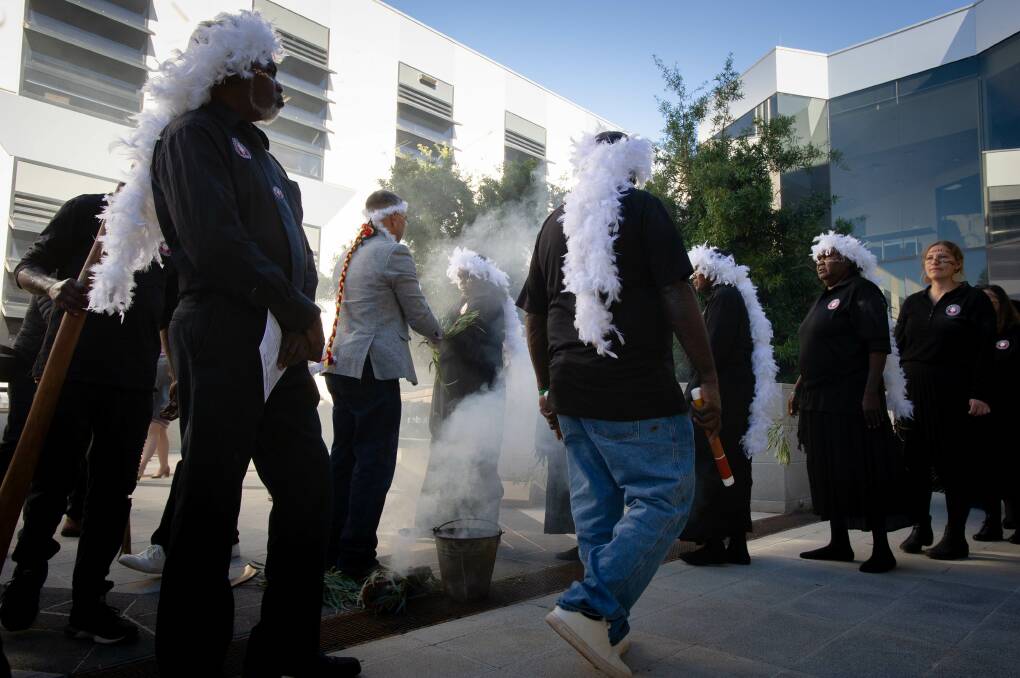
Before they were unveiled, the Galiwin'ku representatives danced around the poles, representing a snake moving through the land.
"When the snake moves it actually gives every tribe's name, cultures and everything. It's like the mother of every tribal people of the Galiwin'ku," Mr Bukulatjpi said.
Ms Hermes said Indigenous genomics was a fast-paced area of science that gave us a different understanding of human biology.
But researchers are working hard to avoid repeating the mistakes of the past by working closely with communities.
"Aboriginal people are really open to to research, we know that we need to be a part of research," she said.
"We've taken our time to actually work with communities and talk about how to do this the right way."
There are about 6000 people still to find from the ANU's collection and two promising genomics projects underway.
"If the government in Australia was really interested in about closing the gap they have to recognise that genomics has a role to play in that. But to do that, you need to provide proper funding," Ms Hermes said.