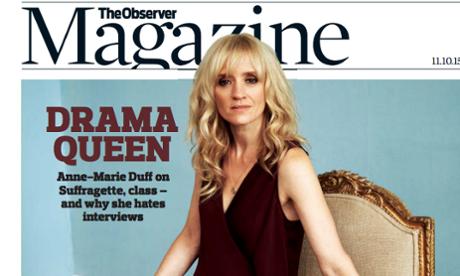
Reading Megan Conner’s Observer magazine article on Anne-Marie Duff left me feeling sympathetic to both women: journalist and actor.
I noted that the comment thread below Conner’s piece was overwhelmingly pro-Duff. Some thought Conner guilty of injecting too much of herself into the article. Others wondered whether she set out to antagonise Duff.
But surely it’s the situation itself, the odd ritual of modern “celebrity” interviews, that was the main culprit here.
What’s the point of them? What should be the end result? And how can the desire for different outcomes from each participant be reconciled?
Duff touched on the problem herself when remarking to Conner at one point:*
“Interviews are a curious thing. You meet a stranger and you have to talk a lot to each other. What an odd thing to do!”
Exactly. Most actors nowadays are media-savvy. They begin interviews determined not to offer up anything that might embarrass them or those closest to them. So they are on the defensive from the start.
Journalists, of course, are determined to obtain something, an indiscretion perhaps, that will make a headline (and thereby please their editors). They must coax a reluctant interviewee to offer up enough to make the exercise worthwhile.
In the event of a draw in which the actor says little, the journalist can rely on writing about the non-interview. Note how Duff is experienced enough to spot that this might just be Conner’s tactic, as this exchange illustrates:
“Anne-Marie, I don’t feel like this is going very well,” I say.
“Oh, please, don’t make it seem like we’re having a terrible interview, darling,” she says.
I explain I’m just feeling thrown and she suddenly looks thunderous. “Are you trying to make this interview go badly?” she asks. “So you can have a story?”
No, I protest. She seems satisfied. “OK, mate, good.”
In fact, I’m sure it wasn’t Conner’s intention at the outset. But it just worked out that way and she will, rightly, think that when a person agrees to be interviewed they should be somewhat compliant and fairly candid. They should play the game.
Going back through the piece, however, Duff does appear to have given her ample material, even speaking about her husband, which Conner had not expected.
So, by the standards of some of these kinds of interviews, I think Duff was quite forthcoming. On the other hand, I can understand why Conner couldn’t ignore the moments when her interviewee was - to use her own word - “resistant.”
It gave her an angle, an edge, and it was the inspiration for the resulting cover line nexto to the obligatory posed picture of Duff: “Drama queen.”
Duff will probably be displeased about the piece but let’s not forget the covert happiness of the third party: the publicist.
For this whole silly business, in which actor is forced to talk to journalist, is predicated on the requirement of the publicity firm, hired by a producer/film company/theatre to stoke up interest in the latest project or projects.
In this case, the publicist will be pleased because the movie in which Duff stars, Suffragette, was mentioned on the cover, three times in the article and also in a footnote.
Similarly, her National Theatre play got three mentions plus a footnote. Job done then for the publicity team.
*When I first posted this I thought Conner had said this to Duff. Evidently, although the copy doesn’t make it at all clear, it was the other way round.