/Sign%20of%20Intel%20at%20entrance%20%20by%20michaelmond.jpeg)
Intel (INTC) got a vote of confidence late last week, just days ahead of its Q2 earnings report on July 23. Susquehanna analyst Christopher Rolland raised the firm’s price target from $80 to $115. The analyst expects a solid quarter, driven primarily by the strong server chip sales. This view lines up closely with what Intel's management said on its last earnings call. CFO David Zinsner stated that the server demand had improved over the previous three months, with double-digit growth expected to run into 2027. Rolland also believes that the server demand could outpace supply well into 2028. He also sees momentum in Intel’s factory business and noted that Alphabet (GOOG) (GOOGL) could use Intel’s advanced packaging for its next AI chips.
However, the analyst is more skeptical about the second half of the year. Rolland expects PC sales to be weaker than usual, mainly due to rising memory prices. Notably, this isn’t just his view. In April, Intel’s management also told investors that it expected PC demand to weaken later in the year. Servers are carrying the momentum, while the PC market looks softer.
Before Susquehanna, several analyst firms, including Stifel Nicolaus, TD Cowen, and KeyBanc, had all recently increased Intel’s price target as well. Early in July, HSBC dramatically increased its price target from $100 to $200. Intel has beaten revenue expectations for six quarters in a row. That streak is expected to continue this quarter, and the stock price dip over the last couple of weeks is enticing. While at any other point I would be skeptical of backing Intel, I believe a 33% fall in share price over just one month, for reasons that aren’t company-specific, is as good a buying opportunity as one can get.
About Intel Stock
Founded in 1968, Intel Corporation operates as a developer, designer, marketer, manufacturer, and seller of computer chips and related technologies. The company generates revenue through three main segments: Foundry, CCG, and DCAI. Its product portfolio consists of graphics chips and processors for PCs, data centers, and AI applications. Moreover, Intel also offers semiconductor manufacturing and related services through its Foundry segment.
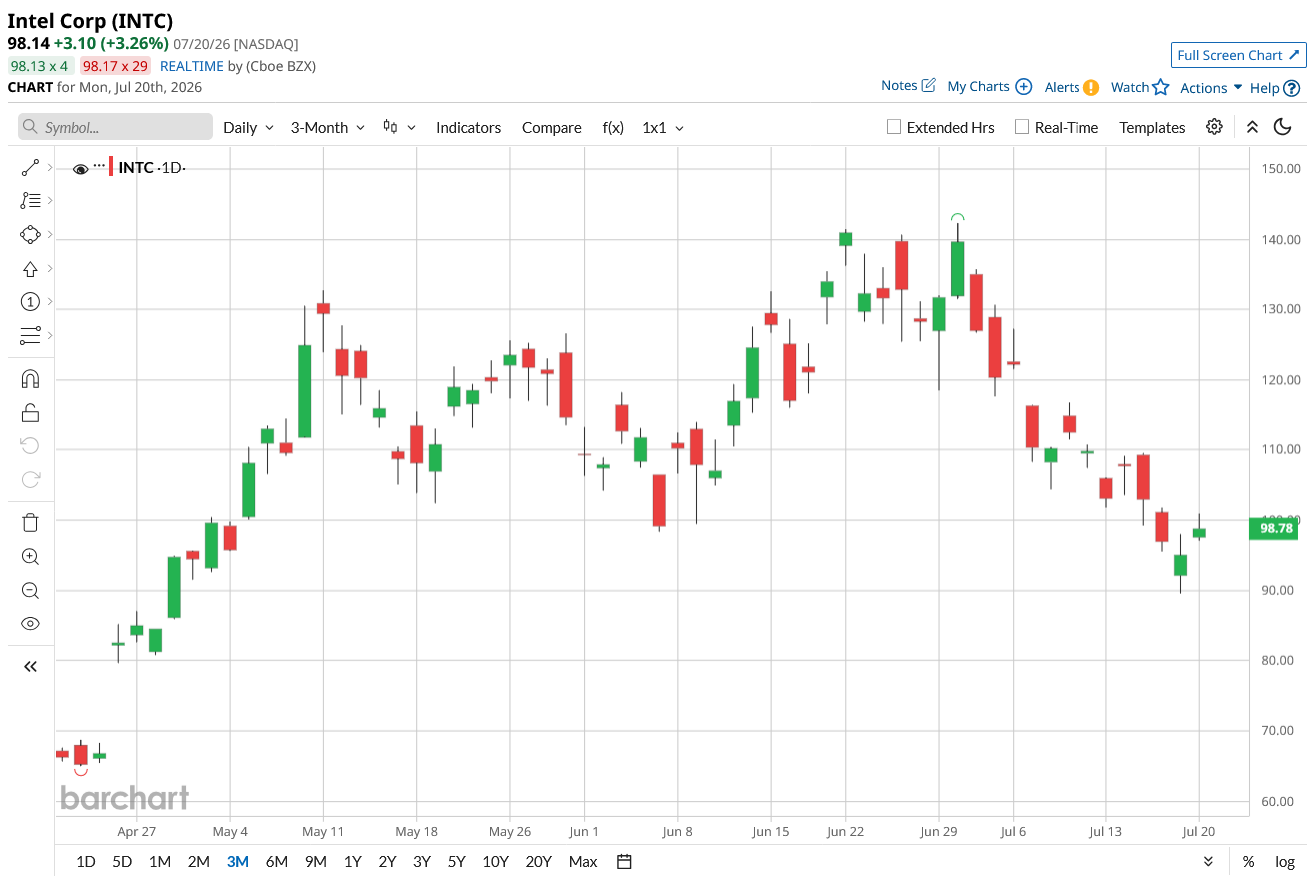
Year-to-date (YTD), Intel’s stock price has increased 167%, far outperforming the iShares Semiconductor ETF’s (SOXX) gains of 76% over the same period. It traded relatively flat for much of the year before starting a strong rally following its Q1 earnings report. After reaching close to its 52-week high at the end of June, INTC stock fell roughly 31% by mid-July. The decline came primarily due to profit-taking and a broader semi stocks selloff.
Intel’s valuation reflects high expectations. The forward GAAP P/E isn’t meaningful, so the price-to-sales tells a clearer story. The forward P/S multiple of 8.28x sits 184% above the company’s 5-year average of 2.91x. This means that the stock is currently trading at a steep premium, with investors backing Intel to make a successful turnaround. The earnings outlook explains why. Intel’s EPS is expected to grow 164% in 2026, 45% in 2027, 49% in 2028, and a further 65% in 2029. That is a strong and sustained recovery rather than a single good year.
Intel's balance sheet is decent, with $32.79 billion in cash against $45.03 billion in debt. A net debt of around $12 billion is modest for a company worth $487 billion. The main concern for investors is that a premium this high leaves little room for error. Management has already warned that PC demand should weaken in the second half, which can impact the optimistic growth expectations. This also explains why, despite analysts increasing their price targets near the quarterly reports, the stock has fallen considerably in the past few weeks.
Intel’s Margins Improve as Server Demand Picks Up
Intel reported its first-quarter fiscal 2026 earnings on April 23. According to CFO David Zinsner, Q1 results benefited from pricing actions, improved product mix, previously reserved inventory, and better Intel 18A yields. These factors helped the company’s non-GAAP gross margin reach 41%. The CCG segment generated $7.7 billion in revenue, with AI PC revenue rising 8% quarter-over-quarter and accounting for over 60% of client CPU sales. In the DCAI segment, revenue came in at $5.1 billion, growing 7% sequentially and 22% year-over-year (YoY).
Q2 earnings are scheduled to be released on July 23. The company guided second-quarter revenue to range from $13.8 billion to $14.8 billion. Intel forecasts a non-GAAP gross margin of 39%, earnings per share of $0.20, and a tax rate of 11%, based on the midpoint of its $14.3 billion revenue guidance. In the second half of 2026, it expects PC demand to weaken due to increasing costs for key components and macroeconomic uncertainty.
What Analysts Are Saying About INTC Stock
A few days before Susquehanna’s price target increase, TD Cowen analyst Joshua Buchalter also raised Intel’s price target from $75 to $115. The firm raised targets across the chip sector in its second-quarter preview, saying the fundamentals remain solid. Buchalter also expects CPU demand to remain strong due to the growing interest in agentic AI. Despite the raised targets, both firms maintained a Hold rating for Intel.
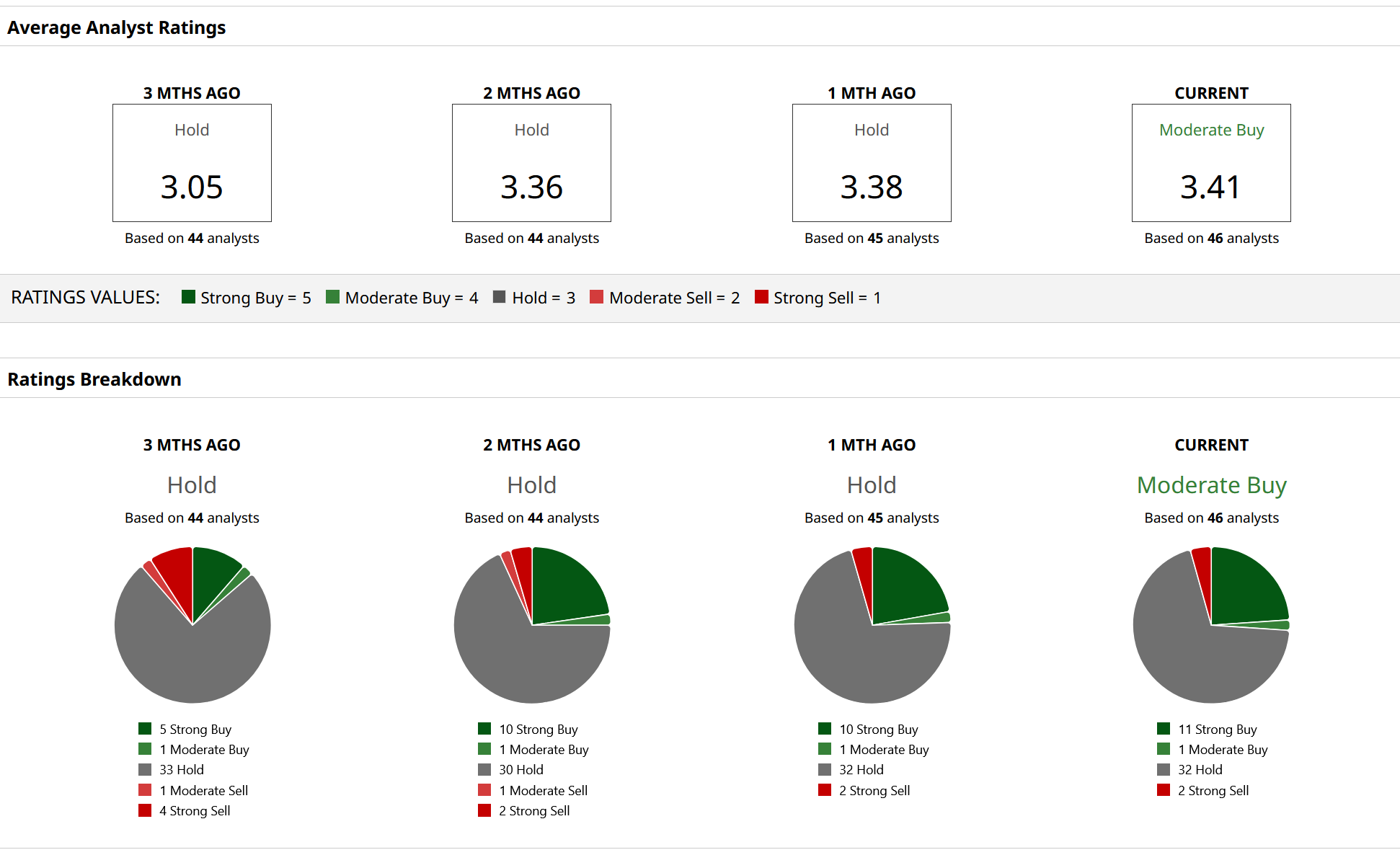
Based on the 46 Wall Street analysts tracked by Barchart, INTC stock holds a “Moderate Buy” consensus rating with a mean price target of $108.46, indicating 11% upside. The highest price target is $200, while the lowest is just $45. This reflects how divided the analysts remain on Intel’s near-term potential.