Did the safety car, triggered by the heavy crash of Haas driver Oliver Bearman on lap 22, cost Oscar Piastri the victory in Japan? At that point, the McLaren driver was in the projected race lead and had already completed his mandatory pitstop.
However, Mercedes driver Kimi Antonelli benefited from the timing of the safety car and was able to make a comparatively inexpensive tyre change, allowing him to overtake Piastri through the pitstop. But how would the race have unfolded without the accident and without the safety car?
Could McLaren have taken the win? Was Mercedes simply too fast? And if so, would Antonelli still have won, or his team-mate George Russell, who was ahead of Antonelli on track before the safety car and thus the leading Mercedes driver?
Russell’s pace too slow for victory
The question regarding Russell can be answered relatively clearly based on the data. The Brit had, with high probability, no chance of winning regardless of whether a safety car had been deployed or not. The reason: lack of pace.
After a poor start that dropped him to fourth place, Russell quickly fought his way back up to second, but he found no way past Piastri. The latter eventually pitted on lap 18 to cover off a potential undercut from Russell.
Russell then had clean air and increased his pace by around 0.25 seconds per lap compared to his time in traffic behind the McLaren. Nevertheless, this pace was not sufficient, as his team-mate Antonelli - also in clean air after overtaking Charles Leclerc and Lando Norris - set significantly stronger benchmarks.
A comparison of lap times shortly before Russell’s pitstop, when both Mercedes drivers had clean air, shows Antonelli was on average 0.61 seconds per lap faster than his team-mate during this phase (1m34.156s vs. 1m34.766s).
Mercedes brought Russell into the pits on lap 21 to defend against a potential undercut from Leclerc, who at that point was lapping about half a second per lap faster (1m34.275s).
Even in the second stint, Russell was unable to make a decisive comeback. According to team principal Toto Wolff, the reason was a poor set up that had already affected him in qualifying.
It is therefore clear: Russell lacked the necessary speed to win the race both in the first and second stints. Without the safety car, he would not have been able to overtake Piastri either. Only an earlier safety car one lap sooner or a pitstop one lap later might have given him a chance to win.
Was victory also on for Antonelli with an overcut strategy?
So, Antonelli proved to be the faster Mercedes driver in Japan, something initially masked by his poor start and his battles with Norris and Leclerc. But once he had clean air before his pitstop, his true pace became evident.
Without the safety car, Mercedes would most likely have opted for an overcut strategy to apply additional strategic pressure on Piastri. A look at Piastri’s lap times after his stop show that with fresh tyres he averaged 1m34.392s - more than two tenths slower than Antonelli on older tyres.
Before the safety car, Antonelli was around 18s ahead of the McLaren, while a pitstop in Suzuka costs about 21.5s. It is difficult to predict exactly how the times would have evolved, but an aggressive overcut - possibly even switching to soft tyres for the final phase - appears very likely.
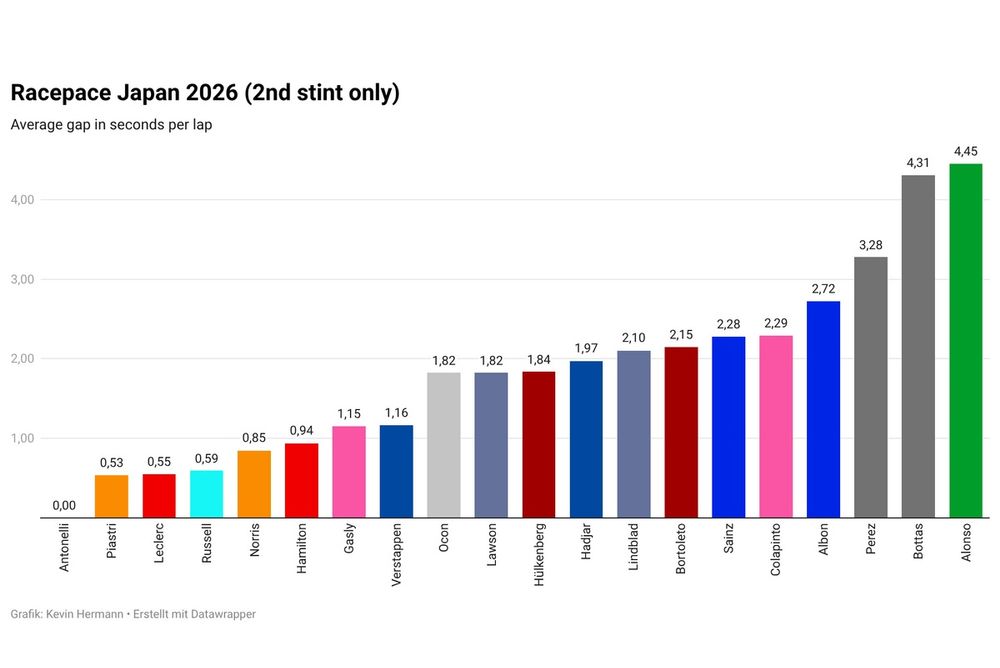
Second stint shows: Mercedes clearly superior
Mercedes’ superiority became particularly evident in the second stint. In clean air, Antonelli was on average around half a second per lap faster than the competition on comparable tyre age.
Adding in the potential tyre delta from an overcut strategy, a theoretical overall advantage of more than nine tenths per lap could have emerged. Tyre degradation on the hard compound was about 0.037 seconds per lap, which over an assumed overcut of 10 laps would result in a theoretical tyre delta of about 0.37 seconds per lap.
Since Antonelli was already faster on older tyres than Piastri on fresh ones, he would likely have rejoined directly behind the McLaren after a late stop. A victory for Antonelli therefore appears highly probable even without the safety car.
Competition closer, but Mercedes remains the benchmark
The data once again shows that the battle for victory appeared closer than it actually was. Mercedes mainly made the race exciting due to poor starts. If they manage to maintain their front-row positions after lap one in the future, the pecking order is likely to become clear quickly.
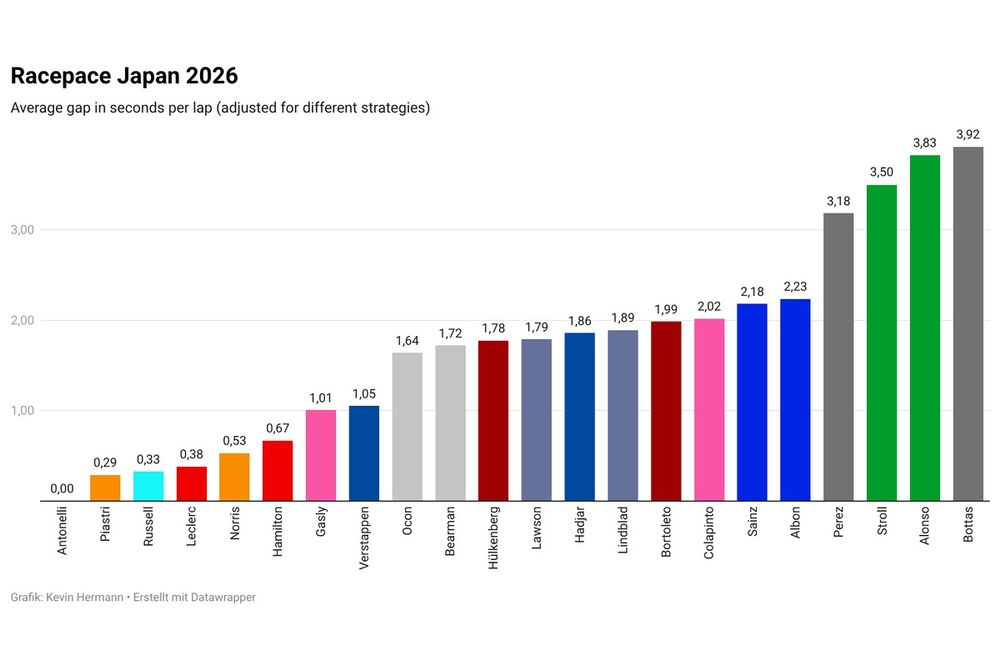
Nevertheless, it can be said that both McLaren and Ferrari were closer to Mercedes in Japan than in Australia and China. Over the entire race, the average gap was 0.29 seconds per lap for McLaren and 0.38 seconds for Ferrari.
Looking only at the more representative second stint in clean air, McLaren (+0.53s) and Ferrari (+0.55s) were still closer to Mercedes than ever before. Previously, Ferrari’s deficit had been around six tenths per lap (Australia: +0.64s; China: +0.58s), while McLaren had been as much as 1.34 seconds per lap behind in Australia.

Japanese GP - Sunday, in photos

Japanese GP - Sunday, in photos

Japanese GP - Sunday, in photos

Japanese GP - Sunday, in photos

Japanese GP - Sunday, in photos

Japanese GP - Sunday, in photos

Japanese GP - Sunday, in photos

Japanese GP - Sunday, in photos

Japanese GP - Sunday, in photos

Japanese GP - Sunday, in photos

Japanese GP - Sunday, in photos

Japanese GP - Sunday, in photos

Japanese GP - Sunday, in photos

Japanese GP - Sunday, in photos

Japanese GP - Sunday, in photos

Japanese GP - Sunday, in photos

Japanese GP - Sunday, in photos

Japanese GP - Sunday, in photos

Japanese GP - Sunday, in photos

Japanese GP - Sunday, in photos

Japanese GP - Sunday, in photos

Japanese GP - Sunday, in photos

Japanese GP - Sunday, in photos

Japanese GP - Sunday, in photos

Japanese GP - Sunday, in photos

Japanese GP - Sunday, in photos

Japanese GP - Sunday, in photos

Japanese GP - Sunday, in photos

Japanese GP - Sunday, in photos

Japanese GP - Sunday, in photos

Japanese GP - Sunday, in photos

Japanese GP - Sunday, in photos

Japanese GP - Sunday, in photos

Japanese GP - Sunday, in photos

Japanese GP - Sunday, in photos

Japanese GP - Sunday, in photos

Japanese GP - Sunday, in photos

Japanese GP - Sunday, in photos

Japanese GP - Sunday, in photos

Japanese GP - Sunday, in photos

Japanese GP - Sunday, in photos

Japanese GP - Sunday, in photos

Japanese GP - Sunday, in photos

Japanese GP - Sunday, in photos

Japanese GP - Sunday, in photos

Japanese GP - Sunday, in photos

Japanese GP - Sunday, in photos

Japanese GP - Sunday, in photos

Japanese GP - Sunday, in photos

Japanese GP - Sunday, in photos

Japanese GP - Sunday, in photos

Japanese GP - Sunday, in photos

Japanese GP - Sunday, in photos

Japanese GP - Sunday, in photos

Japanese GP - Sunday, in photos

Japanese GP - Sunday, in photos

Japanese GP - Sunday, in photos

Japanese GP - Sunday, in photos

Japanese GP - Sunday, in photos