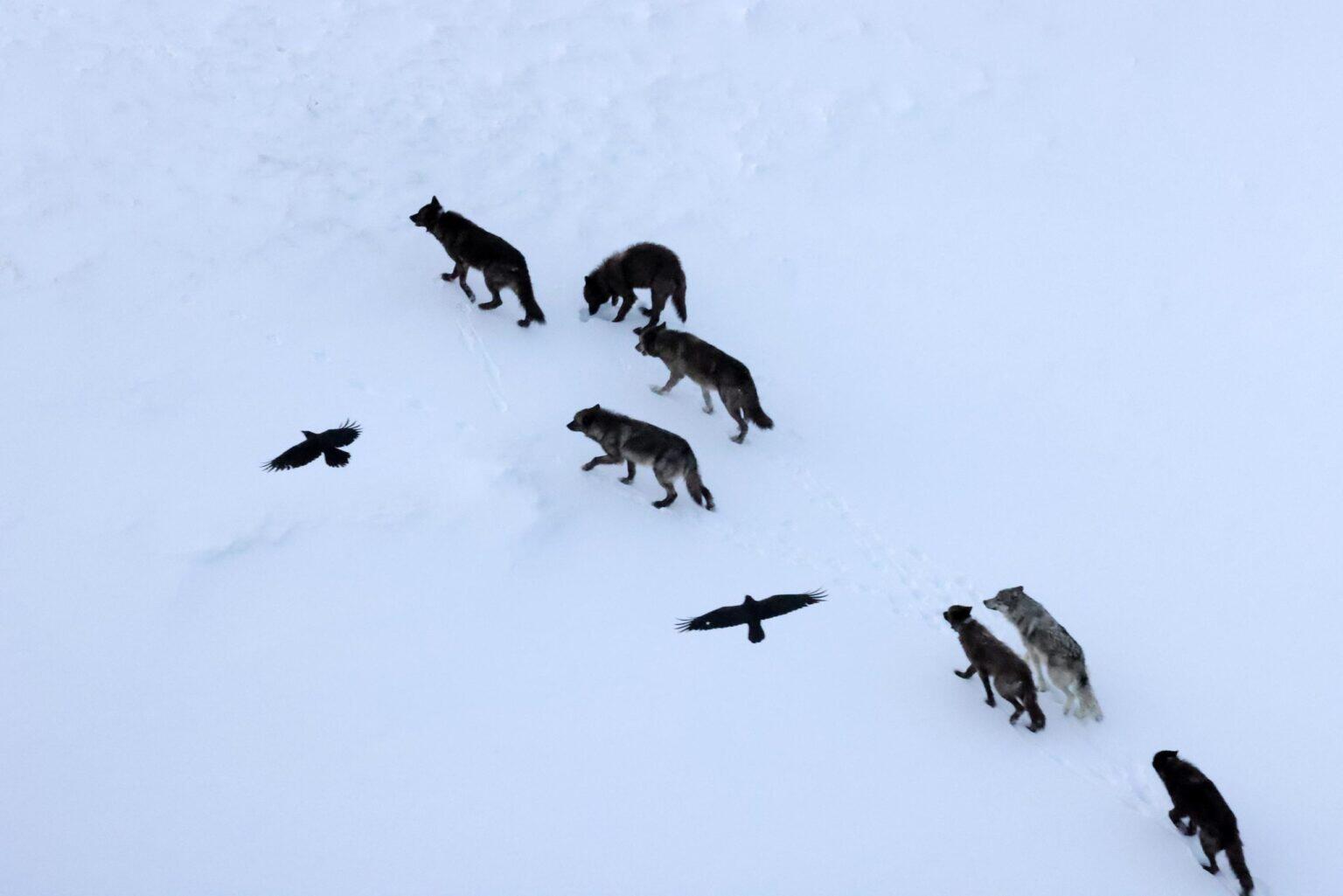
Researchers found years ago that ravens used a simple formula for getting an easy dinner. They just followed the wolves to wherever they hunted prey and then fed on whatever remained.
Get breaking news anytime, anywhere. Download the TOI app now!
New studies show that the birds use more complex strategies. A study in Science reports that ravens in and near Yellowstone National Park do not spend all day following wolves, but instead rely on memory to return to areas where wolves have often killed prey, even when no wolves are in sight.
This suggests strong memory and planning abilities in one of the world's smartest birds.
Ravens use memory, not chasing
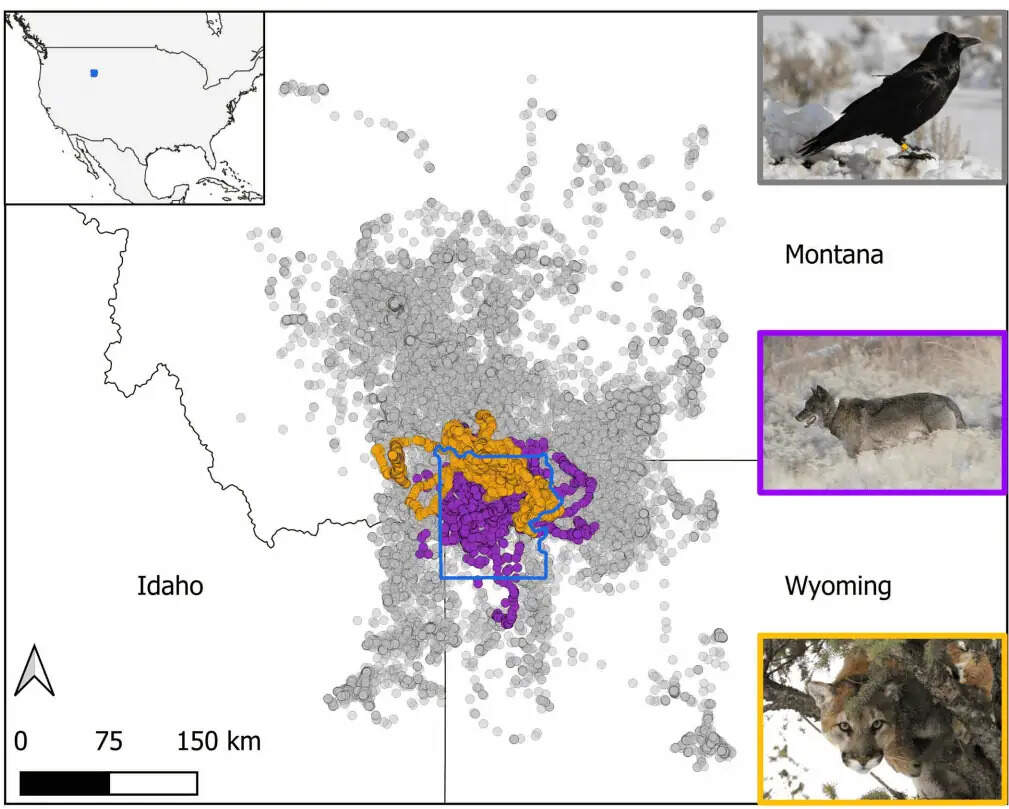
The work was carried out by scientists from the Max Planck Institute of Animal Behavior and Yellowstone National Park. According to the study published in the journal Science, researchers tracked 69 ravens, 20 wolves, and 11 cougars using GPS technology over two and a half years across Yellowstone National Park and surrounding areas in Wyoming, Montana, and Idaho.
The team analysed more than 646,000 GPS points from ravens and tens of thousands of predators. Then scientists compared the movement of ravens and predators with the kill locations of wolves and cougars.
Their conclusion overturned some previously held beliefs. Rather than constantly chasing the wolves, ravens kept returning to the areas where kills were most likely to happen. Which means that ravens remembered the places that could provide food sources regularly.
The Science paper says this behavior suggests ravens use strong navigational skills and memory to improve their chances of finding carrion. The study's lead author, Dr. Matthias Loretto, said ravens can travel long distances to successful foraging locations without wolves' guidance.
Long-distance following proved much rarer than expected
Though ravens are usually observed gathering at wolf kills, analysis of the GPS data showed that long-term tracking of wolves was extremely rare. Over the course of the study, scientists recorded only one occasion when a raven followed a wolf for more than one kilometre continuously for more than an hour. In that case, the animals traveled about four kilometers over two hours.
This result implies that although ravens may follow wolves if necessary, they do not depend on this behavior to find food.
"We all assumed that the birds had a very simple rule, just stick close to the wolves," Yellowstone biologist Dan Stahler said in a news release issued by the Max Planck Institute of Animal Behavior.
In fact, the scientists found that the birds were making their own decisions about where to look for food based on past experience.
An experience-driven landscape
According to Science , wolf kills are not uniformly distributed throughout the Yellowstone landscape. Ecological studies have shown that wolves tend to hunt in valleys, which are flat and snow-covered areas where it is easier for them to prey on elk. Even if each individual kill is difficult to predict, certain hunting spots are fairly stable over time.
As the scientists report, ravens seem to know this and keep visiting the same places because those places have provided food in the past. Some GPS-tracked birds traveled remarkably straight paths and covered distances of up to 155 km in one day to reach areas with potential food sources. It was also noted that individual ravens may spend considerable periods of time away from wolves before coming back to their food spots. The period between revisits varied from roughly 15 days on average to even a year in some cases.
Wolves continue to be more beneficial than cougars
The scientists also investigated the interactions between ravens and another top predator of Yellowstone Park, the cougar. Ravens showed up at wolf kills much more often than at those of cougars. In the first seven days after the death of animals, GPS-tracked ravens visited almost half of the wolf kills, while only about a quarter of the cougar kills.
This is due to the different hunting strategies of these predators. Wolves hunt in packs, leaving large carcasses uncovered on the open terrain where scavengers can easily find and reach them. By contrast, cougars hunt alone and drag prey into covered areas, sometimes hiding the carcass under vegetation or other objects.
Thus, cougar kills are more difficult to discover and reach.
An innovative approach to animal intelligence
Ravens have already caught the attention of scientists due to their high-level cognitive skills. They are capable of remembering food caches, solving difficult problems, recognizing particular individuals, and planning future actions. This study adds new evidence to the existing research.
Unlike other scavengers that react to short-term cues such as seeing or hearing wolves, ravens seem to use what they have learned about the broader landscape to guide future foraging. According to the researchers, ravens still use local stimuli in case there are nearby wolves. It means that they watch for other scavengers and pay attention to wolf activities, yet they rely more on memory when choosing places to search at longer distances.
The finding may change how scientists think about scavengers. Unlike before, now they are getting equal scientific consideration with the predators that they follow.