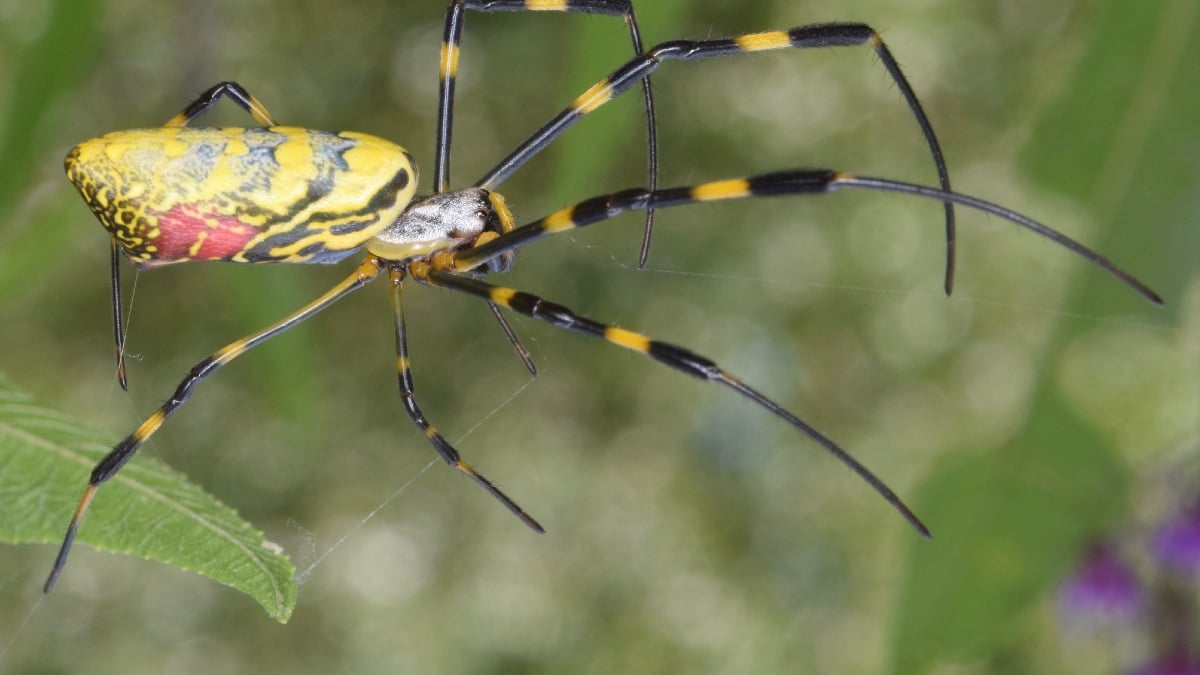
Arachnophobes look out — a fast-spreading invasive species known as the Joro spider is once again making headlines, with recent reports indicating the large, brightly colored arachnids have now been spotted across at least 12 U.S. states.
The Joro spider, common in East Asia, and sometimes described as “parachuting” spiders because of its unique wind-borne travel method, has steadily expanded its range since first appearing in the country in the late early by just over a decade ago. These spiders are known for their striking appearance: females can grow to roughly the size of a human hand, or about 3 inches, with long legs and vivid yellow, blue, and red markings.
They build large, durable webs—sometimes spanning several feet—and primarily feed on insects, including common pests. Their ability to “balloon,” releasing silk strands that catch the wind and carry them over long distances, effectively allowing them to “parachute” into new areas, has played a major role in their rapid expansion across the United States.
Where Jaro spiders are found
Giant venomous flying spiders with 4-inch legs heading to New York area as they spread across East Coast, experts say
— philip lewis (@Phil_Lewis_) June 4, 2024
They do not pose a danger to humans, but the venom could pose a threat to native spiders https://t.co/VB7dIa9KVE
Scientists believe Joro spiders first arrived in the U.S. around 2013, likely through international shipping containers in Georgia. Since then, the species has steadily spread, aided by both human transportation and natural dispersal. Research shows the spiders are highly adaptable, able to tolerate urban environments, noise, and even colder temperatures better than expected
Initially confined to Georgia, Joro spiders have now been documented across a growing number of states, primarily along the East Coast and Southeast. Confirmed or reported sightings include:
- Georgia
- South Carolina
- North Carolina
- Tennessee
- Alabama
- Mississippi
- Maryland
- West Virginia
- Pennsylvania
- Oklahoma
- Florida
- Kentucky
Officials and researchers warn that their range could expand across much of the eastern United States in the coming years.
What officials and experts are saying
Despite alarming headlines, scientists and officials have largely struck a measured tone. Research groups in Georgia and elsewhere emphasize that Joro spiders are not harmful to humans and are unlikely to pose a public safety threat. Some experts note they may provide ecological benefits by feeding on mosquitoes and other invasive pests.
However, concerns remain about their long-term environmental impact. Researchers are still studying whether the spiders could disrupt native species or ecosystems as their population grows.
José R. Ramírez-Garofalo, an ecologist based on Staten Island, told the Daily Mail,
There have been no documented fatalities, nor any notable medically significant bites. Taken together with their behavior — they are very reluctant to bite — and the evidence from the literature, they really pose no threat to humans or our pets.”
via The Daily Mail
So, should Americans be worried? For most people, the answer is no—at least from a safety standpoint. Joro spiders are shy, non-aggressive, and rarely bite. Their biggest impact may be psychological, especially for those with arachnophobia. That said, scientists warn that the full ecological impact remains uncertain.