
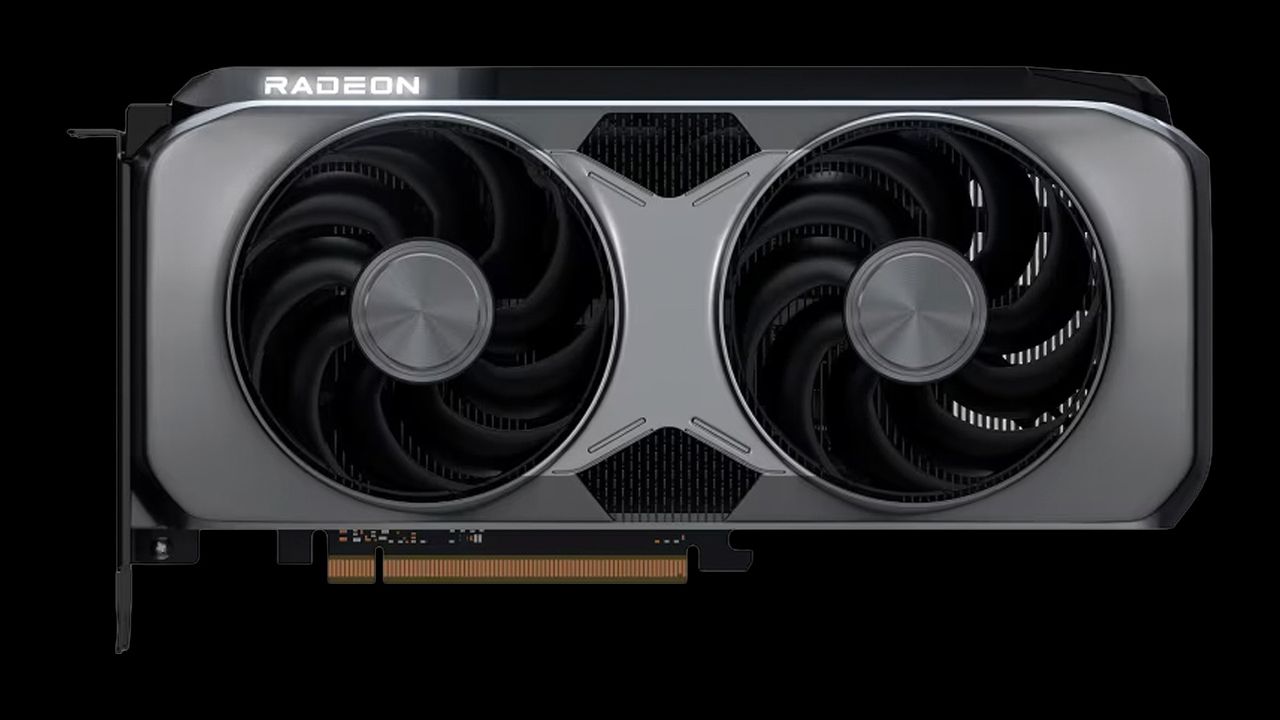
Instead of launching an entirely new product to go head-to-head with the best graphics cards on the market, AMD did the next best thing. The chipmaker has decided to make the Radeon RX 9070 GRE, once a China-exclusive SKU, available worldwide. Announced at Computex 2026, the Radeon RX 9070 GRE will hit global retail shelves on June 2 for $549.
The Radeon RX 9070 GRE features the same 4nm Navi 48 silicon found inside the Radeon RX 9070 and Radeon RX 9070 XT. The primary differentiator among these models is the number of enabled Compute Units (CUs), which directly affects their graphical performance. The Radeon RX 9070 and Radeon RX 9070 XT are equipped with 56 and 64 RDNA 4 CUs. In contrast, the Radeon RX 9070 GRE has only 48 CUs, which is 14% fewer than the Radeon RX 9070 and around 25% fewer than the Radeon RX 9070 XT.
If you want to look at it from another angle, AMD is employing a strategic approach to maximize silicon utilization. The Radeon RX 9070 recycles silicon that didn’t quite meet the stringent requirements to become a Radeon RX 9070 XT. In contrast, the Radeon RX 9070 GRE takes this process a step further by reusing silicon that doesn’t fully meet the specifications of the standard Radeon RX 9070.
The Radeon RX 9070 GRE’s memory subsystem further differentiates it from its more powerful siblings. It comes equipped with 12GB of GDDR6 memory, which is 25% less capacity than the Radeon RX 9070 and Radeon RX 9070 XT, each of which has 16GB.
In addition to its lower memory capacity, the Radeon RX 9070 GRE uses a narrower 192-bit memory interface compared to the wider buses on the Radeon RX 9070 and Radeon RX 9070 XT. The architectural design restricts the Radeon RX 9070 GRE’s maximum memory bandwidth to 432 GB/s, which is 32.5% lower than that of its counterparts. Despite these scaled-back specifications, the Radeon RX 9070 GRE retains a 220W TDP, which is identical to that of the standard Radeon RX 9070.
AMD asserts that the Radeon RX 9070 GRE delivers, on average, 21% higher gaming performance than the GeForce RTX 5060 Ti 16GB in 1440p (2560x1440) gaming scenarios. The chipmaker tested 40 different games across a high-end system powered by a Ryzen 7 9800X3D. Multiple independent reviews from Chinese technology news outlets have confirmed that the Radeon RX 9070 GRE is indeed faster than the GeForce RTX 5060 Ti 16GB, but they also show the RDNA 4 graphics card falling short of the GeForce RTX 5070.
The Radeon RX 9070 GRE will debut globally at $549, so it's essentially launching at the original MSRP as the Radeon RX 9070 and GeForce RTX 5070. However, the Radeon RX 9070 GRE offers lower performance than its counterparts. Thanks to the ongoing memory shortage, the Radeon RX 9070 and GeForce RTX 5070 typically start at $599. The price increases have created a gap in the market for a sub-$550 model, such as the Radeon RX 9070 GRE.
The Radeon RX 9070 GRE is AMD's tactical response to current market conditions that don't seem to be improving. The chipmaker is leveraging an existing SKU and offering it globally at a competitive price point. It's not a bad move if you look at it from that perspective. Stay tuned for our review with the latest updated drivers and benchmarks.