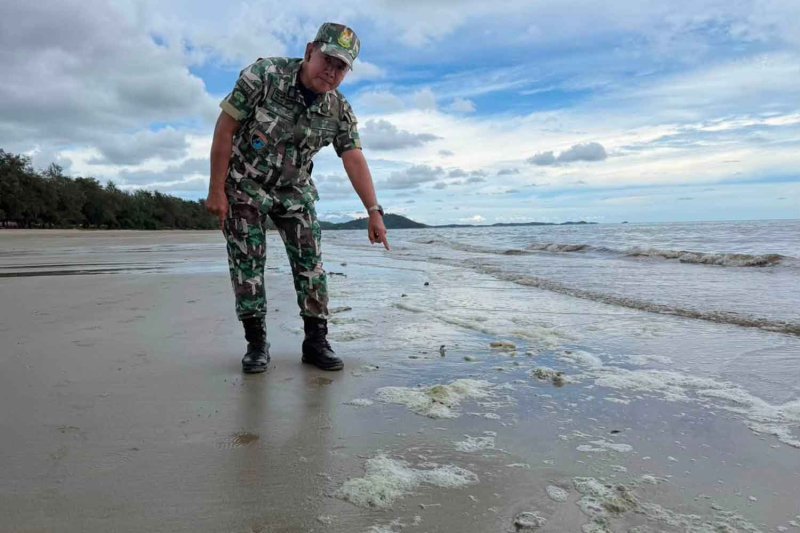
Rayong: A natural plankton bloom turned the seawater off the popular Mae Ramphueng beach a dark black-green, marine officials said, dispelling fears of an oil spill.
Suthep Juala-or, director of the Eastern Gulf of Thailand Marine and Coastal Resources Research Centre, said the agency received public reports on Sunday afternoon of discoloured seawater, foul smells and dark patches along the shoreline in Muang district.
Officials were dispatched to investigate. Local business operators said the discolouration and heavy foam had been visible since morning, but by the time officials arrived at around 4.30pm conditions had begun to improve.
The water had become noticeably clearer, the odour had dissipated, and only small patches of green foam remained along the beach. No dead marine animals were found.
Water quality tests at three monitoring stations showed normal conditions, with pH between 8.10 and 8.16, temperatures of 31.0-31.7C, salinity of 29.2-29.7 parts per thousand, and dissolved oxygen of 6.6-6.88 milligrammes per litre -- well above the minimum standard of 4.
Mr Suthep said the discolouration resulted from a rapid increase in Trichodesmium erythraeum, a blue-green algae that produces no biological toxins. The species is common along Thailand's eastern coast and can trigger seawater discolouration, a phenomenon known as a plankton bloom or "red tide".
Such blooms are typically driven by a combination of factors, including nutrient-rich runoff from rainfall and inland waterways, along with favourable weather, sunlight, water temperature, waves and currents.
While the algae are not toxic, authorities advised the public to avoid direct contact with discoloured seawater or foam during bloom events, particularly people with sensitive skin, as irritation may occur.