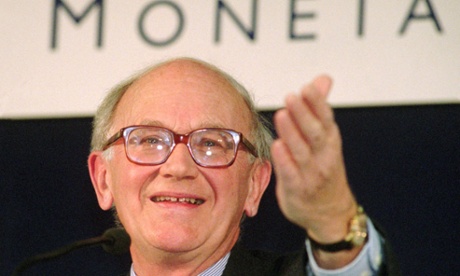
Baron Alexandre Lamfalussy, who has died aged 86, won a place in history after a long and worthy career as a high-class economist and first-rate banker of the old school, when banking was banking. As the first president of the European Monetary Institute, the forerunner of the European Central Bank, from 1993 to 1997, he was “present at the creation” and charged with making the best of an ambitious economic financial architectural project that lacked the political superstructure he knew would be needed for permanent success.
Later, so concerned was Lamfalussy about the dangers inherent in the kind of globalised free-for-all that afflicted financial markets and wider society during and after the crash, that he wrote a number of influential books and articles on the subject, continuing long after he had retired.
The British became aware of Lamfalussy way back in the early 1960s, when, fascinated as he was by the development of post-1945 Europe, he produced a significant work entitled The United Kingdom and the Six: An Essay on Economic Growth in Western Europe (1963). This was when the Common Market, as it was then known, consisted of only six members, and Britain was part of the rival grouping, the European Free Trade Area, consisting of seven members.
The joke at the time was that Europe was “at sixes and sevens” and Lamfalussy, who had been a research student at Nuffield College, Oxford, in the 1950s, became intrigued by the UK establishment’s concerns about Britain’s slow rate of growth vis-a-vis its continental neighbours. This led to the various UK applications to join what was then the European Economic Community, two of which were turned down with a decisive “non” by the French president, Charles de Gaulle.
The fashionable concern these days about the British economy is its poor productivity. This was also one of Lamfalussy’s concerns at the time of his prescient book. In the jargon, he was especially worried about Britain’s “capital/output ratio”.
His stint in Britain constituted an interval in his long-term residence in Belgium, to where he had escaped in 1949 from communist Hungary. He was born in Kapuvar, and grew up in Lenti, where his father was a forestry engineer. In Belgium, he undertook economic studies at Louvain University and enjoyed a successful career at the Banque de Bruxelles, before being recruited to the Bank for International Settlements in Basel, Switzerland, in 1976 – the official institution known as “the central bankers’ bank”, where the leading central bankers of the world convene most months.
Lamfalussy rose at the BIS from being chief economist to general manager. He tried to use the bank’s annual report to express his views, and thus allowed the phrase “economic experiment” to pass into print as the bank’s comment on Thatcherism. In addition to being highly respected by his peers, he was approachable to journalists and very popular for his good-humoured and incisive analysis. Like so many of his ilk, he spoke several languages, and had perfect English.
His role at the BIS made him a natural candidate for the Delors committee of central bankers, who were charged with producing a route map to European monetary union, should political leaders decide finally to go ahead with it. The project had been in the air for decades, and was given some impetus by the formation of the single market in 1986. The Delors committee sat in 1988-89, and reported on options in April 1989.
What gave the project decisive impetus was the reaction of Chancellor Helmut Kohl of Germany and President François Mitterrand of France to the fall of the Berlin Wall later that year, and their desire to tie down the subsequently reunited Germany in a European monetary union.
It was very clear to Lamfalussy that the construction of a monetary union without political union was like putting the cart before the horse. He did his best, and operated skilfully, loving his close relationship with Kohl and his exposure to raw politics after a lifetime as a technocrat. And his technocratic skills were vital. But politics triumphed over his well-founded doubts as to whether certain countries’ economies were strong enough to join the single currency.
Lamfalussy, who had been made a baron by the Belgian king in 1993, refused to be considered for the subsequent role of first president of the European Central Bank. However, he maintained an interest in financial regulation in semi-retirement, describing, not long before the financial crisis, “the current regulatory system” as “a remarkable cocktail of Kafkaesque inefficiency that serves no one”.
He is survived by his wife, Anne-Marie Cochard, whom he married in 1957, and their sons Christopher and Jérôme, and daughters Isabelle and Laurence.
• Alexandre Lamfalussy, economist, born 26 April 1929; died 9 May 2015
• This article was amended on 3 June 2015 to correct a reference to Alexandre Lamfalussy’s children.