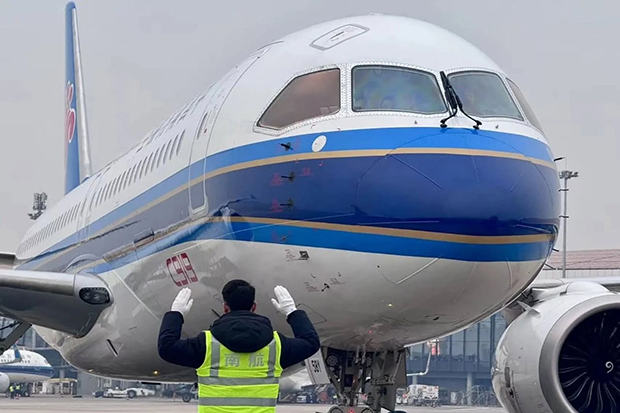
A suspected bird strike on a Chinese-made C909 regional jet in Beijing has reportedly left some marks on its nose and airframe, but experts said the likelihood of any severe damage was very low.
The incident underscores the real-world tests of reliability facing the model as it is more widely deployed at home and abroad, according to observers.
Air China flight CA1150, arriving from Ordos in Inner Mongolia, struck a large bird as it approached Beijing Capital International Airport on Sunday evening. The incident, which occurred near a popular planespotting vantage point, was caught on camera.
The jet continued its descent and landed safely at the busy hub. Social media posts purportedly from passengers indicated a short delay before they were allowed to disembark the aircraft, and there were mentions of "scars" on its airframe.
The C909, bearing registration number B-652Z, was delivered to the Chinese flag carrier by the Commercial Aircraft Corporation of China (Comac) in September 2022. It had reportedly been pulled from service since Sunday for inspections, and flight-tracking platforms have shown no subsequent operations.
This was not the first such incident involving a Comac jet. In October 2024, a newly delivered C919 narrowbody struck a bird while landing at Xian in northwestern China. That jet was cleared to resume operations within two days, following careful checks.
While bird strikes are relatively commonplace near airports, analysts note that these encounters remain a threat to aviation safety and serve as tests for the design and reliability of China's indigenous aircraft.
"An overwhelming majority of bird strikes cause little to no damage," said Brian Yang Bo, an independent aviation analyst. "The C909 involved is likely unscathed, given its excellent build quality, and it will soon be flying again after a meticulous inspection."
Although all modern aircraft are certified to withstand bird-strike risks, there have been past accidents and even hull losses in Boeing, Airbus and military aircraft due to the kinetic energy of high-speed mid-air impacts. As a precaution, standard operating procedures mandate grounding for checks after any such strike.
"It's one of the real-world challenges facing the C909 and C919 as more units are delivered to operate more flights," Yang said, adding that their airworthiness certification aligned with international protocols and standards on bird strikes.
Bird-strike simulations were integral to the development and safety certification of both models. Adhering to internationally adopted standards, these tests simulated scenarios such as a 1.8 kilogramme bird impacting critical areas - including engines, the nose and cockpit windscreen - at a relative speed of 900 kilometres per hour. The aircraft must remain structurally rigid for an emergency landing.
Intended to ultimately rival mainstream series from Boeing and Airbus, the C909 and C919 have been in expanded commercial operations in recent years. Their performance - including any hiccups or incidents - is under intense scrutiny. Another observer noted how the C909 faces a unique challenge as it expands internationally.
"Already flying beyond Chinese skies, the C909 faces more complex operating environments across Southeast Asia and Central Asia, where local conditions - including measures to mitigate bird-strike risks - may vary," said the observer with an operator of the C909 who requested anonymity, owing to not being authorised to speak to the media.
"Planes landing at airports in Indonesia, Vietnam and Laos may be more prone to bird strikes given their tropical climates, especially if the C909 is making four or more flights per day there," the source said.
The C909, with more than 180 units in service, is the first Chinese aircraft operating flights across Southeast Asia and Central Asia and serves as a workhorse model for foreign carriers, including TransNusa in Indonesia, VietJet in Vietnam, and Lao Airlines.
As part of Comac's ongoing efforts to ensure the smooth operation of its aircraft, the planemaker has extended repair and maintenance support across China and Southeast Asia, augmented by a 24-hour flight-monitoring centre that tracks real-time safety performance metrics involving the C909 and C919.