The government's TH-AI Passport project risks becoming a costly subsidy for foreign artificial intelligence (AI) platforms unless it is redesigned around targeted model access based on task complexity, domestic innovation and measurable productivity gains, says a trade group.
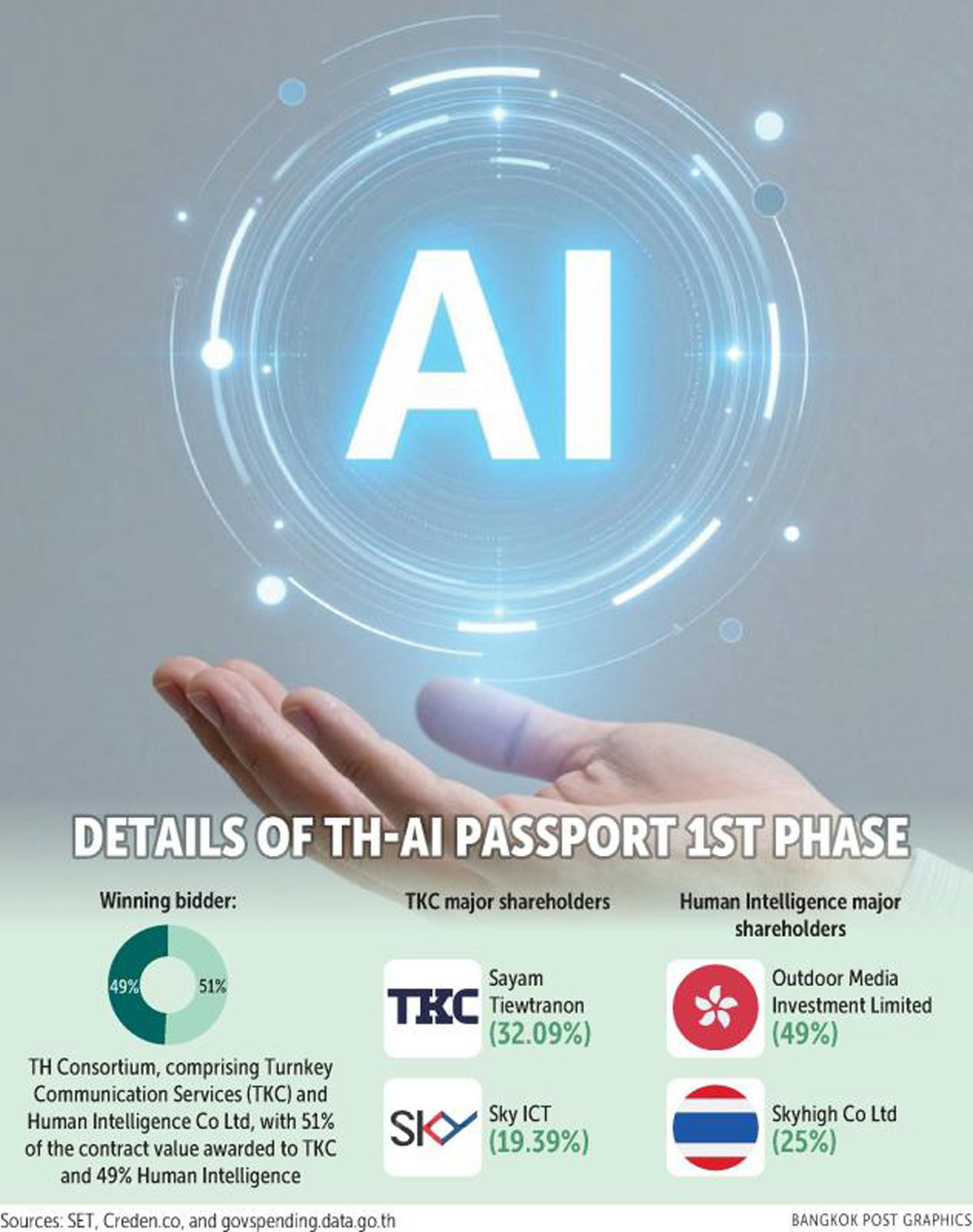
Without stronger support for Thai developers, local large language models (LLMs), startup credits, domestic AI infrastructure and transparent usage reporting, the project could increase short-term AI adoption while leaving Thailand more dependent on global technology providers, rather than helping to build a sustainable national AI structure, according to the AI Entrepreneur Association of Thailand (AIEAT) and technology pundits.
Under the first phase of the scheme, the government plans to spend 1.6 billion baht to procure professional and premium generative AI models for free use by up to 5 million Thais aged 15 and older.
Framed as a national investment in human capital and AI capability, the scheme has drawn scrutiny over its scale, procurement process and value for money.
GUIDELINES
AIEAT proposed eight guidelines to ensure the project delivers maximum benefits in terms of both budget efficiency and the development of Thailand's AI capabilities.
The first is the government should develop a platform strategy to reduce token costs for different user groups when using LLMs, allowing access rights to be allocated according to the nature of their work. This approach would significantly reduce token-related expenses, noted the association.
An AI token is the basic unit of text that an LLM reads and generates. Tokens are also the unit used for billing.
The project should prioritise the use of models starting from free services to those with low token costs to more expensive models, depending on whether a task is basic or advanced, said AIEAT. This policy would ensure resources are used according to actual needs and reduce wasteful spending that does not create added value.
Second, the project should provide developers with access to higher-value token allocations for advanced AI models, which should be reserved for complex tasks that generate high economic value.
Developers should also be allowed to access these models through an application programming interface (API) so they can rapidly build applications and innovations on top of them. This approach would help reduce initial costs for entrepreneurs, particularly startups and new developers, while supporting high-potential players in developing a wider range of products, thereby accelerating the growth of Thailand's AI capabilities, according to AIEAT.
Third, Thai-developed LLMs and their associated local networks should be included as options for users under the project. A mechanism should channel usage data and feedback to Thai researchers and entrepreneurs, subject to appropriate privacy and data security safeguards, allowing Thai-developed models to continuously improve their capabilities and reduce the country's reliance on foreign technology in the long term, said the group.
Fourth, part of the project budget should be allocated to increase the number of AI servers in Thailand, allowing AI researchers and entrepreneurs to access computing resources for free or at affordable rates.
This investment would help Thai entrepreneurs develop efficient AI services and offer them at prices competitive with those of foreign service providers, noted AIEAT.
Fifth, the project should serve as a bridge connecting domestic AI users with Thai AI products and innovations, making them easier to access.
Sixth, a transparent system for reporting token usage across all AI models in the project should be established to disclose actual token consumption. This would help identify user behaviour and usage patterns across different groups.
Such data would be valuable for planning future token allocations, selecting appropriate models and assessing budget efficiency based on empirical evidence.
Seventh, a portion of the budget to purchase credits from Thai AI startups should be distributed to the public and small and medium-sized enterprises (SMEs), allowing them to try AI services for free. This approach would help people and SMEs to use AI to improve productivity, while also generating revenue and building real user bases for Thai AI startups, which supports the sustainable growth of Thailand's AI system.
Finally, the project should establish AI governance and audit mechanisms.
Chanwit Boonchuay, president of AIEAT, told the Bangkok Post the association plans to discuss these proposals with the National Board of the Digital Economy and Society Office.
INDUSTRY CONCERNS
Industry players outside the association raised similar concerns about the project.
Pornthip Kongchun, co-founder of Thai startup Jitta, warned the scheme could end up using taxpayer money to promote foreign platforms such as Google, Microsoft and OpenAI, rather than strengthening Thailand's long-term AI capability.
She said the project could effectively deliver 5 million Thai users to global technology firms, which could later convert them into paying customers.
While the government wants to raise Thailand's AI diffusion rate from 10.7% to 23%, Ms Pornthip argued that promoting AI usage alone is insufficient.
Policymakers should measure real AI adoption, including how people use AI to improve work, business productivity and income, she noted.
Clear performance indicators should be established to measure the impact of AI adoption on economic output and GDP, added Ms Pornthip.
Thannachart Numnonda, executive director of the IMC Institute, said the project may be more realistic and valuable if it focuses on Thai-specific use cases, domestic datasets and investment in local LLM infrastructure.
Sak Segkhoonthod, senior advisor to the Electronic Transactions Development Agency, said distributing 5 million AI platform licences would not be enough if users apply AI randomly.
He proposed profession-specific AI manuals be created for hundreds of occupations, from farmers and teachers to rice growers and grounds maintenance workers, supported by trusted influencers in each field.