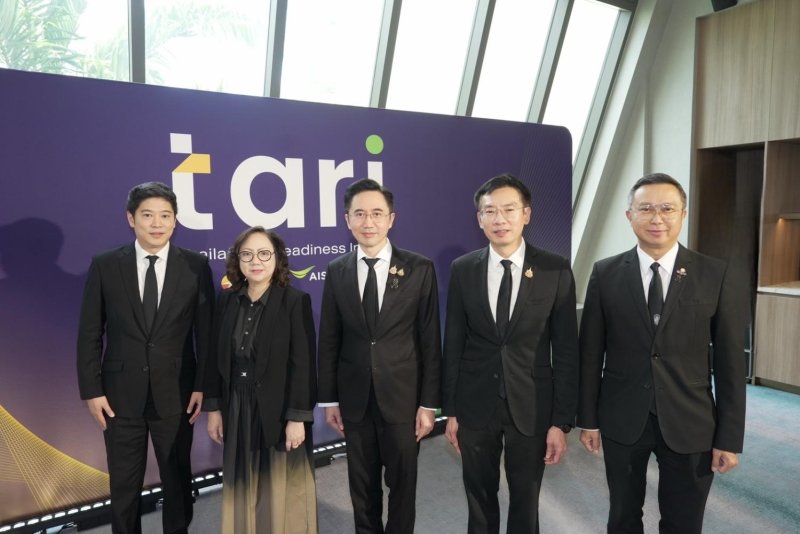
The Ministry of Higher Education, Science, Research and Innovation (MHESI) and its Office of National Higher Education Science Research and Innovation Policy Council (NXPO) has partnered with AIS Academy and IRIS Consulting to launch the Thailand AI Readiness Index project (TARI), the nation's first such tool for organisations.
The partnership aims to help organisations assess their artificial intelligence (AI) readiness and strengthen business competitiveness and country policy in the era of AI.
The findings from the assessment are set to be introduced in December.
By 2027, organisations that participate in the survey receive an AI Capability Report, similar to an AI Capability Assessment certificate.
Thailand wants to build AI infrastructure to become a cost-effective hub for technology and data centres.
"AI is no longer just a technology; it is a strategic force shaping national development across the economy, industry, innovation and the workforce," said MHESI Minister Yodchanan Wongsawat at the launch of the project.
He said that Thai organisations' ability to adopt AI effectively will be critical to strengthening the country's long-term competitiveness.
TARI offers a clear navigation of AI readiness, helping Thailand assess its capabilities against regional and global peers, identify gaps, and design targeted policies and support programmes, said Mr Yodchanan, who is also a member of the National AI Committee.
He said that AI development must be a national effort under the "AI for All" agenda, with MHESI laying the foundations in science, technology, talent development, and practical AI use cases in industry, agriculture and healthcare.
The push comes as Thailand faces three major global disruptions: tech competition, climate change, and an aged society.
Addressing these challenges will require stronger data capabilities, from satellite data for environmental monitoring to genomic data for precision medicine.
"Thailand cannot rely solely on foreign technology and infrastructure. To build true resilience and innovation, we must develop our own technology structures, including data centres, local hardware capabilities, and secure storage for strategic datasets," said Mr Yodchanan.
Thailand's geopolitical neutrality and central location in Southeast Asia enable the country to become a cost-effective hub for technology and data centres, he said.
Critical milestone
"Thailand is at a critical milestone in its transition to an AI economy -- one that is reshaping how we work and redefining national competitiveness," said Kantima Lerlertyuttitham, deputy chief executive and chief corporate officer at AIS.
The key question is not whether AI will replace people, but how we prepare people, organisations, and the nation to use AI to boost productivity and economic growth, she said.
Most organisations do not lack technology -- they lack clarity on their readiness, where to begin, and how to turn AI into real business impact, said Ms Kantima.
"Based on AIS's experience in driving AI transformation, from building AI literacy and upskilling employees to embedding AI into enterprise products and services, we believe AI adoption must start with a clear understanding of readiness across people, skills, data, processes, and culture, not technology investment alone," she said.
Guided by AIS's vision of "Think Ahead for Thais", AIS is working with leading partners to develop TARI as a common tool to help Thai organisations assess readiness, identify gaps, and define a practical path for AI adoption.
"TARI will be an important mechanism to help Thai organisations and the country move confidently toward the AI economy -- where competitiveness is defined by who is better prepared to use it effectively," Ms Kantima added.
"For TARI, we are driven by social responsibility. We stand on the belief that a company cannot grow if the country does not grow."
TARI is a tool to help the private sector move forward systematically with a clear framework, rather than just purchasing technology, she said.
NXPO president Surachai Sathitkunarat said a key challenge in AI policy development is the lack of reliable, comprehensive data on Thai organisations' AI readiness.
Current data remains fragmented, making it difficult to assess readiness across industries.
TARI will provide a common assessment framework to give all sectors a clearer view of their readiness.
"NXPO will use aggregated insights from TARI to design industry-specific support measures, with strong data governance to build trust and ensure responsible use of data for policy development," said Mr Surachai.
AI CAPABILITY REPORT
Chatchai Khunpitiluck, head of AIS Academy, said in 2027 that the TARI assessment will be conducted twice a year, alongside the launch of the "AI Capability Report", a health check-up for organisations to gauge their AI readiness.
"After completing the assessment, organisations will receive an index score that allows them to benchmark their AI readiness against peers in their industry and the national average," Mr Chatchai said.
He said corporate AI adoption comes with risks, including legal compliance, customer data privacy, and data leakage.
Through this initiative, organisations will be able to access an AI readiness assessment free of charge, although such assessments are typically offered as paid services.
The index will serve as a practical checklist for executives to navigate the AI wave, balance risks with business benefits, and avoid investing in AI tools before their foundations -- such as AI policy, data readiness, and governance -- are in place.
The assessment will be structured into three tiers: pioneer organisations led by senior executives from major industries, including in-depth interviews, corporate partners, and community participants like SMEs.
Boriwat Pinpradab, chairman of IRIS Consulting, said the company sees many organisations eager to adopt AI, but are uncertain about whether to begin with people, data or processes.
Some already have AI projects underway but struggle to scale impact across the organisation, which is why a standardised assessment tool is essential.
Under this collaboration, TARI assesses organisational readiness across eight dimensions: AI strategy and leadership; data management; technology and infrastructure; people and AI skills; governance and risk; AI use cases and business value creation; organisational culture and change management; and AI implementation and realised impact.
Over 40 leading organisations have joined as pioneers in TARI. The initiative will later expand to SMEs and supply chains, targeting 5,000 participants in the first year and 20,000 in the next phase.
Organisations interested in contributing to TARI can register at https://thailand-tari.ai.
.png?w=600)