Extracting usable data from documents remains one of the most time-consuming and error-prone tasks in business operations. Whether it involves processing invoices, onboarding identity documents, digitizing contracts, or parsing forms, the volume of unstructured document data that organizations handle continues to grow — while the tolerance for processing delays and transcription errors continues to shrink. Manual data entry is too slow and too unreliable at scale. That's why optical character recognition has become a foundational technology across industries ranging from financial services and healthcare to logistics and legal services.
Yet not all OCR implementations are equal. Traditional rule-based OCR systems have served businesses for decades, but they were designed for a more predictable document landscape — one where formats were standardized, print quality was consistent, and document volumes were manageable. The reality of document processing today is significantly more complex. Here's when a more advanced approach enters the game.
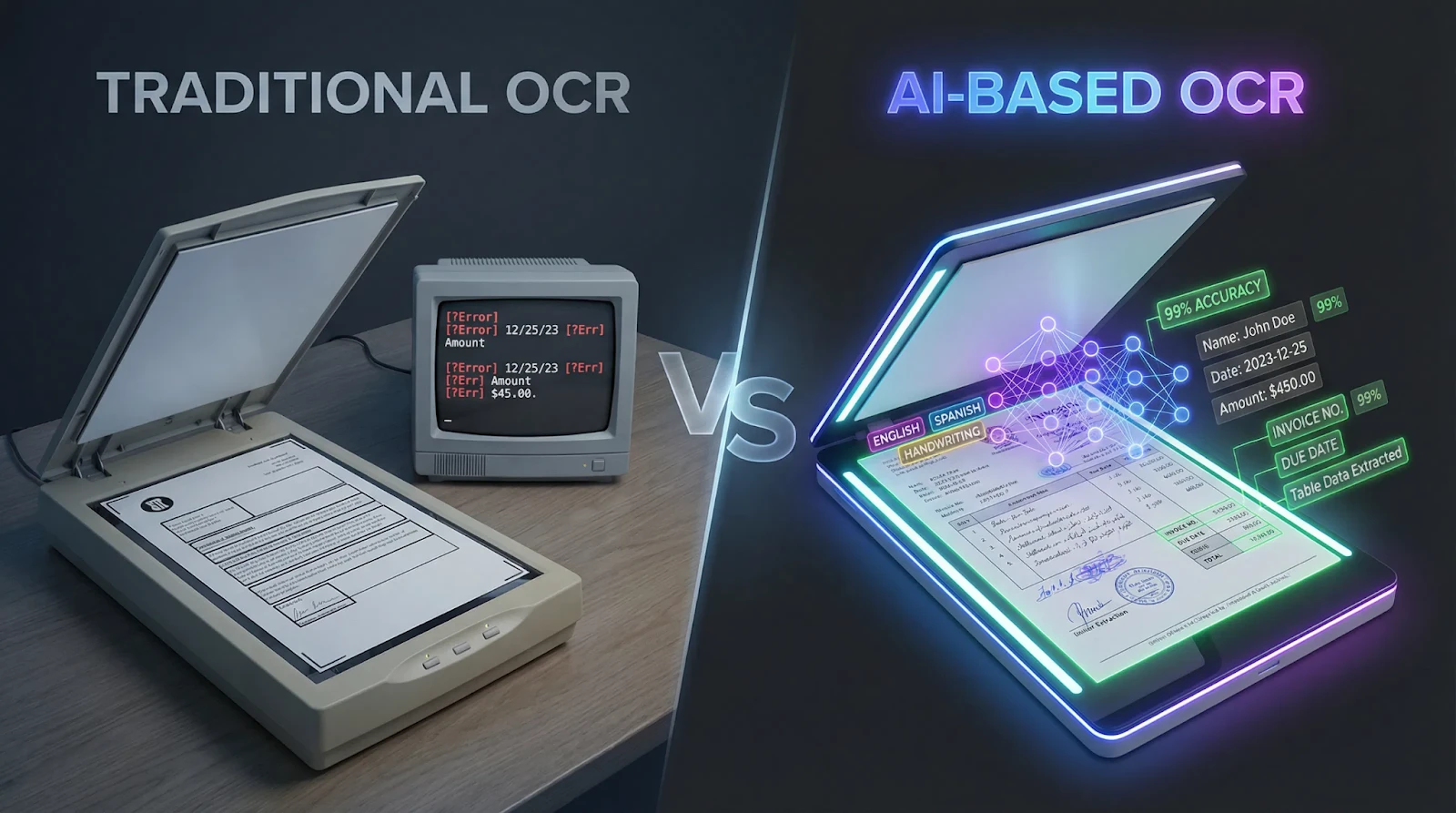
An AI-based OCR solution represents a fundamental shift in how text recognition is approached. Rather than relying on fixed templates and predefined rules, it uses machine learning and neural networks to understand document content contextually — adapting to variation in format, language, handwriting, and image quality in ways that traditional systems simply cannot. Given this distinction, understanding the practical differences between these two approaches is essential for any organization evaluating its document processing infrastructure.
What Is OCR — and How Do the Two Approaches Differ?
Optical character recognition (OCR) is a technology that converts images of text — whether scanned, photographed, or digitally rendered — into machine-readable, editable data. It is designed to eliminate the need for manual transcription by automating the extraction of text from documents.
Traditional OCR operates through a rule-based pattern-matching process. The software compares pixel patterns in an image against a predefined library of character shapes and, when a match is found, outputs the corresponding character. This approach works reliably under controlled conditions — clean scans, standard fonts, consistent layouts — but degrades significantly when documents deviate from expected parameters.
An AI-based OCR solution, by contrast, is built on deep learning and neural network architectures that allow the system to recognize text the way a human reader would — by understanding context, inferring meaning from partial information, and improving its accuracy over time through exposure to more data. In other words, the system doesn't just match patterns; it interprets them. This positively affects accuracy rates across a much wider range of document types, conditions, and languages than traditional OCR can reliably support.
When Does It Make Sense to Choose AI-Based OCR?
The performance gap between traditional and AI-based OCR becomes most visible in environments where document variability is high and accuracy requirements are non-negotiable. The most highly demanded options are found in contexts including, but not limited to:
- Identity document verification: Passports, national IDs, and driver's licenses from multiple countries vary significantly in layout, font, and security feature design — AI-based systems handle this variability far more reliably.
- Invoice and receipt processing: Supplier invoices arrive in dozens of different formats; AI OCR can extract key fields without requiring a custom template for each vendor.
- Healthcare documentation: Medical records, prescription forms, and clinical notes often contain handwritten annotations that traditional OCR cannot process.
- Legal document digitization: Contracts and legal filings may include mixed fonts, stamps, handwritten signatures, and variable formatting that rule-based systems struggle to parse.
- Logistics and supply chain: Shipping labels, customs forms, and delivery documentation require fast, accurate extraction under real-world image quality conditions.
- Financial services compliance: Extracting structured data from unstructured documents for KYC, AML reporting, and audit trail generation.
That's why the global intelligent document processing market — which encompasses AI-based OCR as a core component — has been growing consistently, driven by increasing document volumes and the demand for automation across regulated industries.
Key Differences and Benefits of AI-Based OCR
Understanding the practical advantages of AI-based OCR requires a side-by-side comparison across the dimensions that matter most in production environments.
Accuracy Under Variable Conditions
Traditional OCR accuracy drops measurably when documents are skewed, poorly lit, low-resolution, or printed in non-standard fonts. AI-based systems are trained on vast datasets of real-world document images — including degraded, distorted, and handwritten examples — and maintain significantly higher accuracy across these conditions. This drastically reduces the volume of documents that require manual review or correction.
Handling of Unstructured and Semi-Structured Documents
Traditional OCR requires predefined templates to extract specific fields from documents. When a document doesn't match the expected template, extraction fails or returns incorrect data. AI-based OCR systems can interpret document structure dynamically, identifying fields such as dates, totals, names, and addresses without needing a custom template for each document type. Thanks to this capability, businesses can process a much wider document mix without continuous template maintenance.
Multilingual and Handwriting Support
Traditional systems typically support a limited set of languages and perform poorly on handwritten text. AI-based solutions are built to handle multiple scripts and languages simultaneously, and dedicated handwriting recognition models can extract data from cursive or printed handwriting with meaningful accuracy. This is particularly valuable in healthcare, legal, and international business contexts.
Continuous Improvement Through Learning
Traditional OCR systems do not improve with use — their accuracy is fixed at implementation. AI-based models can be fine-tuned on domain-specific document sets, and some implementations incorporate feedback loops that allow the system to learn from correction data over time. These mechanics boost accuracy progressively, reducing error rates as the system encounters more examples of the document types it processes.
What a Reliable AI-Based OCR Solution Should Have:
- High baseline accuracy across standard and non-standard document formats
- Robust performance under variable image quality conditions
- Support for multiple languages and scripts
- Handwriting recognition capability where relevant to the use case
- Field-level confidence scoring to flag low-certainty extractions for review
- API integration with downstream document management or compliance systems
- Audit logging of extraction results for traceability
How to Choose and Implement the Right OCR Approach
Selecting between traditional and AI-based OCR — or determining whether a hybrid approach is appropriate — requires a structured evaluation. We recommend the following process:
- Audit your document mix first. You should attentively analyze whether your documents are standardized and high-quality, or variable in format, condition, and language — this single factor will determine how much you stand to gain from AI-based processing.
- Define your accuracy threshold. If you want to minimize manual review to below a meaningful operational threshold, you need to evaluate AI-based solutions — traditional OCR is unlikely to reach that benchmark on complex document sets.
- Assess integration requirements. Typical integrations include connections with document management systems, ERP platforms, compliance databases, and case management tools — confirm that your chosen solution supports these via well-documented APIs.
- Request a benchmark test on your actual documents. It will be helpful to provide vendors with a representative sample of your real document types and measure extraction accuracy before committing to a solution.
- Plan for exception handling. Even the most capable AI-based OCR will occasionally produce low-confidence extractions — define a clear workflow for routing these to human review without disrupting overall processing throughput.
- Consider domain-specific fine-tuning. If your document set is highly specialized — medical forms, legal contracts, or industry-specific formats — look for vendors that offer model fine-tuning on custom datasets.
Conclusion
Traditional OCR remains a viable choice for narrow, high-quality, standardized document workflows. However, for organizations dealing with variable document types, multilingual content, handwritten annotations, or compliance-grade accuracy requirements, the limitations of rule-based systems become increasingly difficult to work around at scale.
AI-based OCR solutions offer a meaningfully higher baseline of accuracy, adaptability, and long-term performance — without the ongoing maintenance burden of template libraries and manual correction workflows. The majority of organizations processing significant document volumes are already moving toward AI-driven extraction as the default standard. If your current OCR implementation requires frequent manual correction or fails to handle document variation reliably, you should evaluate whether an AI-based alternative could deliver measurably better outcomes for your specific use case.