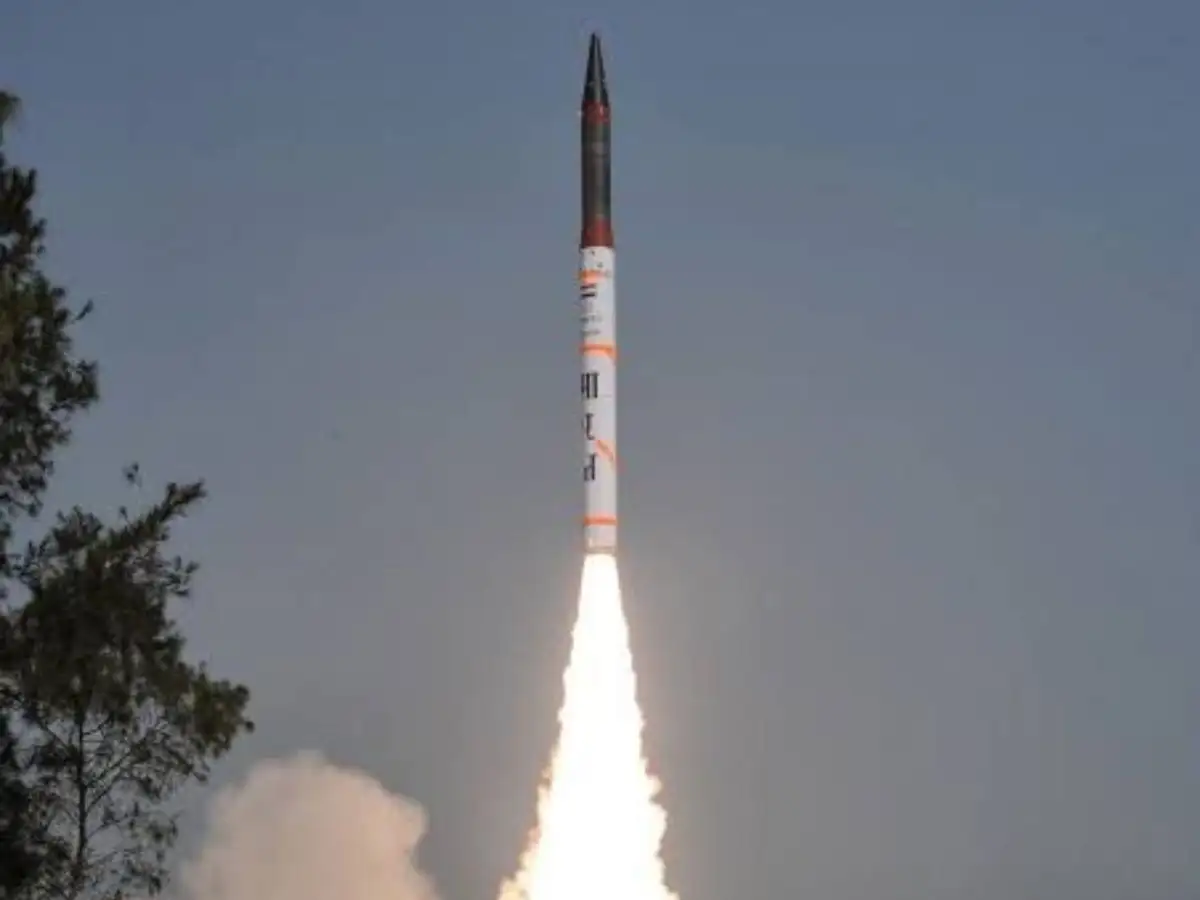
India on Thursday carried out the successful test launch of the Medium Range Ballistic Missile (MRBM) Agni-IV from the Integrated Test Range in Chandipur, Odisha. The launch was conducted under the supervision of the Strategic Forces Command and validated the missile’s operational and technical parameters.
The two-stage, solid-fuelled missile has a reported range of up to 4,000 km and is capable of carrying both nuclear and conventional payloads.
Agni-IV development and testing history
The Defence Research and Development Organisation (DRDO) began work on a 5,000 km-class missile project named Agni-IV in 2007. In 2011, the Agni-IV designation was assigned to an upgraded version of the Agni-II Prime missile developed by DRDO’s Advanced Missile Laboratory in Hyderabad.
The upgraded missile featured a larger first-stage motor, an improved second-stage motor, enhanced guidance and electronic systems, and advanced thrust vector control technology.
India has conducted multiple flight tests of the Agni-IV since its first trial in 2010. The missile was successfully tested to a range of 4,000 km on January 20, 2014, after being launched from a road-mobile platform. During the test, the missile reached an altitude of around 850 km before landing in the Indian Ocean.
Strategic Forces Command conducted user trials
The Indian Army’s Strategic Forces Command conducted its first user trial of the Agni-IV on December 2, 2014, successfully launching the missile beyond 3,500 km. The trial was part of the process before its induction into service.
The Strategic Forces Command later carried out additional successful tests on November 9, 2015, January 2, 2017, and December 3, 2018.
Also Read: Trump dismisses reports of munitions shortages, says US has 'massive amounts'
Agni-IV specifications
The Agni-IV is a two-stage, solid-fuelled missile weighing around 17,000 kg. It measures approximately 20 metres in length and has a diameter of 1.2 metres at its lower stage.
The missile is designed to carry a payload of up to 1,000 kg over a range of up to 4,000 km. It uses a maraging steel-cased first stage and a carbon-fibre-cased second stage, supported by advanced guidance and control systems.
The missile uses an inertial navigation system with ring laser gyroscopes and flexseal thrust vectoring systems for flight control. According to the Defence Ministry, the missile has an accuracy of less than 100 metres circular error probable (CEP) at a range of 4,000 km.
Agni-IV can be configured to carry nuclear as well as conventional payloads and is part of India’s strategic missile capability.