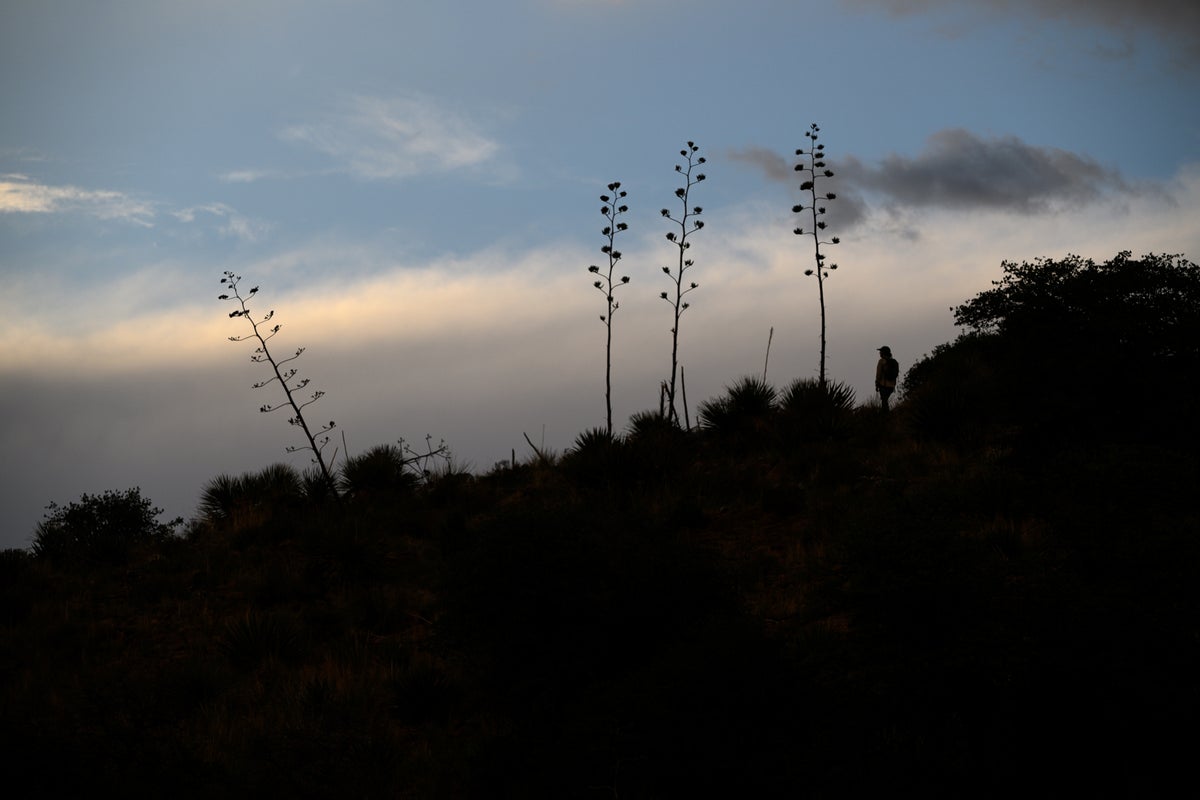
Mexican long-nosed bats have a taste for agave, their tongues designed to lap up the famous desert plant's nectar during nightly flights. It's not just a means of satisfying taste buds. It's a matter of fueling up for an arduous journey.
The endangered species migrates each summer from Mexico into the southernmost reaches of the United States. Big Bend National Park in Texas is a destination, as is Hidalgo County in New Mexico's Bootheel. It wasn't until last year that DNA evidence helped to add Arizona to the list.
Bat Conservation International announced on Tuesday that swabbing agave plants and hummingbird feeders on the fringes of New Mexico's Gila National Forest also turned up proof that the bats are farther north than ever before.
The research shows they're traveling about 100 miles (160 kilometers) beyond their known roosts in New Mexico.
The state's Bootheel region has been hit hard by drought, and agaves there don't seem to flower as much as they used to, said Kristen Lear, director of the Agave Restoration Initiative at Bat Conservation International.
“We think these bats are trying to look for healthy agave food sources elsewhere,” she said. "So that’s kind of driving them farther north, where the agaves are a little bit less hit by drought.”
Traveling another 30 miles (48 kilometers) can add another night to a bat's journey. To keep the sweet nectar flowing along the route, researchers on both sides of the international border say restoration of desert grasslands on the fringes of where the bats have been found in the past will be key to ensuring the future of the winged mammals and the genetic diversity of agaves.
The Mexican long-nosed bat was added to the endangered species list in 1988. It’s estimated that fewer than 10,000 remain.
Complicating matters is that both Mexican long-nosed bats and agaves are slow breeders. The bats have only one baby — or pup — per year. Agaves, which rely on the bats for pollination, can take a decade or more to flower and produce seeds.
“So you’re not going to get huge population rebounds quickly. You have to really work to maintain those levels,” Lear said.
Researchers and volunteers in Mexico and the United States have planted about 185,000 agaves since 2018 in what they call the nectar corridor. Seeds are collected so more plants can propagate. It can take a couple of years of rearing in a nursery before agaves are transplanted into high-priority areas.
Rachel Burke, BCI’s agave restoration coordinator for the U.S., said the discovery in New Mexico underscores the importance of ongoing work to learn more about the bats. According to Burke and the other researchers, detecting the presence of the bats helps to target planting and restoration efforts.
From private ranchers and local communities to government agencies, more than 100 partners have teamed up with Bat Conservation International to continue sampling for DNA and surveying agave patches.
What to know about the disappearance of Nancy Guthrie, mother of 'Today' show's Savannah Guthrie
Savannah Guthrie says her mom is a woman of faith and a source of strength for the family
Iran warns Trump against ‘threats and unreasonable expectations’ after agreeing talks
Pentagon threatens to pull support from Boy Scouts unless they restore ‘core values’
Syrian security forces continue to deploy in Kurdish areas under deal with SDF
Iran-Trump latest: US military shoots down ‘aggressive’ Iranian drone