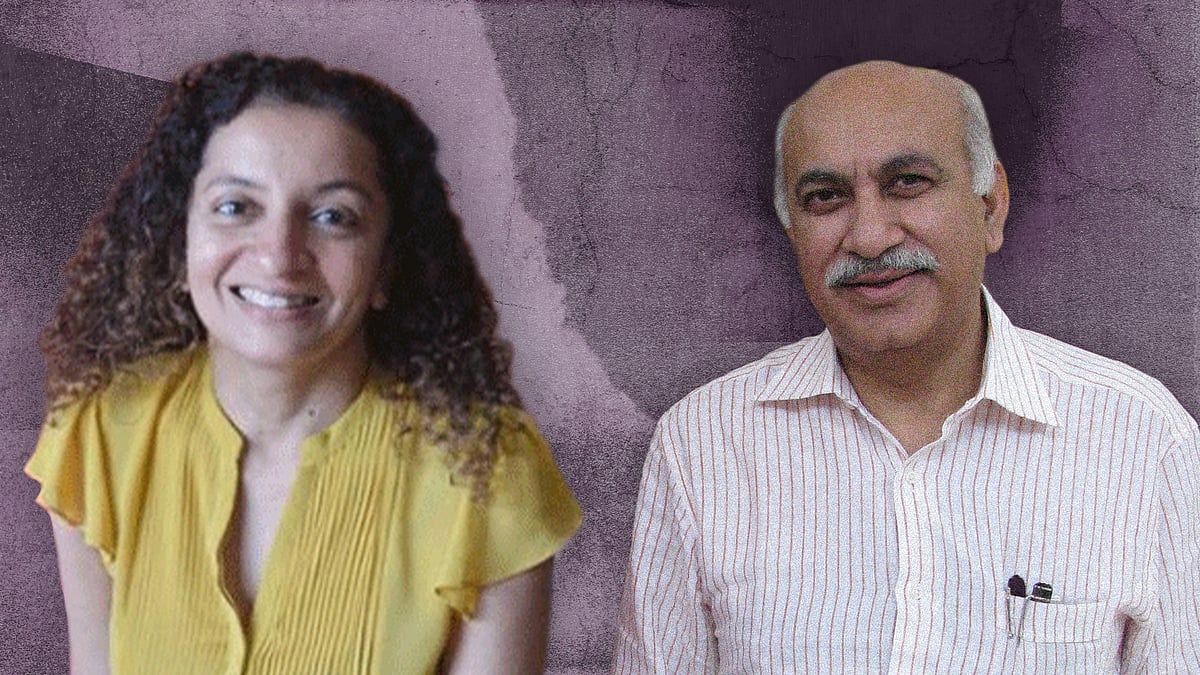
Six months after the last hearing, a virtual hearing of Bharatiya Janata Party leader MJ Akbar’s defamation suit against journalist Priya Ramani took place today. Akbar had filed the criminal defamation case against Ramani in October 2018, after Ramani accused him of sexual harassment.
Judge Vishal Pahuja heard the matter. The last hearing in the case took place in February this year, when Akbar’s counsel Geeta Luthra concluded her arguments.
Ramani’s counsel Rebecca John began the hearing by explaining the structure of her arguments. “I will first give a recap of the case, refer to the statements recorded during the pre-summoning stage, and then argue on the exceptions provided under Section 499 of the Indian Penal Code,” she said.
After her recap, John referred to the Vogue article written by Ramani in 2017. The article included allegations of sexual harassment by a famous editor. In 2018, during the #MeToo wave in India, Ramani had identified the editor as Akbar.
John said the only thing she wanted to highlight, at this point, was that the Vogue article referred to both Akbar and other male bosses. She also argued that the piece had been in the context of the #MeToo movement and the revelations about Harvey Weinstein in the United States.
John then brought up Ramani’s friend Niloufer Venkatraman, who had testified in the case last October. Venkatraman was a key witness who had known of Akbar’s alleged sexual harassment of Ramani. John told the court that Venkatraman’s testimony was used for the purpose of corroborating Ramani’s statements.
She also argued that it “was Ramani’s case that she had a chat with Ghazala Wahab who asked her when the ‘revelation against Akbar is going to see the light of day’.” Wahab, a journalist, testified last year that Akbar allegedly sexually harassed her when she had worked at Asian Age. Akbar had been her editor at the time.
Before Ramani’s revelations about Akbar on Twitter, John continued, Wahab had already written an article in the Wire describing her experience with Akbar.
John also said she would break down Section 499 of the Indian Penal Code into three ingredients that talk about the offence of defamation. The first is publishing a statement or imputation concerning a person, the second is with an intention to harm reputation, and the third is that reputation is hurt due to that imputation.
With respect to Ramani’s admission, John said “ingredient one is satisfied”. “Defamation is not an absolute offence, it’s a justifiable offence,” she said. “That’s why the court will look at the ingredients of the offence differently than that of the other offences.” Referring to one of Ramani’s statements, John said Ramani had pleaded not guilty, and “the truth is her absolute defence”.
She added: “It is not defamation when imputation is true and made in the public interest.” She said that Ramani’s Vogue article was her truth.
John subsequently read out Akbar’s pre-summoning statements, and how he said he was “unaware of the advent of the #MeToo movement in India”. She said it was important for the court to read articles written on Akbar to understand his conduct, and noted various contradictions in his responses. “Earlier he said he doesn’t remember but later he denied them,” she said.
The matter was adjourned to September 8.
Also Read: MJ Akbar vs Priya Ramani: ‘We can’t be a social media country’
Newslaundry is a reader-supported, ad-free, independent news outlet based out of New Delhi. Support their journalism, here.