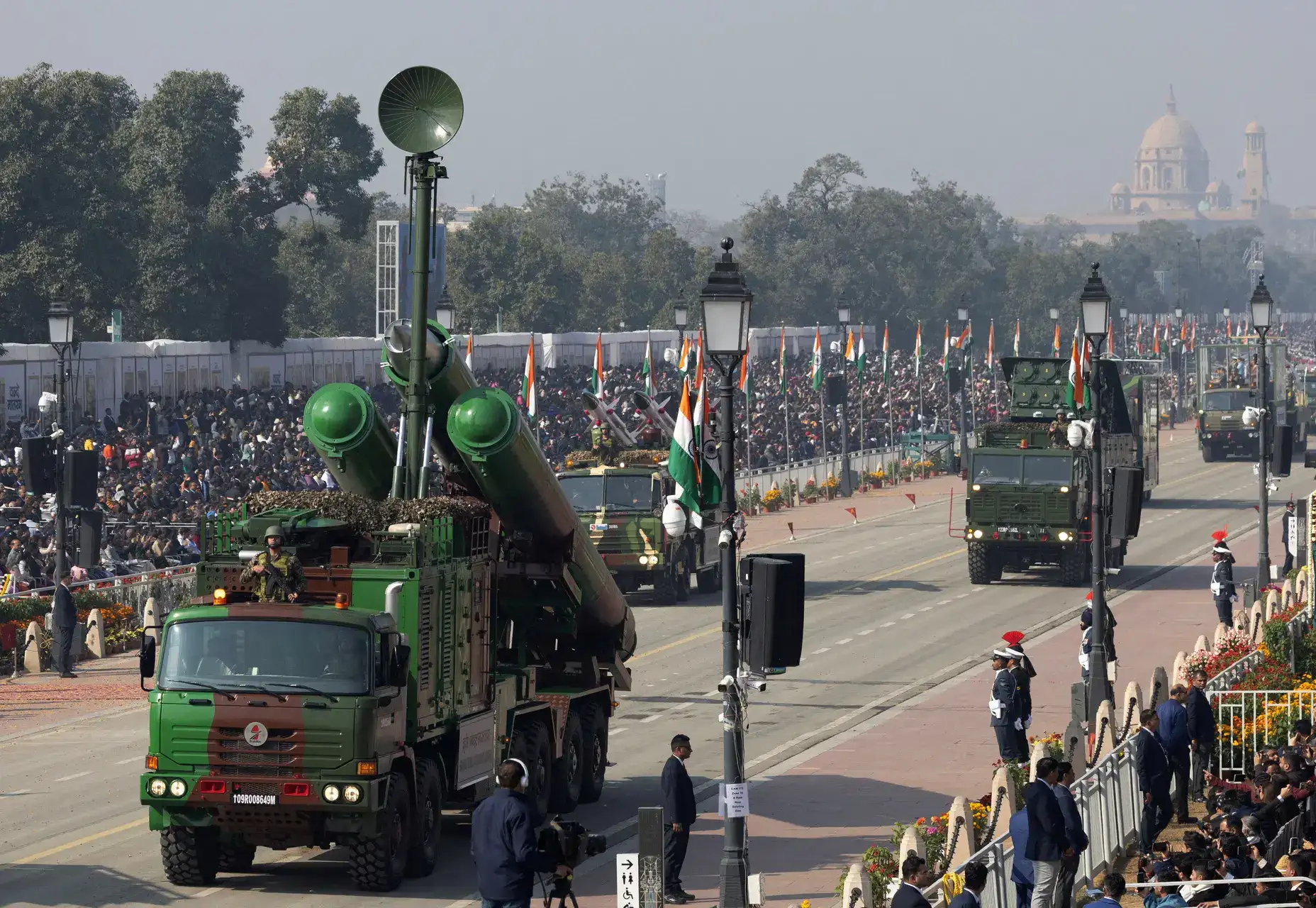
India's defence export narrative has so far been dominated by one name, BrahMos. The supersonic cruise missile has emerged as the country's flagship military export, attracting a few buyers as well as interest from many others. But another Indian system may be preparing for a similar global breakthrough. According to Reuters, the United Arab Emirates (UAE) has shown interest in acquiring both the BrahMos missile and the Akashteer air defence system, a development that could prove just as significant for India's defence industry. If BrahMos represents India's offensive punch, Akashteer could become the face of its defensive technology exports.
The timing is important. Modern warfare is undergoing a dramatic shift. Cheap drones, loitering munitions and low-cost aerial threats are increasingly challenging some of the world's most sophisticated militaries. From Ukraine's long-range drone strikes deep inside Russia to the missile and drone exchanges witnessed across the Middle East, nations are scrambling to strengthen their air defence networks. In that environment, a system like Akashteer arrives at exactly the right moment.
ALSO READ | India in talks to sell supersonic BrahMos missile to UAE: Report
The system that turned air defence into a network
One reason Akashteer stands apart is that it is not merely another missile or radar. It is an automated air defence control and reporting system that integrates sensors, radars, communication networks and weapon systems into a unified operational picture. Instead of individual air defence assets functioning in isolation, Akashteer allows them to operate as part of a coordinated network.
In modern combat, this distinction is critical. Detecting a drone is only one part of the challenge. The real test lies in identifying it quickly, assigning the right interceptor, avoiding duplication of effort and ensuring that decisions are made within seconds. Akashteer was designed precisely for that purpose.
This is why comparisons with traditional air defence systems can sometimes miss the point. Akashteer is closer to the nervous system of an air defence network than to a standalone weapon platform.
Operation Sindoor changed the conversation
Military systems often spend years seeking export customers without attracting much attention. What changes perceptions is combat performance. Operation Sindoor provided that moment for Akashteer. During the conflict, the system was credited with coordinating India's response to incoming aerial threats, including drones and missiles. Official accounts described Akashteer as a central element of the defensive network that intercepted and neutralised incoming attacks. Reports citing Indian Army officials stated that the system helped achieve an exceptionally high kill rate against hostile drones and aerial threats.
For potential buyers, this matters enormously. Defence procurement decisions are increasingly influenced by combat validation. A weapon or system that has performed during actual hostilities carries a level of credibility that no demonstration or brochure can provide. BrahMos benefited from this effect after Operation Sindoor. Akashteer may now be following the same path.
Why the UAE's interest matters
The significance of the UAE interest lies not merely in the possibility of a sale but in who the prospective customer is. The UAE is not a country shopping for low-cost alternatives because it lacks options. It already operates some of the most advanced Western defence systems such as American THAAD and Patriot and has access to cutting-edge military technology. When a country with such capabilities evaluates a new system, it sends a message to the global market. A UAE acquisition would effectively serve as third-party validation of Akashteer's capabilities. It would indicate that the system offers value even to militaries that already possess sophisticated air defence architectures. More importantly, it would demonstrate that Akashteer can potentially complement and integrate with a broader defence ecosystem rather than remain confined to Indian operational requirements. That kind of endorsement is often the difference between a niche export product and a global success story.
A massive addressable market
The strategic case for Akashteer extends far beyond the Gulf. One of the defining lessons of contemporary warfare is that drones have fundamentally altered the economics of conflict. A drone costing a few thousand dollars can threaten assets worth millions. Swarms of inexpensive drones can saturate traditional air defence systems and force defenders to expend costly interceptors. This challenge is no longer limited to major powers. Medium-sized militaries and even smaller nations increasingly face the prospect of drone attacks against military bases, airports, energy infrastructure and critical facilities.
As a result, demand is growing not only for missiles and radars but also for command-and-control systems capable of managing large volumes of incoming threats. Akashteer is positioned squarely within that emerging market. In many cases, countries may already possess radars and missile batteries from different suppliers. What they lack is a unified architecture capable of bringing everything together into a single operational framework. That is precisely the niche Akashteer could fill.
India may also enjoy a unique geopolitical advantage in marketing Akashteer. Countries that might hesitate to purchase Chinese military systems due to strategic concerns or Russian systems due to sanctions and political risks often view India differently. New Delhi's position as a major strategic partner of the United States while maintaining its own independent foreign policy gives it a degree of flexibility that few defence exporters possess. For many buyers, an Indian system can appear politically less complicated than alternatives from rival power blocs. That does not guarantee sales as defence procurement remains intensely competitive. But it does mean India enters many markets without the geopolitical baggage that can accompany competing suppliers.
For years, India's defence export ambitions were closely tied to BrahMos. The missile remains the country's most recognisable military product abroad and continues to attract international interest. Yet mature defence exporters rarely depend on a single flagship platform and go on to build portfolios. Akashteer has the potential to become the next pillar of that portfolio.
Unlike a missile, which addresses a specific operational requirement, a networked air defence management system addresses a challenge that nearly every military now faces. The spread of drones, loitering munitions and low-cost aerial threats has made integrated air defence a universal concern. That gives Akashteer a potentially broader addressable market than many conventional weapon systems.
If the UAE ultimately proceeds with an acquisition and successfully deploys the system, it would represent one of the strongest endorsements Akashteer could receive. A demanding customer with access to some of the world's best defence technologies choosing an Indian air defence management system would send a powerful signal across global arms markets, especially in dozens of small countries who want economic yet effective military systems. BrahMos opened the door for India as a serious defence exporter. Akashteer now has an opportunity to walk through it and establish India not just as a supplier of weapons, but as a provider of sophisticated battlefield networks for the drone age.