Grand foreign-policy strategies rarely disappear overnight. More often, they are dismantled gradually through subtle rhetorical shifts, bureaucratic adjustments, and changing diplomatic priorities. America's Indo-Pacific strategy is no exception.
A decade ago, then-Japanese prime minister Abe Shinzo unveiled the concept of a "free and open" Indo-Pacific. Based on the idea that the Indian and Pacific Oceans form a single strategic theatre, he sought to build a coalition of democracies committed to preventing any one power from dominating the region.
The United States subsequently embraced this vision, reviving the Quad coalition and establishing its members -- Australia, India, Japan and the US -- as the principal anchors of the regional balance of power. The underlying strategic logic was compelling. Like the alliance system more broadly, the Indo-Pacific coalition would amplify US influence by encouraging middle powers to shoulder greater responsibility for regional stability. Moreover, its multiple centres of power and shared objective would make it inherently resilient.
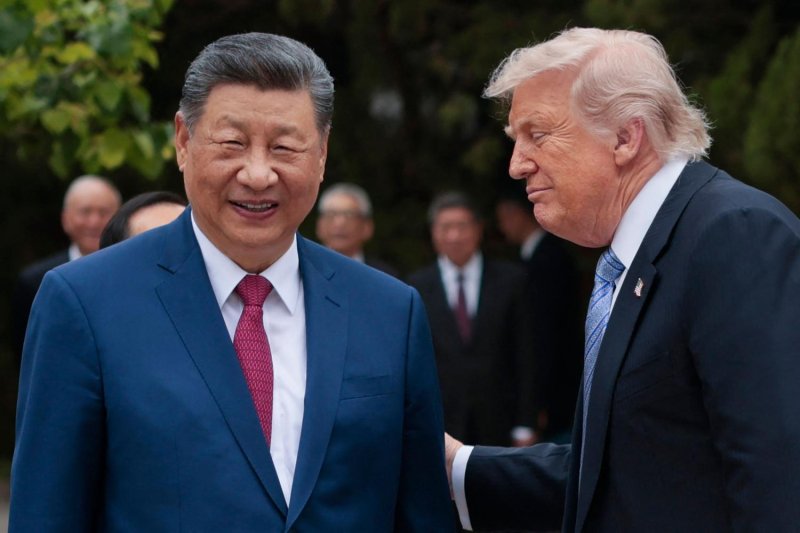
More recently, however, US President Donald Trump has advanced the idea of a "G2" comprising just the US and China. Unlike the free and open Indo-Pacific vision, which seeks to maintain stability by cultivating a broad network of like-minded partners, the G2 concept assumes that the world's two leading powers should shape the regional and global order through direct negotiations.
The approach elevates bilateral deal-making at the expense of multilateral diplomacy, thereby diminishing the strategic weight of middle powers -- and, by extension, US influence. Its durability largely rests on the personal chemistry and shifting calculations of leaders in Washington and Beijing. While Mr Trump seems to be warming up to Chinese President Xi Jinping today, there is no telling what tomorrow will bring. Simply put, the G2 is a highly unstable proposition.
One might be tempted to dismiss this as just another example of Mr Trump's unconventional diplomacy, which often emphasises bilateral bargaining over coalition-building. But his administration has also systematically deprioritised the Quad, with its latest National Security Strategy making just a single passing mention of the grouping. The US Department of Defense, for its part, has reverted to referring to its principal theatre as the "Pacific", instead of the "Indo-Pacific".
Together, these developments suggest that this is no temporary bluff or brief diplomatic glitch. Under Mr Trump, the free and open Indo-Pacific strategy is unraveling.
This carries grave risks for Japan. Over the past decade, Abe's Indo-Pacific vision has anchored Japan's national security strategy, with the goal of ensuring that China does not concentrate its military pressure in East Asia. If the US focuses exclusively on the Western Pacific, Japan would lose its strategic depth and risk finding itself face-to-face with China's maritime might.
None of this is lost on Japanese Prime Minister Sanae Takaichi, who has redoubled her commitment to the vision of a free and open Indo-Pacific. In May, she unveiled an updated Indo-Pacific framework emphasising regional economic resilience and enhanced security cooperation. Her government has been reinforcing the partnerships that give the strategy practical effect by deepening strategic ties with India and Australia and expanding "minilateral" arrangements, including the Japan-US-Philippines and Japan-US-South Korea trilateral groupings.
In Japan's strategy for preserving Asia's balance of power, India occupies a central position. This was apparent during Ms Takaichi's visit to New Delhi last month, when she and Indian Prime Minister Narendra Modi reaffirmed their commitment to the Indo-Pacific framework and agreed to expand cooperation in areas ranging from AI and critical minerals to defence technology. For Japan, India is not just another strategic partner. With its vast size, formidable military, dynamic economy, and commanding position astride the Indian Ocean, it is the indispensable western pillar of the Indo-Pacific architecture.
India presents China with a two-front dilemma, forcing Chinese military planners to split their attention and resources between the continental and maritime theatres. If China did not have to monitor its long, tense Himalayan frontier with India -- where dozens of soldiers died after Chinese land grabs triggered clashes in 2020 -- and protect critical Indian Ocean trade routes, it would be able to concentrate overwhelming force in the Western Pacific.
By removing the "Indo" from "Indo-Pacific", the Trump administration has exposed its lack of understanding of this critical dynamic. Together with its G2 vision, the shift amounts to an important symbolic and geopolitical victory for China. After all, Chinese leaders have long argued that the Indo-Pacific strategy's real aim was to "contain China" and "make Asia-Pacific countries 'pawns' of US hegemony". They would vastly prefer a Pacific-centric framework in which the US and China negotiate directly, and other regional powers do as they are told.
Whatever the Pentagon names its strategic theatre, the geography will not change. China's most important energy and trade lifelines still pass through the Indian Ocean, and the Himalayan frontier still constrains Chinese military planning. Preventing the emergence of a unipolar Asia, therefore, still depends on maintaining a free and open Indo-Pacific, underpinned by a broad coalition of democracies committed to that objective.
Whether the US returns to this framework remains to be seen. Japan, however, has already made its choice. ©2026 Project Syndicate
Brahma Chellaney, Professor Emeritus of Strategic Studies at the New Delhi-based Center for Policy Research and Fellow at the Robert Bosch Academy in Berlin, is the author of 'Water, Peace, and War: Confronting the Global Water Crisis' (Rowman & Littlefield, 2013).