
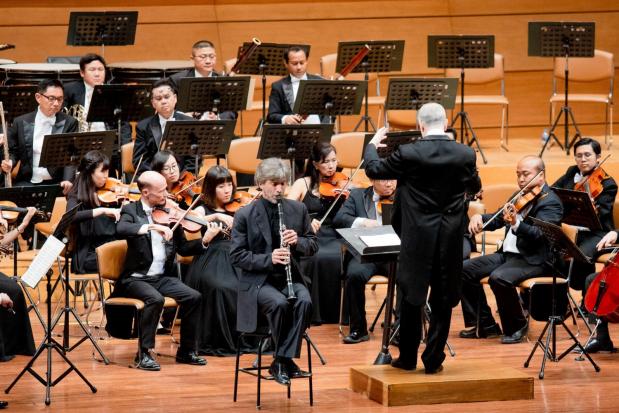
In an already thriving music scene which is only growing in scope and performance standards season by season, the Royal Bangkok Symphony Orchestra is indeed doing very well to continue to attract sizeable audiences for its main symphonic repertoire series, as demonstrated by the impressive recent turnout for "Crown Imperial For His Majesty" at the Thailand Cultural Centre last month.
Inviting top-notch international soloists to collaborate with the enthusiastic local musicians is of course always a sure-fire way of generating more interest and ticket sales, with the visit this time of exceptional clarinettist Dimitri Ashkenazy being a case in point. Even more pleasingly, his quality of musicianship was matched by the superb, clear conducting of distinguished Greek maestro Stefanos Tsialis, chief conductor and artistic director of the Athens State Orchestra.
It is hard to recall another RBSO performance in recent times which had such cleanliness of playing throughout the ranks, or such clarity of texture and tasteful phrasing. Such qualities are invariably brought out by some conductors better than others, and the fact that Tsialis has conducted upward of 80 orchestras worldwide was well in evidence in terms of the cool-headed experience he displayed.
Sir William Walton composed his magisterial coronation march Crown Imperial for the United Kingdom's 1937 crowning of George VI, one of the country's best-loved figureheads. It is an incredibly exciting seven minutes of a very modern nature, although at the same time very redolent of Elgar's "English" style.
Indeed, Walton's work earned the affectionate moniker Pomp & Circumstance March No.6, such is its aura of continuity so central to the concept of hereditary monarchy.
The rollercoaster musical ride conveys so well the sentiments of national pride and noble intention, central themes of hope at the precise moment of anointing of a new leader. The whole orchestra instantly shone from the opening insistent moments of semiquaver-pattern activity, with neatly played snare-drum interjections defining structural junctures.
The large harp part is the icing on the sumptuous orchestration cake, including numerous sweeping glissandos which are designed to send shivers up the spine -- and indeed they did. Japanese harpist Ema Mitarai played her part expertly. Meanwhile, the noble A-flat-major middle section highlighted a newly found depth of tone through to the back desks of the viola section. Apparently the orchestra has been holding many rounds of competitive open auditions of late, and it shows in a generally higher level of playing. Newly appointed principal oboist Nuttha Kuankajorn, for example, also had some wonderfully expressive moments.

Mozart's evergreen Clarinet Concerto In A Major K 622 was then given a most accomplished reading by Ashkenazy. All notes faithfully reproduced with a warm and glowing tone, it is hard to add to that in summation. In the cadenza he went into semi-improvisatory experimental mode, with some enharmonic twists and turns leading to a quote of the famous four-note fate-knocking-on-the-door motif which starts the symphony featured in the second half -- Beethoven's Symphony No. 5 In C Minor. There was a hushed but discernible indication of recognition from some members of the audience, and this original, humorous touch helped to form the impression of this musician as a thoroughly likeable and endearing personality.
Mozart in A major can admittedly be extremely awkward for violinists in particular, and while the firsts managed most of the exposed passage work admirably, there were one or two discreet moments of off-centre intonation and pitch imprecision which were hard to ignore.
Just before Ashkenazy's encore somebody towards the back of the auditorium had presumably carelessly turned their mobile phone on ready for the interval, and a series of message-alert beeps momentarily interrupted proceedings. He made light of it with an immediate and witty response, by repeating back the mobile's rude interjection perfectly on his clarinet. Then followed a very clever solo-clarinet soliloquy, the haunting theme from Sir Peter Maxwell Davies' Strathclyde Concerto No.4 -- utterly Scottish in spirit.
Throughout Beethoven's Symphony No.5 Tsialis showed us all a masterclass in polished podium presence, both from the point of view of stick-technique and profound, deep musical understanding.
The opening bars involve two dramatic pause marks before things are safely under way, and this can often be a nervy moment of bad ensemble for even experienced orchestras. Moreover, the RBSO seemed to be playing sheet-music parts which had for once been bowed and marked up accurately. There was a uniformity of approach in all sections of the orchestra which must have been the result of much careful rehearsing.
A powerfully delivered first movement received rapturous applause itself, the andante con moto then flowing most gracefully, setting the stage for perhaps the most miraculous musical transition in history. This was negotiated beautifully, leading to a rousing allegro finale.



