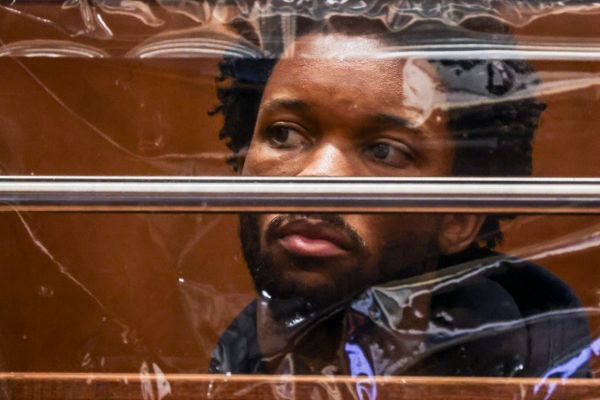
To all appearances, Saturday's fatal collision between a freight train and a public bus was human error. The driver of the freight train lacked a rail transport licence, and a urine test showed narcotic traces in his system. The driver of the bus was charged with violating the traffic law by stopping on the railway crossing.
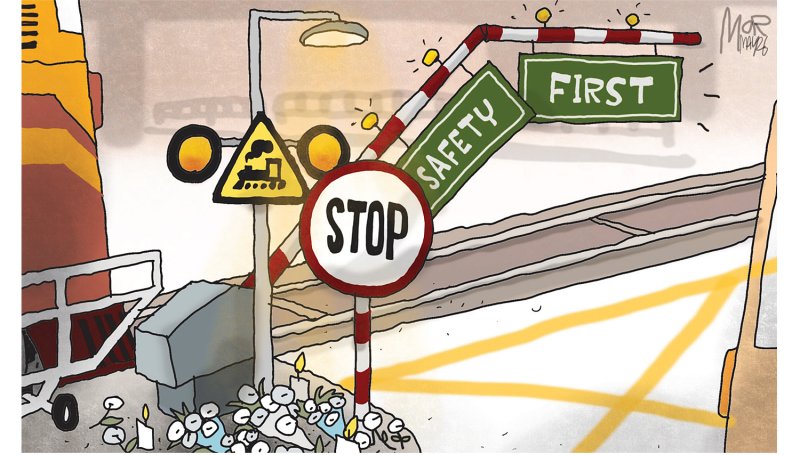
But society must not focus only on finding culprits, and the public must not be content only when culprits are put in jail. This newspaper has long held the opinion that accidents at railway crossings -- including the recent one on Saturday at the Asok-Phetchaburi crossing -- are the outcome of wilful ignorance by governments and responsible agencies that were fully aware of the risks but did nothing to improve safety at level crossings.
In fact, there are accidents at railway crossings somewhere in the country every week. Unlike Saturday's fatal collision, they happen at rural crossings and do not get media coverage. The worst tragedy at a level crossing took place in Chachoengsao province in October 2020, when a freight train hit a chartered tour bus carrying workers to a merit-making ceremony. The crash killed 18 people on the bus. Around 600 of Thailand's 2,639 railway crossings are illegal -- without traffic lights or guard rails.
State Railway of Thailand (SRT) statistics show more than 87 accidents at railway crossings every year on average -- at least seven per month, across 2,639 crossings nationwide. The problem has not subsided. Last year, there were 121 accidents involving trains and vehicles at railway crossings; the collisions claimed 68 lives and injured 186 people.
The tragic accident only illustrates the grim picture of where Thailand stands in terms of overall rail infrastructure. A 2019 review by the World Economic Forum ranked Thailand 75th of 144 countries for railroad infrastructure. Respondents rated the railways in their country on a scale from 1 (underdeveloped) to 7 (extensive and efficient by international standards). Thailand, which started developing its railway system about 130 years ago, scored 2.8 points. Japan topped the list with 6.8, followed by Hong Kong (6.5), Switzerland (6.4), South Korea (5.9) and Singapore (5.8).
After every accident, the government pledges to thot botrian -- to learn the lesson. Successive governments and transport ministers have pledged to improve safety by installing electronic signs. Prime Minister Anutin Charnvirakul has floated the idea of building underpasses at high-risk crossings.
Such pledges will be just hot air. The idea of developing tunnels and underpasses at crossings has been around for several years. In reality, the SRT is bloated with debts. The agency has not been given enough budget to improve existing rail infrastructure.
Of course, Thailand has been keen to improve its rail network. Yet the priority has been investment in high-speed trains and pouring billions of baht into building the Bang Sue Grand Central.
The Anutin government must do better than promising the moon. First, the Ministry of Transport must come up with policies and budget commitments that enable the SRT to improve infrastructure and human resource development. Needless to say, the SRT governor owes the public an explanation and accountability for letting a driver without a licence -- and a record of drug use -- handle a cargo train.
Without accountability and real commitment, railway crossings will continue to be death traps.