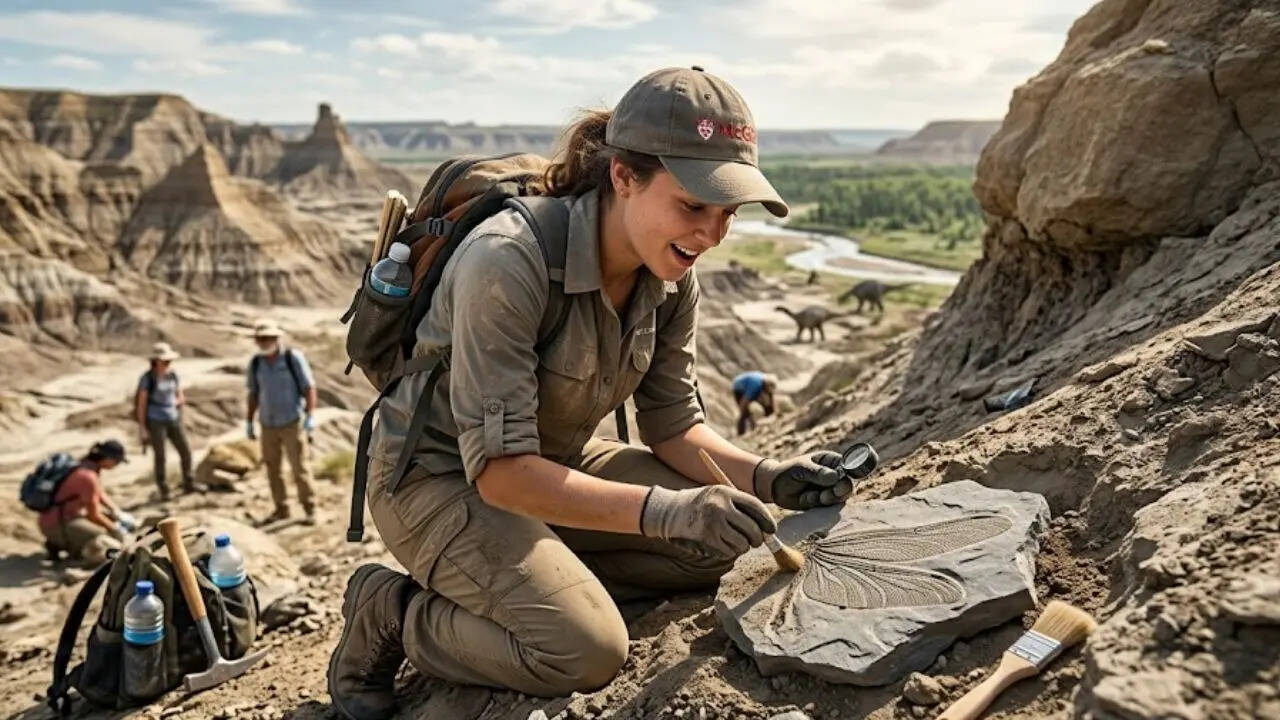
A student, exploring the barren ridges of Alberta's Dinosaur Provincial Park in search of ancient plant life, stumbled upon an extraordinary find that has changed how we view Cretaceous ecosystems. This discovery was a 75-million-year-old dragonfly wing, perfectly preserved, marking the first time an Odonata fossil from the dinosaur era has been found in Canada. Named Cordualadensa acorni, this specimen has led scientists to establish a new family called Cordualadensidae.
Moreover, according to McGill University, it fills a 30-million-year gap in the fossil record and offers crucial evidence of ancient biodiversity. It suggests that while dinosaurs roamed the earth, intricate aerial predators had already developed advanced gliding and migratory adaptations across prehistoric landscapes.
75-million-year-old dragonfly fossil is the first of its kind ever found in Canada
In Alberta's Dinosaur Park Formation, a UNESCO World Heritage site famous for its many dinosaur bones, a fossil was found. This specimen includes a nearly complete hindwing that is about 25 milimetres long. Researchers used high-resolution imaging to examine the wing's venation and determined that it belonged to the suborder Anisoptera. The finding is significant because insect fossils are rarely found in this area, where vertebrate remains are usually more common.
How Cordualadensa acorni rewrites dragonfly history
Before this discovery was made, a large gap existed in the fossil history of these dragonflies, often referred to as a ‘ghost lineage.’ As noted in a study published on ResearchGate, Cordualadensa acorni acts as a missing link, offering physical evidence that links older Jurassic species with today's dragonfly families. When examining the structure of the wing's nodus and the pigmented pterostigma, it becomes clear that this family had already aerodynamic adaptations similar to those seen in modern dragonflies.
How a fragile wing survived a high-energy river
The team of researchers, led by experts from McGill University, found that Cordualadensa's wing structure shows it can glide well. This discovery means the insect probably lived in open areas and might have travelled long distances or migrated. Its behaviour could be similar to extant dragonfly lineages, like the Globe Skimmer. Finding such delicate wing parts preserved in a high-energy river deposit is considered an amazing event in fossil preservation.
The geology behind the discovery
The discovery of this dragonfly hints at subtropical floodplains with lots of still water and various plant life during the Campanian stage of the Late Cretaceous. This specific fossil was found in a layer of siltstone, meaning it was likely covered quickly by fine sediment. This quick burial helped preserve the fragile wing from decomposition or being eaten by scavengers. Such findings allow researchers to piece together the food webs that existed alongside well-known dinosaurs like Hadrosaurus and Centrosaurus.