
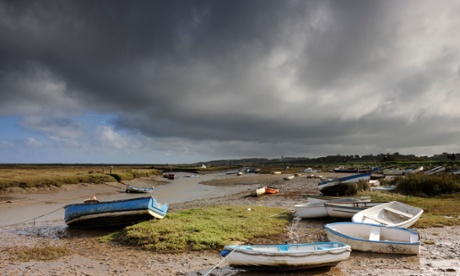
Over three days at a mile an hour I walked the coast from Hunstanton to Cley for the first time. My aim was to see it all as a single unit, a huge 19,000-acre site of special scientific interest, which is only one of the designations securing it among Europe’s most natural shorelines.
An unforeseen part of the walk was the upwelling sense of gratitude to the organisations that have bought it piecemeal over the past 90 years: the Norfolk Ornithologists’ Association (Redwell Marsh), Norfolk Wildlife Trust (Cley Marshes and Holme) and RSPB (Titchwell Marsh), but especially the National Trust. It holds the lion’s share including the more famous portions – Scolt Head and Blakeney Point – but also the Brancaster, Stiffkey and Morston saltmarshes.
These last holdings are probably the coastline’s least popular parts, yet they create the matrix in which the whole thing sits; they bind it all together and give it both wildness and authenticity. Created over decades in silt layer by the high tide, saltmarsh is as niggardly a landscape as its name connotes. There’s no primary colour, contour, built structure – except the odd wrecked ship with its rotting vestige of human story – and no trees. The tallest plants are the salt-loving bushes called shrubby seablite. Along with the other dominant species such as sea purslane, the seablite is so quietly green it’s only just this side of that chromatic boundary that marks out the living from the dead.
The deepest relief on the saltmarsh lies not above the horizon but cut by tidal creek into its level surface. When the winter sky is free of cloud the rippling muds in these channels carry the faintest bluish cast, and the rush of light suddenly reveals the crisscrossing trails pricked by the feet of feeding waders. The creek walls trap the sounds of the birds, narrowing and distorting their natural range so that they seem piped up by megaphone out the mud. However, when the curlews’ music uncurls from birds free-flying overhead, those liquid notes resound and swell and spread across the immense flats in all their sweet loneliness.
Twitter: @MarkCocker2



