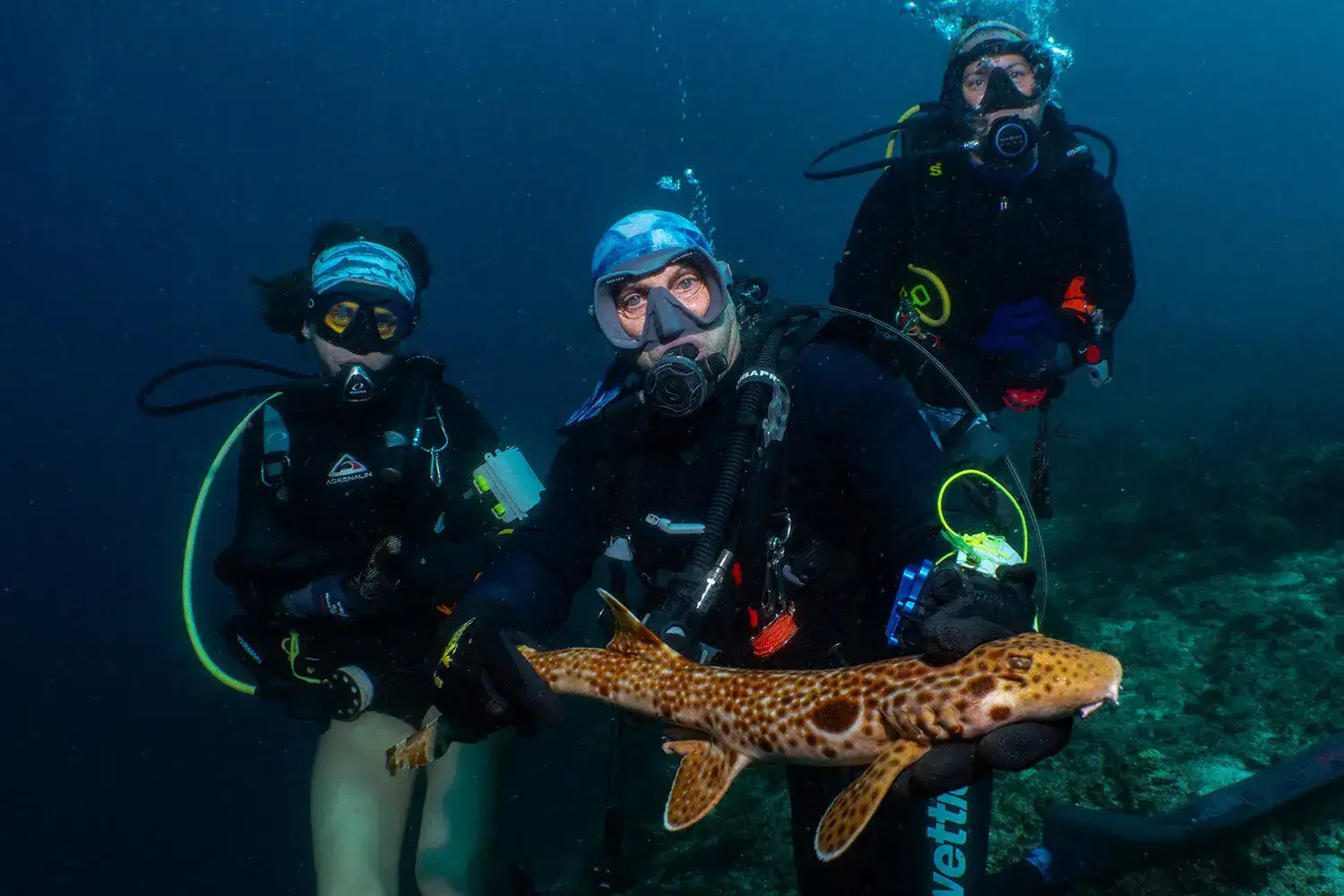
For years, people living near southeastern Papua New Guinea have known about a strange shark that moves across reef flats when the tide goes out. Instead of simply swimming, the creature uses its fins to “walk” along the seafloor. Scientists have now confirmed that this unusual animal is a completely new species. The discovery has excited researchers, but it also comes with concerns that the shark could already be at risk because of environmental threats, according to a report by Smithsonian Magazine.
The waters around Papua New Guinea have revealed another surprise from the natural world. A shark known locally as kadedekedewa, meaning “lazy shark” or “dog shark,” has now been officially identified as a new species after scientists studied its unusual movements and genetics.
The creature, named Hemiscyllium dudgeonae, or Dudgeon’s walking shark, belongs to a rare group of sharks known for their ability to use strong pectoral fins like legs. These sharks can move across shallow reef areas, especially when water levels drop during low tide.
Researchers described the new species in a paper published on June 15 in the Journal of the Ocean Science Foundation. It is the first new species in the Hemiscyllium genus since 2013, according to a report by Smithsonian Magazine.
The shark was named after Christine Dudgeon, an ecologist at the University of the Sunshine Coast in Australia. She first encountered the animal in March 2025 while exploring the shallow waters of Milne Bay in Papua New Guinea.
Dudgeon had been searching for another known walking shark species, the leopard epaulette shark, also called Michael’s epaulette shark, when she spotted a two-and-a-half-foot-long shark moving along the seafloor.
When Dudgeon directed her flashlight toward the animal, it stopped. She was able to carefully approach it, collect the shark, and pass it to lead author Jess Blakeway, who was waiting nearby.
Blakeway immediately noticed that the shark was different.
“This new one has got lots of spots and dashes that reminded me of braille or morse code,” Blakeway tells New Scientist’s James Woodford.
The research team spent several days searching for more examples and found 12 individuals. They collected biological samples from nine sharks before releasing them, while keeping three for additional study. DNA testing later confirmed that the sharks were genetically distinct enough to be recognized as a new species, according to a report by Smithsonian Magazine.
How was the walking shark discovered?
Scientists are still learning about Hemiscyllium dudgeonae, but they believe the species may only live in a limited region. The sharks were found between the Amphlett Islands and the Trobriand Islands, north of Milne Bay.
Researchers think the species may also exist throughout the D’Entrecasteaux and Trobriand islands, and possibly as far away as Muyua Island. The sharks appear to prefer shallow habitats, moving through seagrass areas and coral environments.
The discovery highlights that even shallow waters, which are often thought to be well understood, can still contain unknown species.
“A lot of the time, we talk about the deep sea as unknown—we don’t really think of the shallow water as being unknown,” Blakeway tells 10 News Perth’s Cyndi Lavrencic. “So, finding a new species of shark that is pretty shallow water-orientated is just so exciting.”
Why could this shark be at risk?
Although scientists have only recently identified this shark, they believe it may already face serious threats.
Walking sharks in Papua New Guinea are affected by climate change, coral bleaching, habitat loss, and damage caused by coastal development. The expansion of palm-oil plantations also threatens their environment.
Before this discovery, nine walking shark species were recognized. Two of those species are considered “vulnerable” by the International Union for Conservation of Nature (IUCN), including the leopard epaulette shark that researchers were originally looking for, according to a report by Smithsonian Magazine.
Scientists hope to return to the region to continue studying Hemiscyllium dudgeonae. More research could help determine whether the species should receive a “vulnerable” or “endangered” conservation status.
What makes this species unique?
Walking sharks are unusual because they have adapted to life in shallow coastal environments. Instead of relying only on swimming, they use their fins to push themselves across reef flats and the seafloor.
The newly discovered species adds another example of the biodiversity found in Papua New Guinea. However, researchers warn that discovering a species is only the beginning.
“This species adds to Papua New Guinea’s extraordinary biodiversity, yet it faces local extinction without urgent conservation action,” Blakeway tells New Scientist.
The finding shows that remarkable animals can still be hidden in familiar environments, but it also raises concerns about how quickly these species could disappear if their habitats continue to change.
FAQs
Q: What is special about this shark?
A: It can walk using its fins.
Q: Where was it discovered?
A: Papua New Guinea.