Maggie Bannan, a 24-year-old from Chicago, has always known she is a perfectionist. As a child, teachers noted that she struggled to move on from tasks because she was so focused on getting everything exactly right. The trait served her well academically: at Santa Clara University, she completed a double major and graduated a year early. But in adulthood, the perfectionism that once fuelled her success has become a source of anxiety, self-doubt and burnout.
“I obsess, I try so hard at something, I exhaust myself and get myself into a place of burnout,” Bannan, who now works full-time in marketing while pursuing acting on the side, tells me. Without the benchmarks she had in education, she feels lost. “When I graduated, I was just looking around, being like, ‘How do I judge myself as good enough anymore without grades?’ Now in my job, I find it hard to be confident about the work I’m doing because I have such a high standard for myself… It’s exhausting.”
Bannan isn’t alone. According to a new study published by the American Psychological Association, perfectionism — recognized as a strong preoccupation with self-evaluation and an excessive pursuit of high standards — is at an all-time high among college students in the U.S., Canada and the U.K. over the last 35 years, meaning they feel more pressure to be perfect than their parents’ generation.
Researchers analyzed data from more than 82,000 college students in the US, Canada and the UK between 1989 and 2024. They found that “perfectionistic striving” — setting extremely high standards for oneself — has risen steadily over time, roughly 5 percent on average since the late 80s. But “perfectionistic concerns”, such as fear of failure, indecisiveness and worries about being negatively judged by others, have increased even more sharply.
Can you blame young people for feeling this way? Thomas Curran, the study’s lead author and professor of psychology at the London School of Economics, thinks that the odds are against young people.

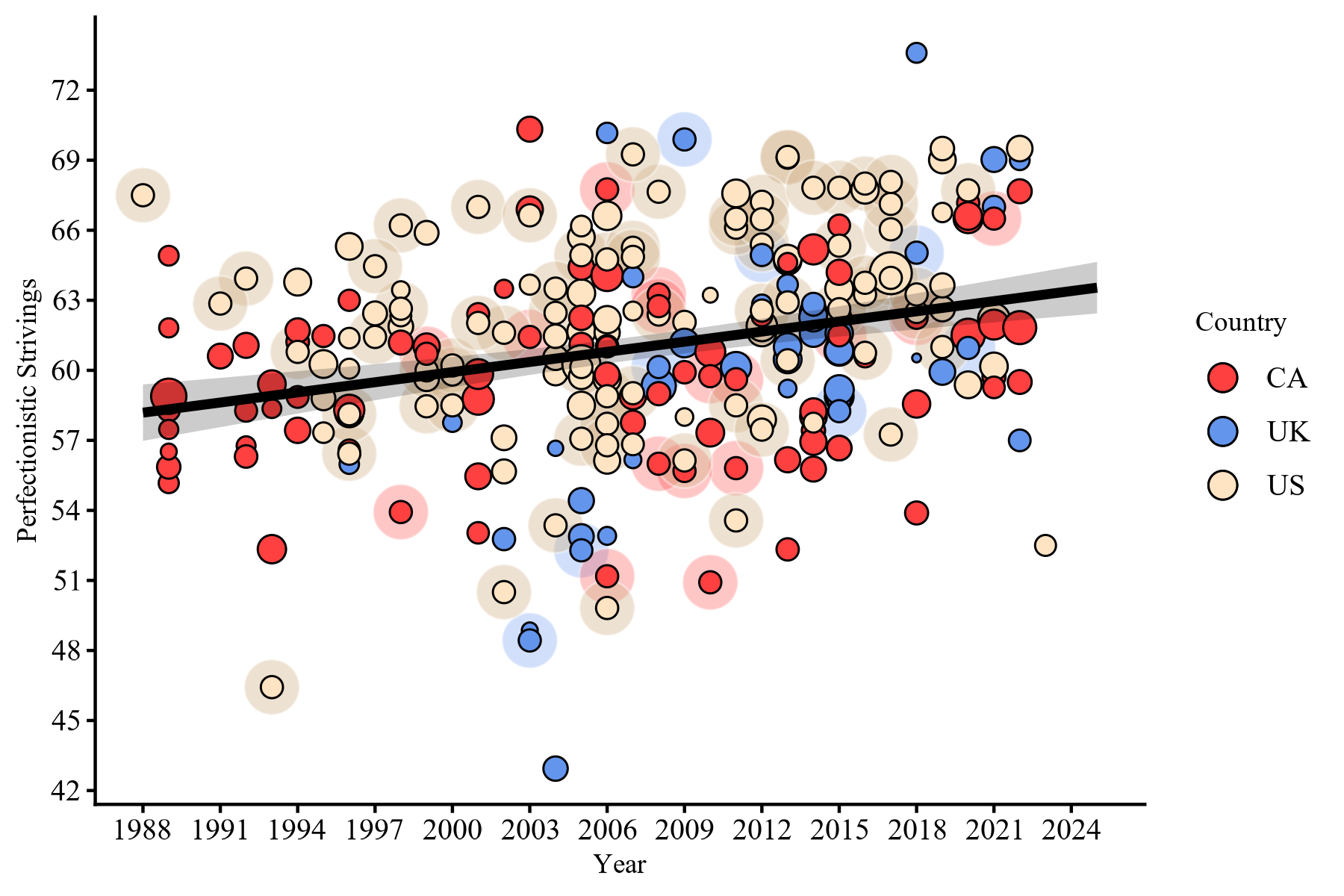
“The cruelty is, young people who are increasingly meeting an economy that is withdrawing opportunity year on year,” he says. “In both the U.S. and U.K., for young people, there is a gap between expectations and reality.” The study’s most striking revelation is the clear link between macroeconomic decline and perfectionism. They found that slowing GDP per capita was associated with higher rates of perfectionistic striving, while rising economic inequality was associated with steeper increases in perfectionistic concerns. Curran says the scarce jobs market that young people are graduating into isn’t helping, either.
In psychology, this is called the fear gap, AKA the mental space between where you currently are and where you want to be in your life. “All of it comes down to this idea that ‘I have to be more,’” says Curran. “The idea that if you’re not using this time to be more productive, then you’re leaving cash and opportunities on the table. Perfectionism is a problematic relationship with yourself. You besiege yourself with criticism. You surveil yourself every minute of the waking day to make sure that you're in line with your own impossible expectation.”

Curran has noticed that people with perfectionist tendencies often find themselves at a standstill in their lives due to indecision. “[Perfectionism] pushes us at 110 miles an hour, but in order to get somewhere, you have to pick a lane, you have to foreclose all those other opportunities and be at peace with that,” he says.
Perfectionism levels have risen at a time when the noise surrounding self-optimization and hustle culture has only gotten louder. Young content creators are championing the “5-to-9” side hustle — waking before dawn to pursue passion projects, freelance work or business ventures before the traditional 9-to-5 — as a route to financial success and faster career progression. Meanwhile, another sphere of influencers promotes a type of aesthetic perfectionism. Controversial internet personality Clavicular is just one influencer who promotes looksmaxxing, the idea that a rigorous glow-up — often achieved through invasive cosmetic procedures — can define a person’s success.
Jolie Chen, a 24-year-old NYU graduate and self-described perfectionist, says she cannot switch off because the jobs market is so competitive. “My friends know me as someone who doesn’t know how to chill,” she says. “I’m always trying to work, trying to prove myself… I’ve become a robot.” At work, Chen says she is in constant fear of failure or messing up. “I'm scared to make mistakes… I’m always like, oh my God, are they gonna replace me?”
.jpg?trim=974%2C0%2C1042%2C0)
Chen believes the origins of her perfectionism lie in her adolescence. At just 15, she left Guangzhou, China, to study at a high school in Maine, where the pressure to succeed in a new country quickly became intertwined with her sense of self-worth. “I’m a first-generation immigrant here and I feel as though those limitations have pushed my need to be better than everybody else,” she says. “I’m trying to prove [to myself] that you go above the system by being the best… no matter what background you come from.” She is currently working in music publicity in the U.K. on a visa program granted by her college.
The pressure to be perfect has seeped into every aspect of her life, even her personal relationships. “It’s affecting how I socialize with people,” she says. “In my relationships, I force myself to be the perfect girlfriend, friend and daughter who makes my parents proud,” she says. Chen often overanalyzes her social interactions and finds that her inner monologue is constantly telling her to be better, to be the brightest in the room.
“When you move through the world feeling out of place as a foreigner or immigrant, you start believing that if you're smart enough, prepared enough, hard-working enough or talented enough, maybe you'll be allowed to stay — or maybe you will belong,” says Chen. “I think my perfectionism isn't really about wanting things to be perfect but chasing a sense of security.”
Bannan, meanwhile, says being a perfectionist makes her determined — sometimes to her detriment. She points to the time she climbed Kilimanjaro, Africa’s highest peak, and set strict rules for herself that ultimately made the journey more arduous. She vowed not to take altitude medication or have anyone help her with her bags. “The guides told me that I don’t like accepting help — but I just wanted to have a perfect climb so I could feel happy with myself at the end of it,” she says. “If I had cut corners, I wouldn’t have been satisfied.”
Self-optimization has a lot to answer for, says Curran. “In modern culture, we wear these self-imposed pressures as a signature of our worth, even though we know it’s bad for us,” he says. Through his research, Curran has argued that perfectionism is a real public health concern. “Anxiety, depression, people pleasing and overthinking — these are all symptoms of a broader malaise that comes from the normalization of excess,” he says.
“And perfectionism is also very strongly linked with social disconnection, loneliness, and those things are also very bad for our mental health,” says Curran. “It should be taken seriously.”
Bannan says she wishes she could let go more often. “I was always so concerned about getting ahead, but I’m also so concerned about doing all the things socially and extracurricularly that I don’t stop and think, ‘Do I want to do this?’”