ORLANDO, Fla. _ A mass shooting used to seem like an improbable threat for local first responders. Sure, cops and firefighters trained for it just in case, but rescuing plastic dummies in pretend scenarios didn't feel real.
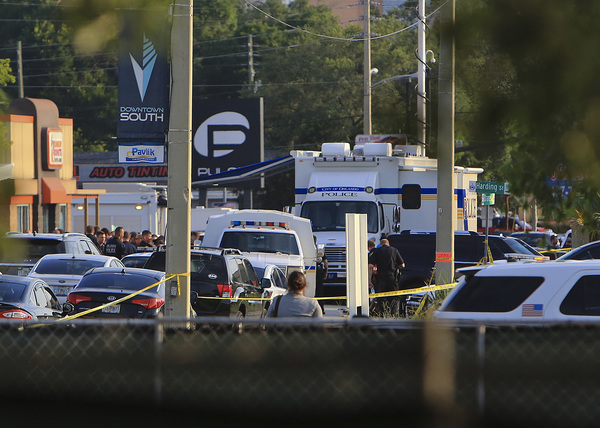
That changed on June 12, 2016.
"The human condition is, 'That's going to happen to somebody else. The active shooter, that's something that happens in the Middle East, in Europe,'" said Orange County Fire Rescue Chief Otto Drozd III. "Not anymore. It's happened in the United States, and it's happened here in Orlando."
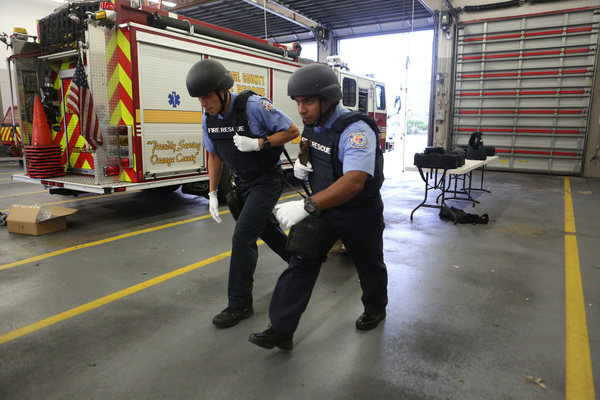
As fire departments continually respond to violent situations alongside police, Drozd said first responders are fine-tuning mass casualty training and using protective gear to adapt to what he calls "a new reality."
Adapting to new threats
"Eli, issue out the vests!" Orlando Fire Department Lt. Davis Odell, Jr., remembers hollering to firefighter Elias DeJesus after learning of a shooting at a Subway restaurant down the block on April 27. It was the first time since the station got its own ballistics gear that firefighters got to use it.
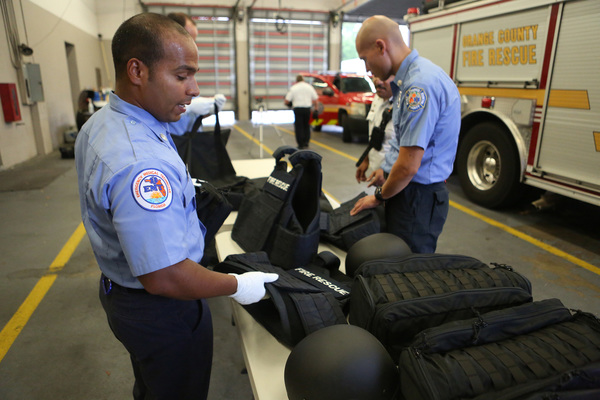
After Pulse, both OFD and the county's Fire Rescue bought ballistic vests, combat helmets and medical kits for each of their units. It cost the city $88,000 to buy 150 vests, and the county spent $325,000 for 334 vests and helmets; another 16 were paid for with a $16,250 grant from the Office of the Orange County Medical Director.
Before, the departments had reserve amounts of vests and helmets for emergency purposes _ but they weren't at every station.
"The theory within the fire service had been (to) have a cache of these in case you have an active shooter event," Drozd said. "But the reality is that these things happen every day."
Now, they're using the gear for routine threats of violence, like the Subway shooting call.
"Even though the suspects hadn't been caught, knowing that we had the vests on gave us a little sense of protection," Odell said. "Our offensive weapons are a hose line when we go into a fire and our medical equipment when we're addressing medical situations. But when it comes to police matters, we now have body armor."
Though the concept of wearing ballistics gear is still new, Orange County Fire Rescue's Capt. Troy Broadaway said they are adapting.
"I definitely never thought in my lifetime or career that this would happen," Broadaway said. "But we're up for the challenge."
Odell said it's just part of the "different paradigm" of modern fire services that they've since learned from Pulse.
"Ultimately, nothing can be taken as it once was _ it all has to be looked at through this new prism of the world today," Odell said. "Is it inherently safe? No, but firefighting isn't inherently safe."
A new understanding
First responder mass casualty training hasn't necessarily changed, but it's become more relevant since Pulse, Drozd said.
"There's a new understanding that while we're going through these trainings, we could actually be called upon to use it," Drozd said.
For years, the Orlando Fire Department and Orange County Fire and Rescue have been training with law enforcement on Swift Assisted Victim Extraction, which teams firefighters with armed officers who protect them in active-shooter situations so they can treat patients closer to the action.
Orlando Police Chief John Mina and Orange County Sheriff Jerry Demings highlighted this "critical" training when they testified before Congress last year in an attempt to get Orlando counterterrorism funding.
"This course is designed to teach law enforcement officers and the fire department the tactics necessary to enter a 'semi-secure' area, which will reduce time to render aid to victims and save their lives," Mina said.
Last week, Orlando was denied the funding it asked for through the government's Urban Area Security Initiative. The police department has been paying for the training for the past two years without the money.
Fire officials say there are no plans to discontinue the joint training, which Odell said are "certainly more real" having had the firsthand experience of Pulse.
"There's an added depth to it. There's more texture to it," Odell said. "We had an introduction to it, now we are in the meat and potatoes of the actual thing with the relevant experience behind us."
Odell, who was in charge of the fire station two doors up from Pulse the morning of the attack, said the department has done more preparation this year.
"Ultimately it's all about the training because when the time comes, you all have to refer back and kick into muscle memory," Odell said.
Mina said that's why repetition and continued support for the training is important.
"Without continued training, these perishable skills would surely deteriorate," Mina told Congress.
Moving forward
Equipped with their experiences, Drozd and OFD Chief Roderick Williams have presented lessons learned from Pulse to departments across the country. Mina and Demings have been doing the same among the law enforcement community.
"I think it's not only the right thing to do, it's our responsibility to do it," Drozd said.
Drozd and representatives from OFD have also been working with industry leaders to develop the National Fire Protection Association's first uniform guidelines for active-shooter responses.
After Pulse, Drozd said they looked at recommendations from FEMA and other fire, police and medical organizations and decided one comprehensive set of standards was needed.
"There's this huge body of knowledge out there, but there's not one document that people can look at and say, 'this is the best practice,'" Drozd said.
The NFPA recently agreed to develop uniform standards, Drozd said. A committee to draft the document has its first meeting this month.
"What we're advocating for is if that call comes in and it's a violent event _ just like we equip them to go into fires _ we're going to protect them and give them the right gear," Drozd said.