A month in space: quantum teleportation, a shuttle's final flight and mysterious Martian spheres – in pictures
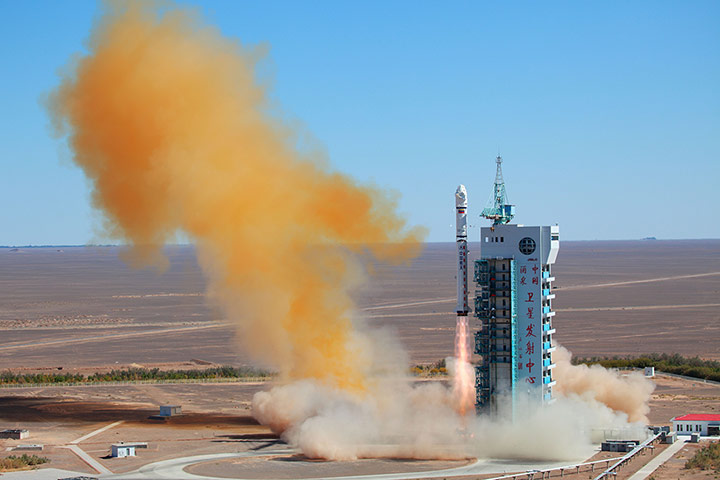
A Chinese rocket lifts off in the Gobi desert on 29 September carrying the Venezuelan Earth observation satellite Miranda. The $140m satellite is named after the Venezuelan independence hero Francisco de Miranda and will provide images for mapping agriculture, spotting illegal drug crops and monitoring floodsPhotograph: AFP/AFP/Getty ImagesOn 19 September, the space shuttle Endeavour flew over Houston, piggybacking on Nasa's Shuttle Carrier Aircraft. The shuttle was en route to Ellington Field near the Johnson Space Center, where it made a scheduled stopover. This was the first leg of Endeavour's journey, which concluded in a crawl through Los Angeles ending on Sunday 14 October at the California Science Centre Photograph: NASAAstronomers used the Chandra X-Ray Observatory to find evidence that the Milky Way is embedded in an enormous blob of hot gas. This artist's illustration shows the halo around our galaxy and two small neighbouring galaxies. The halo's mass is estimated to be equivalent to the mass of all the stars in the Milky Way. If its size and mass are confirmed, the halo could be the solution to the 'missing-baryon' problem Illustration: Chandra X-ray Observatory
On 7 September, Nasa astronaut Joe Acaba (left) and Russian cosmonauts Gennady Padalka and Sergei Revin (centre and right) conducted a 'suit leak check' in the Soyuz spacecraft in preparation for their return to Earth on 16 SeptemberPhotograph: ISS/NASAJapanese astronaut Aki Hoshide takes a picture of himself during a spacewalk outside the International Space Station. Hoshide and Nasa astronaut Sunita Williams (visible in the reflections of Hoshide's visor, apparently) completed the installation of a Main Bus Switching Unit and installed a camera on the space station's robotic arm. On Monday 17 September, Williams became the second woman to take command of the orbiting outpostPhotograph: ISS/NASAThe Curiosity rover also took a picture of itself – using a camera on its arm – but left the dust cover on. The purpose of the picture was to check that the cover on the Mars Hand Lens Imager (MAHLI) was free of debris, but the picture also captures a cloudy image of the top of the Remote Sensing Mast, showing the Mastcam and Chemcam cameras Photograph: Malin Space Science Systems/JPL-Caltech/NASAAfter a few short drives, Curiosity's progress can be seen from orbit on 2 September. Monitoring the tracks over time will provide clues about how the surface is changing as dust is deposited and erodedPhotograph: University of Arizona/JPL/NASAThe rover found evidence of an ancient, flowing stream on Mars, including the rock outcrop pictured here, which the science team named 'Hottah' after Hottah Lake in Canada's Northwest Territories Photograph: MSSS/JPL-Caltech/NASAMeanwhile Nasa's veteran rover Opportunity sent back a picture of mysterious spherical objects at an outcrop called Kirkwood in the Cape York segment of the western rim of Endeavour Crater. Each spherule is about 3 millimetres in diameterPhotograph: Modesto Junior College/USGS/Cornell Univ./JPL-Caltech/NASAPhysicists passed a milestone in the development of a 'quantum internet' by transmitting quantum states between telescopes on La Palma and Tenerife – a record distance of 143km. The visible laser beam was used to stabilise the telescopes sending and receiving the quantum signal. In theory, 'quantum teleportation' will enable the exchange of messages with greater security, and allow calculations to be performed much more efficiently than is currently possiblePhotograph: IQOQI Vienna/Austrian Academy of SciencesThe cloud of gas that forms the head of the Seagull Nebula. The cloud glows brightly due to radiation blasting from a very hot young star at its heart. The entire nebula, which resembles a seagull in flight, has a wingspan of over 100 light years. See the whole bird herePhotograph: ESOMirror segments for the James Webb Space Telescope were packed up in special canisters for shipping to Nasa from Ball Aerospace & Technologies Corp of Boulder, Colorado, where they were made Photograph: Ball Aerospace/NASAThrough the looking glass: Technicians check one of the mirrors in the clean room at Nasa's Goddard Space Flight Center in Greenbelt, Maryland. Each of the infrared telescope's 18 hexagonal primary mirrors – which will form a single mirror in space – measures more than 1.3 metres across and weighs approximately 40kg. The segments are made of beryllium coated with gold. The telescope will be capable of peering through clouds of dust to the first galaxies to form after the big bang, and is scheduled for launch in 2018Photograph: Chris Gunn/NASAAstronomers spotted what could be the most distant galaxy ever seen, looking further back in time than ever before into the 'cosmic dark ages' when the universe was just 3.6% of its current age. Light from the primordial galaxy took around 13.2bn years to reach Nasa's Spitzer and Hubble telescopes. To see the galaxy astronomers relied on 'gravitational lensing', a phenomenon predicted by Einstein whereby the gravity of objects in the foreground warps and magnifies light from more distant objects Photograph: Hubble Space Telescope /NASA/ESAThe Whirlpool Galaxy. Faint trails of light show its small companion galaxy being gradually torn apart by the gravity of its giant neighbour. This image was the overall winner and winner of the deep space category of The Royal Observatory's 2012 Astronomy Photographer of the Year competitionPhotograph: Martin Pugh (Aust/The Royal Observatory's 2012 Astronomy Photographer of the YearThe Pencil Nebula, part of the remnants of a supernova explosion about 11,000 years ago. The image was captured by the MPG/ESO 2.2-metre telescope at the European Southern Observatory's La Silla Observatory in ChilePhotograph: ESOAstronomers combined 10 years of images from the Hubble Space Telescope to create the deepest ever view of the universe, the eXtreme Deep Field, which includes 5,500 galaxies. The image delves into a small patch of space in the constellation Fornax (The Furnace)Photograph: Hubble Space Telescope /NASA/ESAThe Dark Energy Camera – the world's most powerful digital camera, based on a mountaintop in Chile – opened its eye for the first time on 12 September. This is a composite image of the Small Magellanic Cloud, a dwarf galaxy that is a satellite of our own Milky Way galaxy. The 57-megapixel camera is part of efforts to explain the 'dark energy' that is driving the accelerating expansion of the universe Photograph: Dark Energy Survey Collaboration/NOAOThis image was taken by Voyager 1 on 14 February 1990 when the spacecraft was 6.4bn kilometres from Earth. At that distance our home planet has been reduced to a pale dot. On 5 September 2012, exactly 35 years after its launch, the craft is now 18.21bn kilometres from homePhotograph: NASAIn 1604, Johannes Kepler witnessed what appeared to be the birth of a new star that was much brighter than Jupiter but which then dimmed over several weeks. What Kepler was actually seeing was the thermonuclear explosion of a white dwarf star. The debris is still visible and is known as the Kepler supernova remnant. Observations by Nasa's Chandra X-ray Observatory now suggest the explosion was even more powerful and further away than astronomers thoughtPhotograph: Chandra X-ray Observatory Center/NASA
Sign up to read this article
Read news from 100’s of titles, curated specifically for you.