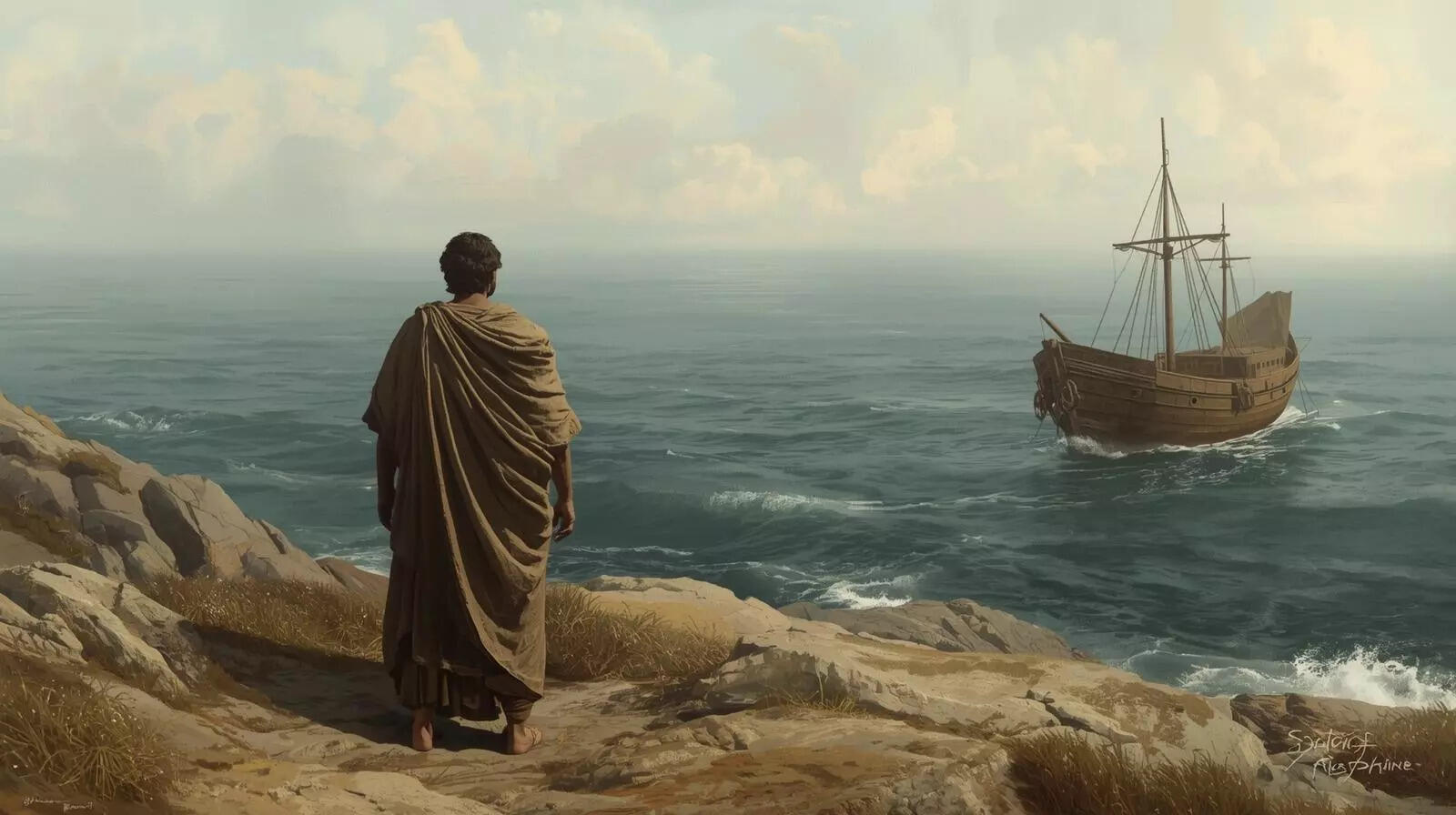
History tends to cluster its explorers in the same few centuries, frequently ignoring older figures whose expeditions left fewer evidence. Long before Marco Polo travelled east or Columbus crossed the Atlantic, a Greek adventurer from the Mediterranean is believed to have sailed into portions of Europe that were well outside the known globe at the time. Pytheas of Massalia lived in the fourth century BC, a time when Greek understanding of the Atlantic was limited and unclear. What remains of his work suggests a journey north over foreign seas, possibly hitting Britain and even distant regions such as the Arctic. His stories were broken down later repeated and debated, but they continue to influence how historians see early exploration in northern Europe.
The ancient Greek who may have sailed to Britain when maps barely existed
Pytheas came from Massalia, the Greek colony that later became Marseille. At the time, it was a busy port linking Greek traders with Celtic communities in Gaul. Little is known about his early life, but the city itself dealt daily with sailors, merchants and stories from beyond the Mediterranean. That setting likely made long-distance travel feel possible, if still risky.
The voyage north followed routes few Greeks had recorded
Around 325 BC, Pytheas is believed to have set sail westward through the Pillars of Hercules, entering the Atlantic Ocean. From there, he appears to have followed the coastline of western Europe before crossing the Channel. Later writers suggest he travelled widely around Britain, possibly even circumnavigating the island, though the details remain unclear.
Britain appeared in Greek writing for the first time
Pytheas did not discover Britain in a literal sense, but he may have been the first Greek to describe it directly. He referred to the islands as 'Prettanike' or 'Bretannike' and recorded observations about local communities, farming practices and fishing. He also noted the tin trade in Cornwall, a detail that mattered to Mediterranean economies.
Did Pytheas describe Greenland as Thule
Beyond Britain, Pytheas described a place called Thule, six days’ sail to the north, where summer nights barely grew dark. Scholars have long debated its location. Iceland, Norway and the northern islands of Scotland have all been suggested. No firm conclusion exists, but the description matches high-latitude conditions better than anything the Greeks had previously recorded.
Later writers preserved fragments of a wider contribution
Pytheas’s original texts are lost. His journey survives through references by Strabo, Pliny the Elder and others, some of whom doubted him. Modern historians tend to be more cautious. Pytheas measured latitude using the sun, linked tides to the moon, and noted unfamiliar climates and peoples. His work sits awkwardly between myth and measurement, still unsettled and still quietly influential.