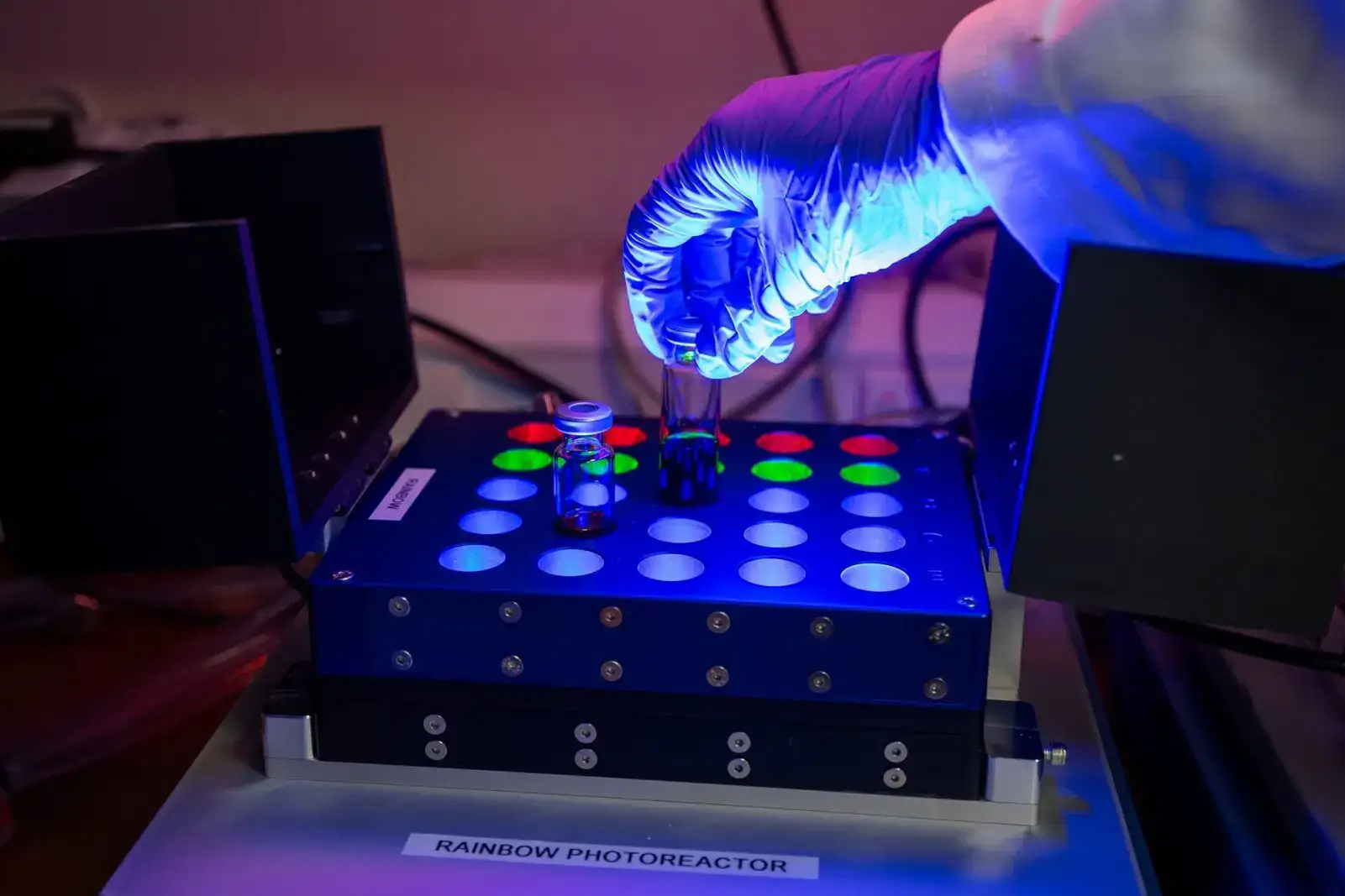
Something quietly extraordinary happened in a chemistry lab in Münster, Germany. Researchers didn't just find a new way to make a molecule. They cracked open a door that biochemists and pharmaceutical scientists have been pushing against for decades. Using nothing more powerful than blue light and a clever photocatalyst, they built one of chemistry's most stubborn structures — the housane molecule — from simple, widely available starting materials. The implications for drug development, materials science, and synthetic chemistry are hard to overstate.
Understanding why this matters requires a brief detour into what makes these tiny housane molecules so difficult — and so valuable — to produce. A housane is a bicyclic hydrocarbon structure named for its resemblance to a child's drawing of a house. It's compact, angular, and packed with internal tension. That tension is not a flaw. It is the feature. High-strain molecules store chemical energy the way a coiled spring stores mechanical energy, and they release it during reactions in ways that flat, relaxed molecules simply cannot.
Why housane molecules have been so difficult to synthesize — until now
The problem with housane molecules has never been their usefulness. Everyone in synthetic chemistry knew what they could do. The problem was making them without destroying them or the surrounding molecular architecture in the process. Earlier synthesis methods demanded high temperatures, aggressive reagents, and conditions that stripped away the delicate functional groups attached to the starting materials.
The research team led by Professor Frank Glorius at the University of Münster's Institute of Organic Chemistry took a completely different approach. Rather than throwing heat and chemical force at the problem, they used light. Specifically, they worked with 1,4-dienes — straightforward hydrocarbon starting materials — and introduced a photocatalyst that absorbs blue light and transfers that energy directly into the molecule. This energy lifts the reaction over the thermodynamic barrier that normally makes housane formation so difficult.
How light-powered photocatalysis solves the strained ring problem
There is something counterintuitive about using something as gentle as light to build something as tense as a strained ring structure. But photocatalysis works precisely because it delivers energy in a controlled, targeted way. A photocatalyst absorbs photons — in this case, from blue light — and enters an excited state.
The Münster team's key insight was not just using a photocatalyst, but tuning the molecular side chains of their starting 1,4-dienes to suppress the competing reactions that normally derail this chemistry. Under light exposure, these dienes have a tendency to undergo unwanted side reactions before the desired cyclization can occur. By modifying the side chains, the researchers effectively blocked those competing pathways.
What this discovery means for drug development and pharmaceutical research
Drug development is fundamentally a problem of molecular architecture. The right shape, the right tension, the right functional groups in the right positions — these are what determine whether a compound binds to its target, survives the journey through the body, and does what it's supposed to do without causing harm. Small strained ring molecules have been central to some of the most important drugs ever developed.
Housane molecules offer a different but related kind of structural leverage. Because they are so energy-rich, they can serve as starting points or intermediates for building larger, more complex pharmaceutical compounds. Having a reliable, mild, functional-group-tolerant synthesis route for housanes means medicinal chemists can now incorporate these structures into drug candidates that would have been impractical to build before.
The implications of this photocatalytic housane synthesis extend well beyond the pharmaceutical industry. Materials science has its own deep interest in strained ring structures. High-tension molecules are valuable in polymer chemistry, in the development of reactive coatings, and in applications where controlled energy release at the molecular level is an asset rather than a liability.
There is also a broader principle at work here that deserves attention. This research is part of a larger shift in synthetic chemistry toward milder, more selective, and more sustainable methods. Photocatalysis uses light — a renewable, non-toxic energy source — instead of heat or reactive chemicals. It operates at or near room temperature. It leaves functional groups intact. These are not minor technical footnotes.
FAQs:
Q1. What is light-powered chemistry for housane molecules and why is it important?Light-powered chemistry for housane molecules is a photocatalytic process that uses visible light to build highly strained ring-shaped molecules called housanes. These structures are difficult to create using traditional heat-based chemistry because of their extreme internal tension. The importance lies in their ability to act as reactive building blocks for drug development and advanced materials, opening new pathways in modern synthetic chemistry.
Q2. How can light-powered chemistry for housane molecules impact medicine and materials science?
Light-powered chemistry for housane molecules can significantly improve how complex pharmaceutical compounds are designed and synthesized. The method allows cleaner, more controlled reactions that reduce unwanted byproducts and improve efficiency. In materials science, it enables the creation of energy-rich, responsive structures that could lead to smarter, more adaptable materials for future technologies.