The sun is shining, the mānuka is coming into flower and New Zealand’s beekeepers are hoping for a great season. But as business editor Nikki Mandow discovered, producing some of the world’s best honey products is way harder than it sounds | Content partnership
If you want to write a story about beekeepers, you better be prepared to get up early. I talk to Alejandro Gibson, Comvita’s Taupo-based apiary manager, at 7am, but he’s already been up a couple of hours, is dressed in his hi-viz gear, and is champing to get off the phone to head off to his hives, before it gets too hot for the bees.
Talking to journalists? Not high priority on a sunny day.
But then I ask the question: “What’s it like being a beekeeper?” and any impatience or reluctance disappears. Gibson’s love for bees is infectious - almost an hour later, when I press stop on the Zoom recording, I’ve caught the bug.
I’m hooked on bees and beekeeping.

For example, who knew the main difference between a worker and a queen is their diet? All bees receive royal jelly - a semi-magical mix of amino acids, fats and proteins secreted from a gland in the head of a female worker bee - for the first three days of their lives. But the queen is the only bee in the hive to receive this food for her entire life, from egg through adulthood.
Another thing I didn't know: that a queen bee mates only once in her life. When she's about a week old she flies up towards the sun and mates with up to 40 drones in succession. For those drones, that mating fulfills their single purpose in life; they die soon after.
But the queen returns home and stores all that genetic material in a gland in her abdomen to fertilise eggs over the course of her entire lifetime - it might be three or more years.
Possibly the weirdest thing I learn is that queens can be carefully hand inseminated by bee breeders in the effort to select the best traits and encourage the following generations to have better health, higher disease resistance, and improved honey yields.
The insemination process involves a special microscope-like gadget that allows a beekeeper to get up close and personal with a queen bee’s bottom.
Insemination is a highly specialised job and one that another Comvita beekeeper, Noelani Waters, did for a time in Hawaii, where she grew up and started her career.
Hawaii’s Big Island is the largest producer of queen bees in the world, supplying half a million queens a year to the US and Canada, with the biggest number going to help with the annual almond pollination in central California.

Waters has her own sobering bee fact: that the honey bee’s primary parasite, the varroa mite, is one of the largest parasites in the animal kingdom relative to the size of its host.
Varroa mites, which spread from Asia between 1980 and 2010, pierce the exoskeleton often of bee larvae or pupae, sucking fluid, weakening them, and acting as a vector for diseases. Without treatment the mites multiply and can rapidly kill a colony.
The equivalent for a human of a bee larvae being attacked by a varroa mite would be having a plate-sized insect sucking on your body tissue. A badly infested bee might have four, or even more mites on its body.
Puts a sandfly bite into perspective.

No wonder beekeepers want to protect their charges. But because the chemicals used to target varroa aren’t great for bees either - as well as leaving residues in the honey - Comvita is working on trying to reduce the amount of chemical pesticides it has to use with its bees.
Hence the search for organic treatments and the targeted breeding programme.
A day in the life of a beekeeper
Most university students get a cat or a goldfish if they feel in need of a pet. Carlos Zevallos, now Comvita's apiary branch manager Whanganui, got bees. That was more than thirty years ago, when Zevallos was 21 and specialising in animal science in his native Peru. His cousin gave him his first bee colony and his first lessons in harvesting honey.
Was it love at first sight? Not exactly.
“Obviously the first time was not a great experience - I got stung.”
But the experience was worth it. “I wanted to learn more and more about bees.”
So much so, Zevallos ended up killing his first queen - with kindness.
“My cousin told me ‘You shouldn’t check the hives every day - you just want to go and look every two weeks. You don’t need to even try to see how the queen is doing.’ That was my first lesson as a beginner.”

By the time Zevallos left university he had 15-20 hives and he spent his first few years as a professional beekeeper working in Canada during the summer honey season there, then returning to Peru to attend to his own bees during the southern hemisphere summer.
That’s a normal phenomenon worldwide, Waters says. A proportion of Comvita’s beekeepers, at least before the pandemic, were seasonal, following the sun from their own hives in the northern hemisphere - places like the Philippines, Serbia and Ukraine are beekeeping hotspots - to Comvita’s hives in our summer.
But having a periodically-absent beekeeper is tough on bees, which need a certain amount of attention, even over winter when they basically spend the time huddling in their hives to keep warm, Zevallos says. He hated coming back to Peru and finding his own bees struggling.
“Every time I returned I had to rebuild my hive numbers. Because, you know, if you don’t look after your hives yourself, they won’t be looked after very well.”
So, after five years commuting, Zevallos sold his hives in Peru, did one last season in Canada, and then accepted a job in New Zealand, moving over with his wife in 2002.
Nineteen years later, Zevallos is still learning about bees and beekeeping. With Comvita under new leadership and with climate change mitigation and environmental management a high priority at the company, Zevallos and his fellow Comvita beekeepers are working on some fundamental changes around how they work.
Kaitiakitanga and bee welfare
Take the decision to switch from feeding bees on sugar syrup during the winter, to using the bees’ own honey, harvested during the non-manuka season. Honey is the best food for bees, but it's more expensive, so commercial beekeepers have tended to use white sugar instead for supplementary feeding.
"The company is moving towards the concept of kaitiakitanga - looking after the environment and how we treat the bees and the welfare of bees," Alejandro Gibson says. "Slowly, slowly we are trying to make the bees behave in a natural way."
Part of the process is work scientists are doing to develop organic mite treatments, and therefore avoid having to use harsh chemicals around the bees.
"We aim to transform our beekeeping practices to have bee welfare at the top of our priorities," Noelani Waters says. "This means asking ourselves at every turn how something we are doing will benefit the bees and be low impact on the environment."

A third stream of work at Comvita is around how to reduce the need to move hives around the country - something their inhabitants aren’t that keen on - and to make any journeys as stress-free as possible for the bees.
During the mānuka flowering season, honey producers all over the country move their hives from one mānuka forest to another, starting in the north where flowering happens earlier, and heading southwards as other forests bloom. In addition, bees are also used in the annual seasonal pollination of approximately 14,000 hectares of kiwifruit orchards.
Moving hives around involves a tough juggling act between the welfare of the beekeepers (driving at night has more health and safety risks, particularly in rural areas) and the welfare of bees, which fare better travelling at cooler times of day, Waters says. Taking hives to busy mānuka forests can also mean Comvita bees mixing with bees from other honey companies, increasing the risk of diseases spreading between colonies.
In an ideal world, Carlos Zevallos says, Comvita’s bees would be moved as little as possible and isolated from other bees as much as possible. So as the company moves towards kaitiakitanga and welfare goals, it is trialling forests with a variety of plant species that flower at different times, so bees can spend more time in one place, he says.

“We need to see the results of our mānuka and other forest plantings in terms of the quality of our honey and also being able to isolate some of our bee hives from other areas which are congested with bees from other big companies,” he says.
Over the last decade, Comvita has planted more than 10 million mānuka trees, and many of these are now mature enough to be used in honey production.
“We are starting to move some beehives into areas we have planted already and we’re going to start to see the benefit of that in terms of being able to start to apply our own ways of beekeeping, including more friendly treatments against varroa and more friendly management of our hives.”
Working towards a high-mana profession
Yet another thing I didn't know about beekeeping is what a tough profession it is. There are the early starts, and the work can be physically demanding - hives are heavy and beekeepers are working in rough terrain in out-of-the-way places. Stings aren’t exactly a perk of the job, though all three beekeepers Newsroom talked to said you hardly notice them after a while.
Traditionally, there have been more men than women in the profession, but that's is hopefully changing. Waters says the high prices being achieved around the world for Kiwi mānuka honey, with its well-researched benefits for digestion, boosting immunity and wound healing, gives Comvita the opportunity to work on creating a more diverse and sustainable workforce, and to promote beekeeping as a career.
"We hope to create a new industry standard for other commercial beekeeping operations to follow, both in New Zealand and beyond - and that includes creating more sustainable work environments for beekeepers," she says.
Alejandro Gibson, who was born in Argentina, says New Zealand is a sought-after destination for beekeepers from other countries, and has the opportunity (or at least had the opportunity before Covid shut borders) to attract some of the best beekeepers in the world.
“New Zealand is unique in the world with beekeeping - you won’t have the quality of life or the lifestyle you have here as a beekeeper in another country,” Gibson says.
“You need to have a passion for bees to do the job - people that see it as just a way to pay the bills don’t last long in the industry.” – Alejandro Gibson, Comvita
But there's still a shortage of beekeepers. Even before Covid shut borders for overseas workers, Comvita had launched an apprenticeship programme to encourage New Zealanders to become beekeepers. That's ramped up since lockdowns started.
"At the beginning, the idea was to get young people out of school to join beekeeping," Gibson says. "But with Covid we decided anyone that wants to re-train is welcome. You don't have to be 20, you could be 50 if you're the right person for the job. So this year we have a whole intake of around 10 to 12 apprentices through our branches - people new in the industry. And then in three or four years time we will have a lot of new, experienced beekeepers. It's not something you can just learn it in a season."
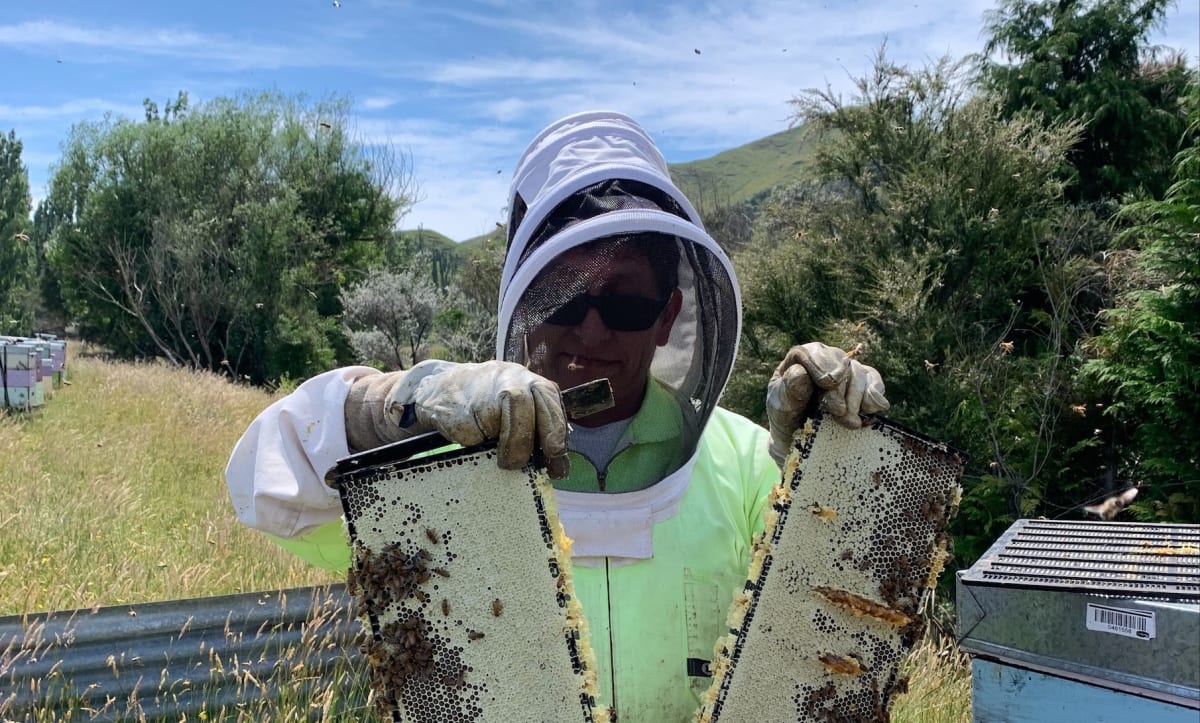
Gibson says there’s something unique - and a bit quirky - about people in his profession.
“You need to have a passion for bees to do the job - people that see it as just a way to pay the bills don’t last long in the industry.”
Beekeepers love the outdoors, he says. “I struggle to get my beekeepers to stay inside their sheds doing maintenance, they always want to be out in the field”.
They also tend to be adaptable, unflappable around change, happy to work hard, and laid back - except when it comes to their bees.
“Don’t ever criticise a beekeeper’s hives, don’t tell them their bees are no good or their hives are weak. They have a lot of pride in their work and they are going to get pretty angry.”
Not for the faint-hearted
Noelani Waters’ first honey industry job after leaving university was with the Hawaii Department of Agriculture’s apiary inspection service. The inspectors travel between the seven inhabited islands in the archipelago issuing health certificates, monitoring bee biosecurity threats, and teaching people about beekeeping and disease diagnosis.
It was a huge learning experience.
“I thought I knew something about bees and beekeeping before I came to that job, and then I realised I knew just the tiniest little bit of the iceberg. And to be honest, I still feel that way.”

Comvita’s beekeepers work in pairs, for health and safety reasons, Waters says, but each one might be responsible for about 500 hives or bee colonies
Day-to-day work involves checking on the health of the hives, monitoring for disease, supplementing the bees’ feed if necessary, optimising the way the honey frames are organised in the hive, and checking in on the mānuka forests.
“Beekeepers have to be plant people too - they monitor blooming and nectar flows and respond to that by either bringing the bees to pollinate a particular orchard or harvest specific nectar, and then moving them out when it’s not flowing anymore.”
Comvita is one of New Zealand’s biggest apiary operations, with approximately 20,000 hives and 60 beekeepers.
Scheduling and science
A large part of running a successful beekeeping operation is about timing and strategy and science, Waters says. It’s about working backwards from what you want your bees to be doing at what time (collecting mānuka nectar in spring, as the mānuka forests flower, for example) and then scheduling all the other operations to produce the right number of the best-bred bees to do the job, even with the vagaries of the weather, the threats from parasites like varroa, and the dangers from farmers’ agricultural chemicals.
Take the breeding programme. Specialised beekeepers have to get the right drones (male bees) at the right time to produce strong sperm, then collect and mix it, and insert it into the mother queen bees at exactly the right time, so those queens will go on to produce lots of hopefully genetically-diverse, disease-resistant daughters, who will fly upwards and get mated by other drones...
“There’s a lot of steps you have to do where you have to make sure you’ve got drones at the perfect age, because you want to select them to be totally sexually mature at the time you are harvesting the semen, which is 30-40 days after they’ve emerged. So a lot of our work is setting things up, detailed scheduling.”
Since early this year Waters has been working in the Comvita education team, helping set up and run Comvita's new Wellness Lab, an experience centre on Auckland's waterfront.

Not only does it mean she doesn’t have to get up at five every morning, rain or shine, through the months of the honey season. But it means she gets to talk about bees and beekeeping all day – and get paid to do it.
Did I know that worker bees know they have a queen in their hive because she secretes a chemical mix called queen mandibular pheromone through her feet as she moves around the hive? And the presence of that pheromone reassures her daughters that all’s right in their world.
But if they don’t sense that pheromone for just a few hours, the workers will start feeding up a number of bee larvae to be potential future queens. Once they hatch, one of these will sting and kill the others and become the new queen.
I didn’t know that, and I’m glad I do now.
What about this? Worker bees get promoted through a set range of jobs over their lifetime - a bit like humans do. They start inside the hive in the nursery, looking after the eggs and the larvae and feeding the young bees. Later they get given hive cleaning, maintenance, and protection tasks.
Only towards the end of their life do they get to do the job they are known for - collecting nectar from plants and making honey.
And in case you need another astonishing beekeeping fact, a worker bee will produce less than a quarter of a teaspoon of honey in her entire lifetime.
Quality, not quantity.
This is the third story in a Newsroom content series with Comvita