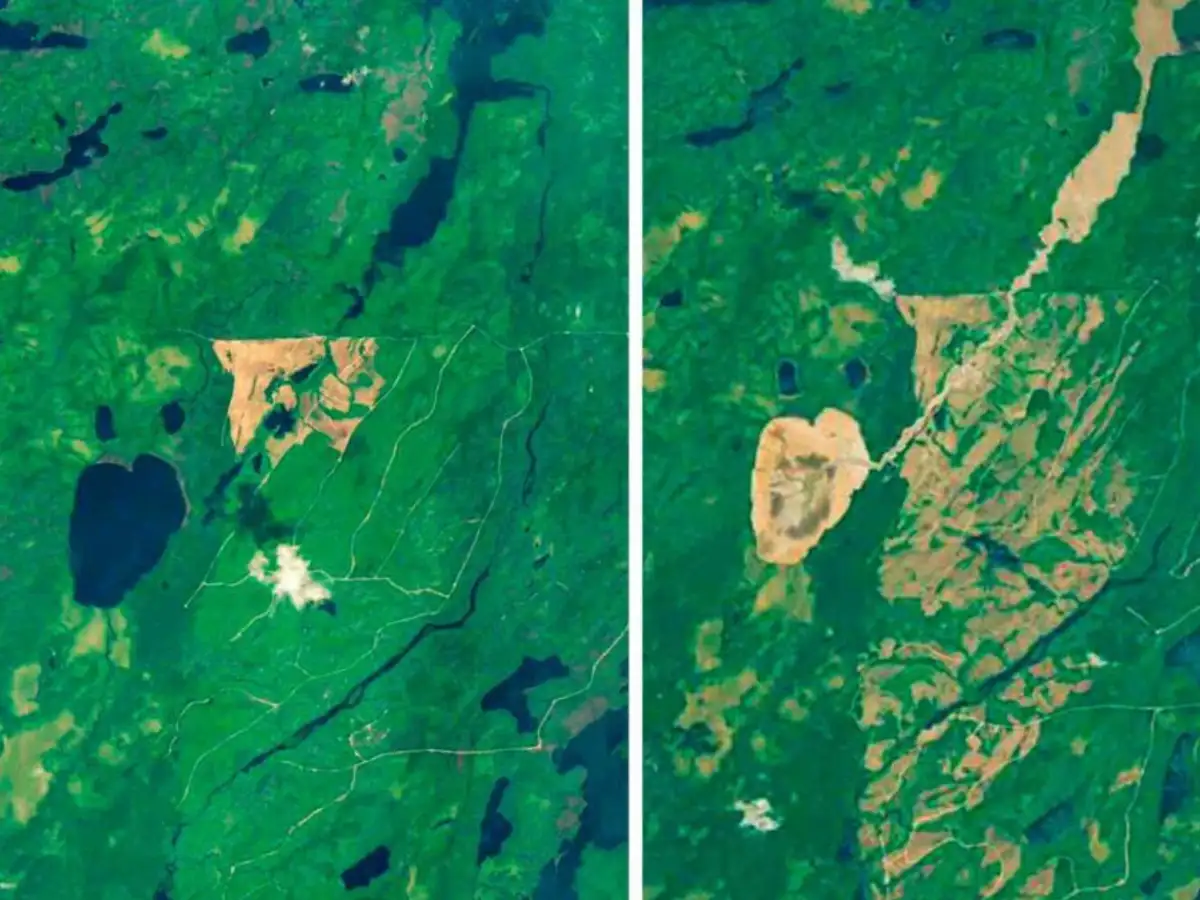
Somewhere in the boreal forests of south-west Quebec, there was a lake that looked like an emoji from space. Lake Rouge, next to two smaller round lakes, made a clear shocked face: wide open mouth under two round eyes. It was the kind of thing that did the rounds on satellite photography blogs, got a couple of thousand likes, and was forgotten.
But in May 2025, members of the Cree First Nation of Waswanipi were driving down a logging road when they saw something deeply wrong. Mud everywhere, dead fish scattered all over the ground, and no obvious source. They followed the trail to an empty crater which had once been a lake of about a square mile in extent.
"It looks like it’s a natural disaster," said Irene Neeposh, chief of Waswanipi. "We’ve never seen anything like this."
She wasn't making it up. The lake was simply gone.
What really happened
There was no gradual fading of Lake Rouge through a dry summer. The eastern side of the lake collapsed in a landslide, and the entire volume of water surged outward in a violent outburst flood, as researchers call it.
There was no stream to follow the water or river. It cut a path through a series of smaller ponds, ran for about six miles, and emptied into Doda Lake, a much larger body of water that turned brown almost immediately from all the sediment. NASA’s Landsat 9 satellite images show the before and after: a lake full in June 2024, a barren, muddy crater by June 2025.
Scientists have dated the collapse to sometime between April 29 and May 14, 2025. When exactly? Unknown. Why? That part is getting very clear, and we should all be worried about that.
This almost never happens, so why did it?
These outburst floods are generally associated with glaciers, where a barrier of ice damming large amounts of meltwater until the barrier catastrophically collapses. Freshwater lakes are very rare to drain in this regular, non-glacial way. Researchers told The Guardian that it almost never happens outside glacial or reservoir settings.
What went down at Lake Rouge? Here's the short version: everything went wrong at once.
Large areas were burned by wildfires in 2019 and 2023, which were among the worst years for wildfires in Canadian history. Those fires didn’t just burn trees. They fundamentally changed how the land dealt with water. A 2018 study published in Hydrology and Earth System Sciences found that wildfires substantially boost surface runoff and peak water flows by eliminating vegetation that normally absorbs rainfall and snowmelt. If the ground is burned, water can't soak in; it runs over the surface and builds up quickly.
It made it worse with logging. For decades, the clearing of forest around Lake Rouge has accelerated the flow of spring snowmelt into the lake, in greater volumes and at a faster rate than the banks were ever meant to accommodate naturally. Then there was the winter of 2024-25, when there was abnormally heavy snow through most of the region and dangerously high water levels.
Quebec’s geology was the final layer of fragility. Much of the province is on land formed by a retreating ice sheet about 20,000 years ago. "It's a very young landscape that's evolving very fast," said François-Nicolas Robinne, a forest hydrologist with the government of Alberta. Young post-glacial land is particularly vulnerable to multiple stressors at once.
Why is this not just a Canadian problem
The collapse at Lake Rouge was not an accident, but an inevitability, according to the researchers. It was always going to happen given the conditions; it was just a matter of when.
These conditions, from wildfires to continued logging to extreme snowpack, are not unique to one corner of Quebec. A review published in Water Resources Research says post-fire surface runoff may increase by 100% to nearly 10,000% relative to pre-fire conditions. As wildfire seasons grow longer and more intense across North America, including the American West, the same sequence of events that emptied Lake Rouge could happen in watersheds across the continent.
The US has its own version of this story in the making. Millions of acres of vegetation that keep watersheds stable have been burned away by massive wildfires in California, Oregon, and Washington. Throw in record snowpacks in some mountain ranges, post-fire erosion, and aging landscapes still recovering from past glaciation, and you've got a slow-building risk that most people aren't thinking about.
A place that won't come back
For the Waswanipi Cree, this is not a statistic, not a climate headline. For generations, Lake Rouge was a place of hunting, fishing, and trapping. That's over. The lake bed remains, but the community gets no replacement.
The mud on that logging road was a message from a landscape that had taken every insult in silence until the moment when it could do no longer. The emoji lake is no more, but the warning it left behind is here to stay.