With the Guardian’s unstoppable rise to global dominance (NOTE: actual dominance may not be global. Or dominant) we at Guardian US thought we’d run a series of articles for newer football fans wishing to improve their knowledge of the game’s history and storylines, hopefully in a way that doesn’t patronise you to within an inch of your life. A warning: If you’re the kind of person that finds The Blizzard too populist this may not be the series for you.
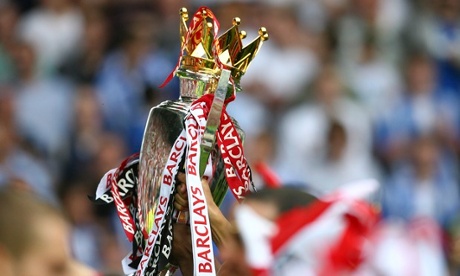
Congratulations to Chelsea Football Club on their fifth English league title! It’s a relatively new experience, this, watching the west London club cavort around in celebration of the championship. Before José Mourinho turned up for his first managerial stint at Stamford Bridge in 2004, they’d only won the title once, back in 1955, when the identity of the English league champions was ascertained by the First Division rather than the Premier League (but let’s not go into that, that sort of thing is what footnotes are for*).
All of a sudden, there are now only six English teams with more league titles to their name than Chelsea. Even those who are relatively new to English soccer will be able to identify the top three, we’ll be bound: Manchester United, Liverpool, and Arsenal. Positions four, five and six may raise an eyebrow or two, given the current composition of the Premier League table. But we’ll get to those in a minute.
Manchester United lead the way with 20 titles, the vast majority of those picked up in the Sir Alex Ferguson era. Fergie won 13 of them between 1993 and 2013. Sir Matt Busby’s personal haul of five titles, chalked up between 1952 and 1967, had up until that point looked impregnable. United famously waited 26 years for a title between the Busby and Ferguson eras, though that oft-quoted statistic obscures the fact that Busby’s first title broke a 41-year drought. Pre-Busby, the club had only won two titles, back in 1908 and 1911.
Those had come under the yoke of Ernest Mangnall. (It’s a strange quirk of United’s record haul, which took 105 years to gather, that only three men have managed the club to the title.) Magnall’s star man was toothpick-munching winger Billy Meredith, though his teams were set up with a defence-first emphasis. The United Way indeed. Mourinho would have loved him. Magnall also trumped fitness guru Arsène Wenger by a good eight decades, insisting his players trained hard, a left-field request in an era when delicious cigarettes were thought to have cardiovascular benefits.
Liverpool had previously held the English record for titles with 18. The last of these were in 1990, which means that the club is certain to at least equal, and most likely go past, the 26-year mark set by United for services to impotent frustration. Expect a lot of talk about that 41-year Mangnall-to-Busby wait emanating from Merseyside in the next 12 months or so.
Liverpool won their first titles under a bowler-hatted gentleman called Tom Watson. They had their first chance of winning the championship in 1899, but had to win at title rivals Aston Villa on the last day of the season. They were 5-0 down at half time. No matter, they finally got there a couple of seasons later. Watson won a second title for Liverpool in 1906, though it was his fifth in all. He had previously managed Sunderland to three titles, and so became the first man to win the English championship with two different clubs. More of him, and Sunderland, anon.
But back to Liverpool. The Reds won a couple of titles in the early 1920s with a team of defensive stars including the long-serving England full-back Ephraim Longworth and revered star goalkeeper Elisha Scott (who set a rabble-rousing blueprint for Bill Shankly to follow with regular crowd-pleasing “I speak to these people” pronouncements). They snaffled a couple more in the 1960s, Shanks having dragged the club up from the Second Division. He then rebuilt the team in the early 1970s, won another title, then resigned, watching with a queer mix of pride and frustration as Bob Paisley clocked up six titles in nine years. Plus three European Cups and a Uefa Cup. They thought it would never end, and to be fair that’s exactly how things looked. But it always does.
Liverpool’s era of dominance came to an end in the early 1990s, Arsenal knocking them off their perch. (Sorry Fergie, but you were beaten to the punch.) Not before Kenny Dalglish won three titles, the second two with a team whose fluid movement owed more to the philosophies of Total Football than is commonly imagined. “Alan Hansen can go past me, and I’ll take his position.” John Barnes, tricky winger and sometime central defender, there. However arguably the club’s most impressive championship is one that’s long been forgotten. It was won in the very first season after the Second World War, and can be put down to either the mid-season purchase of goalscorer Albert Stubbins (subsequently the only footballer to feature on the cover of Sgt Pepper); Jack Balmer’s mid-season scoring run of 3-4-3-1-1-1-2; or Liverpool’s pre-season decision to go to the USA and fatten themselves up on steak, cake and malted milk. Given there was severe food rationing in post-war Britain, and Liverpool subsequently retained the energy to pip Wolves to the title in their last game of the season, the answer seems obvious.
Arsenal have 13 titles to their name, putting them third in the all-time list. Their title story, when you boil the bones down, is the tale of two managerial greats. Perhaps three. Arsenal took a while to notch their first title, only really getting going as a serious concern in 1925, when they poached Arsenal Managerial Great No1, Herbert Chapman, from Huddersfield Town. Chapman had just led Huddersfield to back-to-back titles. Chapman lost his first game as Arsenal manager to Spurs, and his side were soon tonked 7-0 at Newcastle. Hmm.
But the thrashing had a positive effect in the long run. Striker Charles Buchan convinced Chapman of a tactical tweak - an extra defender to counter the brand-new offside law, which was helping forwards to help themselves to goals - and though the team took five years to win their first trophy, the new WM formation became a crucial part of Arsenal’s dominance in the 1930s. The team won three titles on the bounce, though Chapman didn’t live to see the sequence completed. But his reputation as a genius was assured, not least because the Huddersfield team he’d left in the 20s completed a title hat-trick too, winning a third league on the spin in 1926. (Chapman’s new club, Arsenal, came second that year. A hell of a one-two, that.)
For quite a while, Arsenal’s single-most famous season was their league-and-FA-Cup double of 1970-71. Then came 1989, when George Graham’s side went to Anfield, needing to beat Liverpool by two clear goals to snatch the title from the home side. Alan Smith and, in the last few seconds, Michael Thomas did the business for Arsenal. The Kop stayed to applaud the new champions. (They had form here, having extended the same sporting courtesy to Leeds United, who won the title at Anfield in 1969. And to think some petulant folk are moaning about the prospect of Liverpool forming a respectful guard of honour for Chelsea this coming weekend. For shame.) More than a quarter of a century down the line, Thomas’s goal still has more cultural currency than Sergio Aguero’s arguably more dramatic United-sickening strike for Manchester City against QPR in 2012. It’s just the way it is. We don’t write the rules.
Graham probably deserves to be considered as Arsenal Managerial Great No2, but he later took over at Spurs, so a few bridges were torched there. Wenger unquestionably gets the nod, though. He’s only - only! - won three titles in his 19 years at the club, but when he gets there, he gets there in style. Two of those titles led to league-and-cup doubles, while the other was the famous Invincible campaign, the first time a club had gone through a top-flight season unbeaten since Preston North End managed it in 1888-89 to win the very first title of all. And Preston only had 22 games to play, as opposed to Arsenal’s 38. Though to be fair, Preston also won the Cup that season, without conceding a goal, and retained their title the following year. It’s swings and roundabouts.
So there’s the top three. And the other three teams ahead of Chelsea in the all-time pecking order are ... Everton with nine titles, Aston Villa with seven, and Sunderland with six. Everton won their first title in 1891, the second club after Preston to become champions of England. An epochal event, then, but mainly because the landlord of their Anfield home, John Houlding, decided to raise the rent as a result of the club’s success. Everton stormed off to Mere Green Field - quickly renamed Goodison - and Houlding was left with a stadium and no team to play in it. You can guess what happened next, but just to confirm, we’re offering no prizes for correct answers.
The majority of Everton’s league haul is split between three separate eras.
Working backwards, then. One: the Howard Kendall team of the mid 1980s, which should really have won the double Liverpool made off with in 1986, Gary Lineker scoring 40 goals for the club in his only season at Goodison. Thoroughly dominant titles in 1985 and 1987 would have to do. Two: the Harry Catterick era of the 60s and early 70s. The 1963 title-winning side is best remembered for the Scottish inside right Alex Young, who has surely the best nickname of any footballer, ever: the Golden Vision. Young would be the subject of a 1968 Ken Loach drama-documentary – The Golden Vision - the best part of which features a young Evertonian saying his prayers. “The father, the son, the holy ghost, amen. God bless Gordon West, Tommy Wright, Ray Wilson, Brian Labone, Colin Harvey, Howard Kendall, Alan Ball, Alex Young …” Having run through the whole team, he asks the big man upstairs to “bless all the reserves” before eventually adding an afterthought: his mum and dad. That’s the power of football for you.
Three: the side built around Dixie Dean in the 1920s and 1930s. So, that aforementioned change to the offside law in 1925**. It caused plenty of confusion. In the 1926-27 season, Swindon’s Harry Morris scored 46 goals in the Third Division (South)***. The same year George Camsell broke the Football League scoring record in the Second Division, by notching 59 of Middlesbrough’s 122 goals. Camsell’s haul included nine hat-tricks, a record for a single season which still stands today. But his 59 would only last a single season. Here comes Bill ‘Dixie’ Dean of Everton, who made it to 60 on the final day of the 1927-28 season by scoring a hat-trick against Arsenal. Everton won the title that year, unsurprisingly.
It was the beginning of a crazy few years at Goodison. Everton managed to get themselves relegated two years later, won the Second Division at the first attempt, scoring 121 goals, then followed it up the next season with another league title, and the FA Cup the year after that. Dean left Everton in 1937 for Notts County, having scored 349 goals in 399 matches. He hated his nickname.
Aston Villa are fifth in our list, and they were the first real powerhouse of the English league. They had been one of the dominant sides in the 1880s, winning the majority of the friendly matches they played. But the fans were getting fed up of watching the same old, same old. One of their board members, William McGregor, owned a drapery shop in Aston (a suburb of England’s second city, Birmingham). It was next door to a coffee shop run by Joe Tillotson, who would express his boredom at watching Villa trample over teams of local nonentities. McGregor took the hint, and set about arranging a “fixity of fixtures”. This scheme would become the Football League, launched in 1888.
McGregor would be rewarded for his efforts soon enough. Villa won their first league title in 1894, and had clocked five by the turn of the century. Star man was their captain and striker John Devey, who was their leading scorer in their first championship season with 20 goals, and featured in those other four title-winning campaigns to boot. One of those, in 1897, secured England’s second league-and-cup double. (The third wouldn’t arrive until Tottenham Hotspur managed it in 1961.) Devey also played top-level cricket for Warwickshire, scoring over 7,000 runs in his career. Villa won their sixth title in 1910, then had to wait 71 years for the seventh. Their patience was rewarded with the European Cup in 1982. Since then, more waiting.
Then in sixth place, Sunderland, with six titles. The first three were won in Victorian times, by that man Tom Watson. He was the first truly great manager in English football history. He became manager of Sunderland in 1889 aged just 29, and built a team on the famous Scottish passing game, the town’s proximity to the border allowing him to make off with plenty of hot talent: strikers Jimmy Millar and Johnny Campbell, midfield hard man Hughie Wilson, defender John Auld, and eccentric goalkeeper Ned Doig, a man so self-conscious of his balding dome that he played in a cap secured with a chin strap.
Sunderland hadn’t been invited to join the new Football League in 1888 – they were too far north, and nobody could be bothered to travel up regularly – but they staked their claim anyway, beating Preston North End 4-1 during Preston’s Invincibles 1888-89 league season, and belting William McGregor’s Aston Villa 7-2. Sunderland were granted their league wish in 1890 – the first new team to be admitted, replacing Stoke City – and soon reached the top. After one season of acclimatisation, Watson’s side won three titles in four years. Sunderland’s last title came in 1937. And they’re still sixth on the list!
And then there’s our modern heroes Chelsea, with five titles. Below them, plenty of big names. For the completists out there, and there are plenty of us: Manchester City, Newcastle United and Sheffield Wednesday with four; Leeds United, Wolverhampton Wanderers, Huddersfield Town and Blackburn Rovers with three; Tottenham Hotspur, Derby County, Portsmouth and Burnley with two; Ipswich, Nottingham Forest, Sheffield United and West Bromwich Albion with one. Ipswich won theirs (1962) under the iron rule of Alf Ramsey, who would go on to win the World Cup for England in 1966. Forest have only one title (1978) and twice as many European Cups (1979 and 1980); they remain the last first-time winners of the English league.
But let’s end where we started, with Chelsea. They’ve won four titles of late, three now under Mourinho, the other under Carlo Ancelotti. What about that one in 1955, though? That was inspired by manager Ted Drake, who transformed a relegation-haunted side into a hard-working unit, built around defenders Peter Sillett (whose brother John would win the 1987 FA Cup as Coventry City manager) and Ron Greenwood (who would lead England to the 1982 World Cup finals). Striker Seamus O’Connell, who scored seven goals in 10 appearances, was a cattle farmer by trade. The winger Jim Lewis spent most of the week travelling the country selling Thermos flasks. Roy Bentley was their star forward, scoring 21 times on the way to a title most folk had expected to be claimed by either Wolves or Manchester United. It was Chelsea’s first piece of silverware, and something of a shock. You suspect José, who loves nothing more than to prove everyone wrong, would have appreciated this particular success very much.
* Up until 1992, the English title was won by the team who topped the First Division of the Football League. Then the Football Association launched the Premier League, which became the top division in English football, nudging all the Football League divisions down by one tier of importance. The old First Division retained its name, though in terms of status it was England’s second division. The Second Division became the third division, and the Third Division became the fourth. The Fourth Division was no more. Later, the First Division, which was the second division, would be rebranded the Championship, even though the winners of the Premier League were the champions of England. The Second Division, which was the third tier, was rebranded League One, and the Third Division, which was the fourth tier, became League Two. Try to follow the logic, but it’s like staring at a magic eye poster, or an MC Escher painting. The marketing departments of the FA and Football League want their heads banging together.
** Instead of there needing to be three players between attacker and goal, the rule now required only two. The reason the offside law is there at all, is to stop everyone hanging around the goalmouths, a state of affairs which would turn soccer into an ersatz form of basketball.
*** Don’t ask.