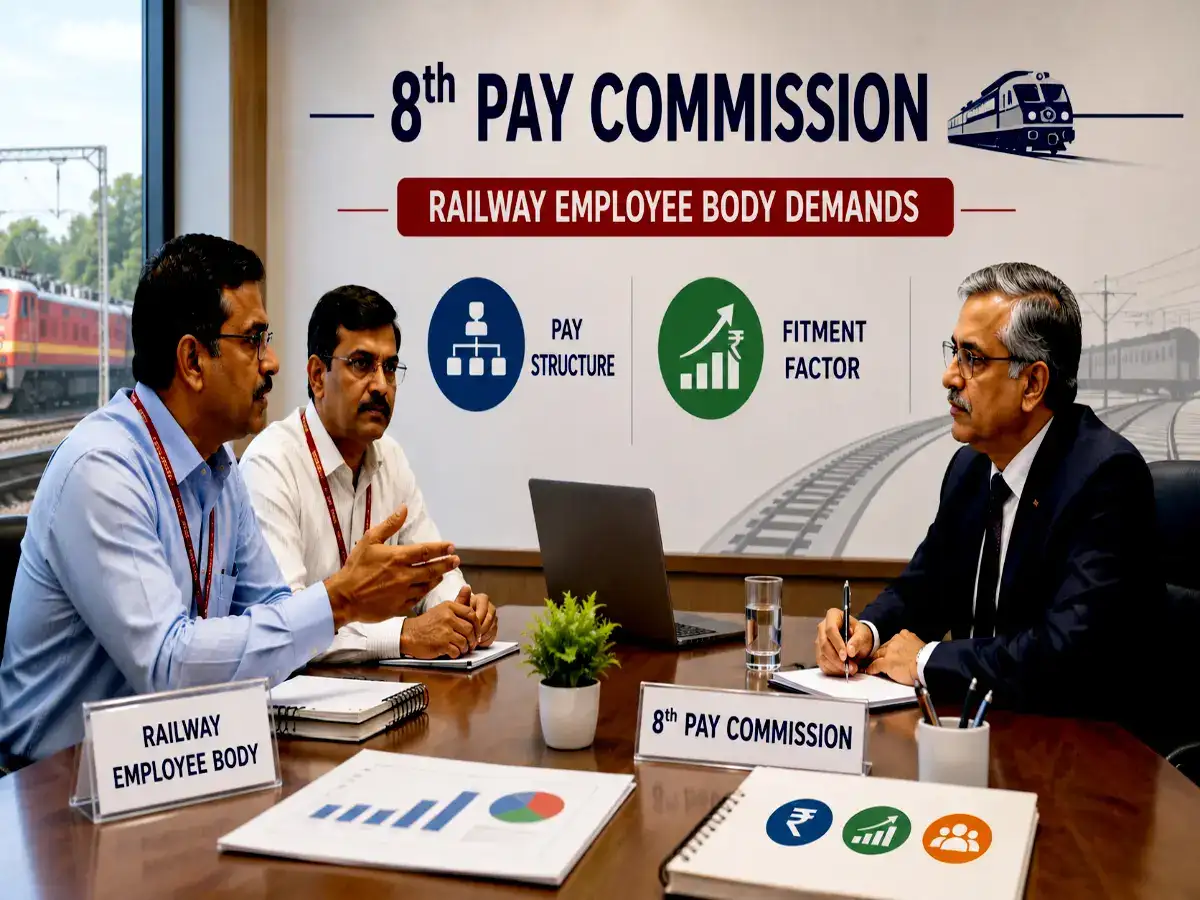
A minimum salary of Rs 52,000, multiple fitment factors, resolving pay discrepancies, increased House Rent Allowance (HRA) rates and counting the training period for MACP calculation were some of the main requests made by the Indian Railway Technical Supervisors’ Association (IRTSA) during their meeting with the 8 th Pay Commission officials in New Delhi on Tuesday.
KV Ramesh, general secretary, IRTSA, shared with ET Wealth Online that during their discussion with the 8 th CPC chairperson Ranjana Prakash Desai and other officials, the Railway technical employees’ body brought up several long pending issues. Ramesh emphasized that IRTSA is keen on having their suggestions included in the 8 th Pay Commission’s recommendation report.
The 8 th Pay Commission also wrapped up its Delhi meeting on Tuesday where it engaged with employee representatives from both the defence sector and Railways.
ET Wealth Online takes you through the 10 key points that were discussed in the Railway employee body’s meeting with the 8 th Pay Commission.
1. Rs 52,000 minimum salary and multiple fitment factors
Unlike most employee oragnisations, IRTSA didn’t propose a single fitment factor. IRTSA has demanded a minimum pay of Rs 52,000 and fitment factors in the range of 2.92 to 4.38 for different levels of employees.
| Pay level | Proposed fitment factor |
| L-1 to L-5 | 2.92 |
| L-6 to L-8 | 2.92 × 1.2 = 3.50 |
| L-9 to L-12 | 2.92 × 1.3 = 3.80 |
| L-13 to L-16 | 2.92 × 1.4 = 4.09 |
| L-17 & L-18 | 2.92 × 1.5 = 4.38 |
2. Allowances
IRTSA pointed out that the Railways requires the Finance Ministry’s approval for any change or modification to their allowance rules. The employee body says Railways should be given reasonable authority to approve allowances related to running additional trains and safe and punctual operations of trains. IRTSA has suggested these allowances for technical employees.
- Dearness allowance
IRTSA has said that the principle laid down by the 5 th CPC for the merger of 50% of DA with the basic pay as DP should be followed in the 8 th Pay Commission. The employee body has recommended that DA should be paid net of income tax, since it is paid as compensation for inflation.
- House rent allowance (HRA)
IRTSA has suggested increased rates of HRA for the 8 th Pay Commission. HRA rates in the 7 th Pay Commission are 8%, 16% and 24%, which were increased to 10%, 20% and 30% after DA reached 50% in 2024.
IRTSA has suggested the following HRA rates for the 8 th Pay Commission:
They have suggested that the three-tier classification should be made into four-tier as given below
A class cities (40%+DA): Population 50 lakh and above.
B class cities (30%+DA): Population 20 lakh to 50 lakh
C Class Cities (20%+DA): Population 5 lakh to 20 lakh.
D class cities (10%+DA): Population below 5 lakh.
- Night duty allowance (NDA)
IRTSA says the 7th CPC recommendation of continuing prescribed hourly rate of NDA equal to (BP+DA)/200 should be extended to all Railway employees, and the ceiling limit of Rs 43,600 for calculating NDA for Railway employees should also be removed.
- Transport Allowance (TA)
IRTSA has demanded TA to be increased by three times of the existing rates. The employee body says 19 specified cities should be added in the list of higher TA rates.
- Accident-free service award (AFS)
IRTSA has demanded that on completion of every eight years of service, one month’s basic pay and dearness allowance (DA) should be granted as AFS.
3. Career progression
IRTSA has demanded that the number of financial upgradation for an employee under Modified Assured Career Progression (MACP) should be five times in 30 years of service. Financial upgradation under MACPS should be awarded after 6, 12, 18, 24 and 30 years of service, according to IRTSA.
Among its other demands, IRTSA suggested that the training period for JEs, SSEs and other technical non-gazetted staff should be counted for financial upgradation under MACPs.
IRTSA has also suggested that the 8 th CPC should maintain parity in benefits of MACP scheme for graduate engineers recruited before September 1, 1998, with those graduate engineers appointed on or after September 1, 1998.
4. Fix pay anomalies
Citing an order dated February 26, 2026, issued by the Central Administrative Tribunal (CAT), Chennai, IRTSA pointed out that the court has directed the 8th CPC to address pay anomaly of Railway technical supervisors.
Based on the decision, IRTSA has demanded-
Grant of Grade Pay (GP) of Rs 4,600 to junior engineers (JEs) above senior technicians working under them.
Enhance the GP/Pay level of Senior Section Engineer (SSEs) to adequately above JEs, office superintendents, etc, working under them.
Wages of technocrats should be fixed separately from non-technocrat employees with a view to adequately compensate them for hazards/job requirements, additional working hours and peculiar conditions of service.
Five grade structure should be available for the category of technical supervisors in Railways similar to CPSE (ONGC).
Other than that, IRTSA has also requested the 8 th Pay Commission to fix total working hours 48 hours per week. Citing that many other worker categories have 45 hours working hours per week, IRTSA says weightage should be given to technical employees for the additional working hours.
| Cadre | Level |
| Junior Engineer | Level-7 |
| Senior Section Engineer (Gr-B) | Level-8 |
| Asst Manager (Gr-B) | Level-9 |
| Manager (Gr-B) | Level-10 |
| Senior Manager (Gr-A) | Level-11 |
In its note, IRTSA said that Chemical & Metallurgical Assistants (CMA), Chemical & Metallurgical Superintendent (CMS), Depot Material Superintendent (DMS), Depot Material Superintendent (CDMS), junior engineer JE(IT) & section engineers SE (IT) having similar recruitment qualification, similar duties and responsibilities should be placed on par with technical supervisors.
5. Retirement benefits
IRTSA has demanded Old Pension Scheme (OPS) for employees who joined their service on or after January 1, 2004. It has also demanded that the National Pension System (NPS) and the Unified Pension Scheme (UPS) should be abolished.
- Retirement gratuity
IRTSA says retirement gratuity should be calculated @ 1/3 rd of a month’s basic pay (BP) + DA drawn on the date of retirement for each completed six monthly period of qualifying service.
The retirement gratuity payable for qualifying service of 33 years or more should be 32 times of BP + DA, subject to a maximum of Rs 50 lakh, as per IRTSA.
- Death gratuity
IRTSA has demanded that the maximum amount of death gratuity admissible should be Rs 50 lakh. The Railway employee body has suggested the following rates for death gratuity.
| Length of service | Retirement/death gratuity |
| Less than one year | 4 times of basic pay |
| One year or more but less than 5 years | 12 times of basic pay |
| 5 years or more but less than 11 years | 24 times of basic pay |
| 11 years or more but less than 20 years | 30 times of basic pay |
| 20 years or more | Half of emoluments for every completed 6 monthly period of qualifying service, subject to a maximum of 50 times of emoluments |