The universe has a way of making us remember how little we really know about the area outside of our solar system. For the third time in recorded history, a visitor from the dark depths of interstellar space has sped past our sun, giving us a brief look at the chemistry of a star system far away.
This icy traveler, known as 3I/ATLAS, is now leaving in style, but not before giving scientists a few parting gifts and leaving fans with a lot of questions. The Asteroid Terrestrial-impact Last Alert System (ATLAS) in Chile first saw the object on July 1, 2025. It is very old, possibly up to 14 billion years old, which makes it very special. It may even be older than our own sun.
Recent data captured by sun-watching spacecraft has revealed exactly how much 'sweat' this cosmic traveller lost during its high-speed swing around the sun. As it rounded our star in late October, the intense heat triggered a massive release of water vapour. However, while the physical chemistry of the object is becoming clearer, a separate, more ambitious search for signs of life has returned a haunting silence.
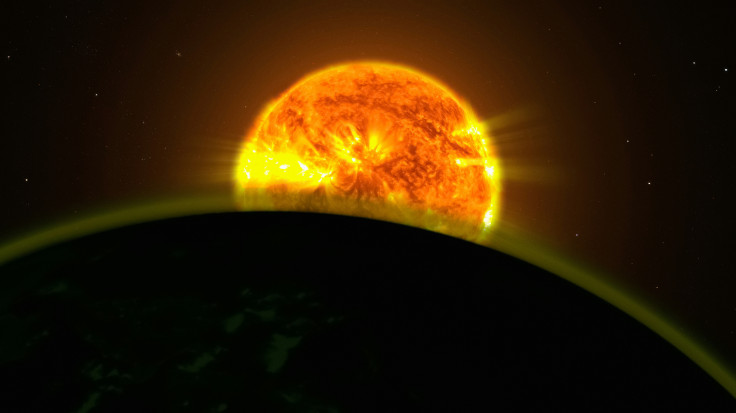
The Dying Gasp of 3I/ATLAS as It Flees the Sun
Tracking an object moving at a staggering 210,000 kilometres per hour is no small feat. A team led by Michael Combi used the Solar and Heliospheric Observatory's (SOHO) SWAN instrument to monitor the comet's 'hydrogen coma' — a ghostly ultraviolet glow created when sunlight tears apart water molecules.
The findings, submitted to The Astrophysical Journal Letters, suggest that 3I/ATLAS was remarkably active shortly after its closest approach to the sun, known as perihelion, which occurred on Oct. 29, 2025 at a distance of 1.36 AU. On Nov. 6, the team estimated the comet was shedding water at a rate of 3.17 x 10^29 molecules per second.
To put that into perspective, that is an incredible amount of material being blasted into the vacuum of space every heartbeat — amounting to roughly 13.5 million metric tons of water released between early November and December. By Dec. 8, as the comet receded into the colder reaches of the solar system, this rate had plummeted to between 1 and 2 x 10^28 molecules per second, showing how quickly these interstellar visitors 'wind down' once the sun's influence fades.
Understanding this 'winding down' process is vital for astronomers. It allows them to compare 3I/ATLAS to our local comets and determine if water behaves differently in other parts of the galaxy. So far, the data suggests that while its origins are alien, its physical behaviour is somewhat familiar, though its chemical signature is notably rich in carbon dioxide and atomic nickel compared to typical solar system comets.

Radio Silence and the Mystery Surrounding 3I/ATLAS
While the physical measurements depict a standard, albeit rare, comet, another group of researchers was looking for something far more extraordinary. The Breakthrough Listen project, famous for its search for extraterrestrial intelligence (SETI), pointed the massive 100-metre Robert C. Byrd Green Bank Telescope toward the object on Dec. 18, just 24 hours before the comet's closest approach to Earth.
They scanned frequencies ranging from 1 to 12 gigahertz using L, S, C, and X-band receivers, listening for 'technosignatures' — the kind of narrow-band radio transmissions that nature simply doesn't produce. The results, however, were a definitive 'nondetection'.
Lead researcher Ben Jacobson-Bell reported that no candidate signals were found down to the 100 mW level, a sensitivity equivalent to detecting a mobile phone's power output at that vast distance. Every 'ping' detected was eventually traced back to mundane human technology and radio interference.
This hasn't stopped the speculation. Harvard astrophysicist Avi Loeb has pointed to peculiar features in Hubble images, such as three evenly spaced inner jets and a sunward 'anti-tail' extending at least 100,000 kilometres. Loeb argues the geometry is so specific — with jets oriented at precisely +/- 120 degrees relative to each other — that it warrants intense scrutiny, though he admits gas dynamics and the rotation of the nucleus (estimated at 15.5 hours) could potentially explain the patterns.
For now, NASA maintains that the nucleus of 3I/ATLAS is likely between 440 metres and 5.6 kilometres wide. It never posed a threat to Earth, passing no closer than 270 million kilometres on Dec. 19, 2025. As it disappears back into the interstellar void, it leaves us with a growing pile of data but no smoking gun for alien technology. We are left, once again, staring at a fast-moving ball of ice and dust — extraordinary for what it is, even if it isn't what some had hoped it might be.