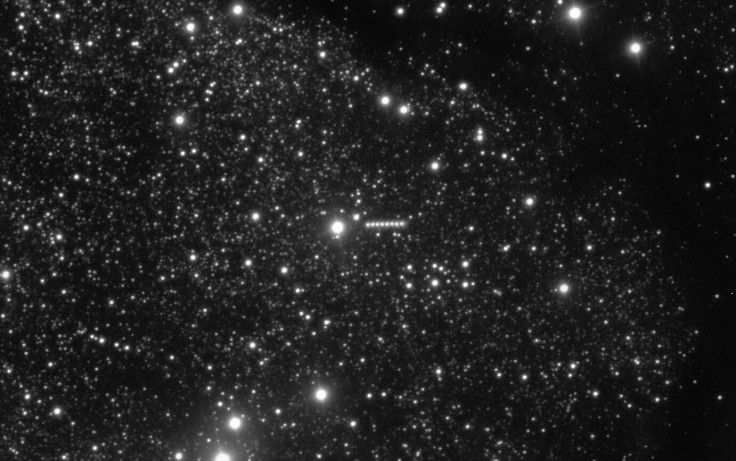
Since its discovery on 1 July 2025 by the survey telescope ATLAS in Chile, interstellar Comet 3I/ATLAS continues to be under careful watch by observatories across the globe, including probes in space.
But while scientists are probing into its behaviour and composition, the masses have been involved in public discussions, as 3I/ATLAS's atypical activity continues to arouse suspicion of an 'alien' life amid the comet's visit to our Solar System.
Imagery and Data
A visitor from outside of our Solar System, the comet is reportedly passing through on a hyperbolic trajectory. In a report from Chron, NASA astrochemist Martin Cordiner studied the gases emitted by the comet using the Atacama Large Millimetre Array (ALMA) and found rising levels of methanol (CH₃OH) and hydrogen cyanide (HCN), which are linked to forming the fundamental components of life.
Sources to read more on “Compositional Anomalies in Interstellar Object 3I/ATLAS”:
— Astronomy Vibes (@AstronomyVibes) October 26, 2025
1. JWST detection of a carbon dioxide dominated gas coma surrounding interstellar object 3I/ATLAS — Martin A. Cordiner et al., arXiv (Aug 25, 2025). This JWST NIRSpec study reports a very high…
Cordiner tells New Scientist in an interview, 'Molecules like hydrogen cyanide and methanol are at trace abundances and not the dominant constituents of our own comets. Here we see that, actually, in this alien comet they're very abundant.'
Astronomer Avi Loeb says, 'The anomalously large ratio of methanol to hydrogen-cyanide production by 3I/ATLAS suggests a friendly nature for this interstellar visitor,' Chron further reports.
Further data collection showed that the comet's atmosphere is also rich in Carbon Dioxide (CO₂), with an abnormally high CO₂-to-H₂O ratio, far above that typically found in comets in our Solar System.
Unusual Activity
Apart from the unusual chemical composition exhibited by 3I/ATLAS, a noteworthy physical activity has also recently been noted from the comet, particularly from observations coming from the Hubble Space Telescope and ESA's JUICE mission, stating that it has developed remarkable tails made of small solid particles and electrically charged gas interacting with the solar wind.
🚨📸 NEW 3I/ATLAS STUNNER 📸🚨
— Drew Doss (@drew4worldruler) December 8, 2025
Well, G Rhemann and M Jäger apparently can’t miss. Yet another awe-inspiring capture of 3I/ATLAS from a duo that we have all come to know and love.
The tail. The anti-tail. The galactic cameos. This image has it all!
Please enjoy and don’t forget… pic.twitter.com/2lrzkB36hA
Early in November, NASA Space News reported that 3I/ATLAS had rapidly brightened as it approached perihelion, baffling scientists with behaviour that deviates from expectations for comets of similar size. NASA further refers to this phenomenon as a peculiar activity.
The Inevitable 'Alien' Question
It's not surprising how the comet's bizarre activity in gas emission and tail formation has
sparked off speculation among the public, particularly in the 'alien' department. In social platforms and forums, NASA's recent enhanced images showing the comet's tail and dense core have been making the rounds, seemingly hinting at something that has been 'manipulated.'
Scientists clarify that the data do not include anything that might indicate any alien astrophysical activity, and that interstellar comets are expected to have chemical compositions unlike those of comets born in our Solar System.
Updated the anomaly detection system while listening to some podcasts about 3I/Atlas. 3I/Atlas shows too many strange behaviors to be an average comet, too few to be an alien spaceship. probably something new we just don't recognize yet. pic.twitter.com/OcBrb6ZUfB
— Dilum Sanjaya (@DilumSanjaya) November 1, 2025
Despite this, the public is insistent on the possibility of extraterrestrial life, particularly based on the images released by NASA. On the other hand, researchers are intent on giving us a glimpse of the rare phenomenon known as a gift to science and will continue to release new observations and data as they come.
Earthly Fascination
3I/ATLAS may have just captured the imaginations of humans with its simple trip around our Solar System. The data provided to us by experts make the 3I/ATLAS a true scientific marvel, despite fueling debates about whether extraterrestrial life is imminent.
Ultimately, 3I/ATLAS gives us a once-in-a-lifetime chance to study material from a different star system than our own. Its passage reminds us that something millions of kilometres away can pave the way for advancing science and bringing people together, whether to agree or disagree on something, showing us the surprises our world has for us, one celestial visitor at a time.