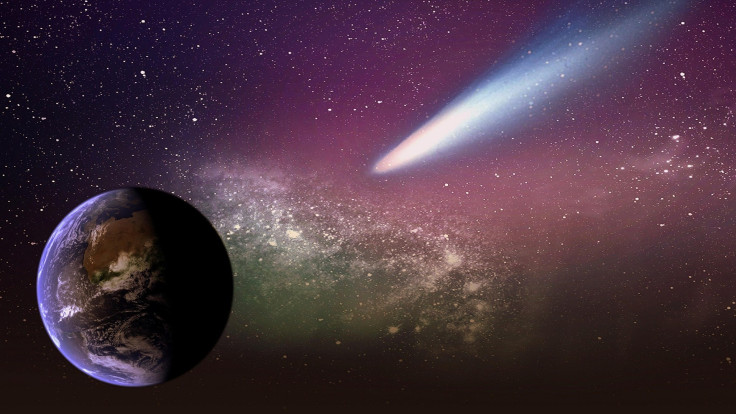
This intriguing observation points to physical changes occurring as the visitor traverses our solar system.
Understanding these fluctuations in spin could provide vital clues regarding the composition and origin of this mysterious cosmic traveller.
Whistleblower Claims Rapid Slowdown
Speculation regarding the interstellar visitor 3I/ATLAS has intensified following a string of X posts from an account named 3I/ATLAS WHISTLE BLOWER (@3IATLASEXPOSED). These updates invite new scrutiny of the object's activity, specifically suggesting that its spin is decelerating at a pace that contradicts established scientific theories.
🚨 3I/ATLAS: ITS SLOWING DOWN! 🚨
— 3I/ATLAS WHISTLE BLOWER (@3IATLASEXPOSED) December 16, 2025
New paper by Avi Loeb reveals the rotation period dropped from 16.16 hrs (July) to 15.48 hrs (Aug) pre-perihelion.
Thats 4% slowdown in weeks!
Could it have slowed down further since?
Also… This is the FIRST ever jet wobble detected with… pic.twitter.com/6QfLuD2cyn
The profile referenced a new study by astrophysicist Avi Loeb, noting that the object's spin moved from 16.16 hours in July to 15.48 hours in August. The account reported a 4% drop over a few weeks. '3I/ATLAS: ITS SLOWING DOWN!' the update stated, pointing out that this happened before the object reached its closest point to the sun and questioning if the pace has decreased even more since then.
The update also drew attention to a landmark discovery, claiming this is the initial instance of a jet wobble being found alongside lighthouse precession. It further stated that the object will make its closest approach to Earth on 19 December, finishing the message with a UFO emoji.
Analysing the Findings from Loeb
These assertions stem from a recent piece published on Medium by Avi Loeb, called 'A 14th Anomaly of 3I/ATLAS: Alignment of Its Rotation Axis with the Sunward Direction at Large'. In this article, Loeb examines unusual characteristics of the body's spin and its jet movements. This includes proof of a shift in its anti-tail that matches a wobbling rotating axis.
In his report, Loeb details two distinct rotation times determined by different observing methods. The first figure, calculated from brightness changes, yielded a period of 16.16 hours. The second, which came from modelling the wobble caused by the object's jets, yielded a primary result of 15.48 hours.
The central value (15.48 h) suggests a 0.68-hour slowdown from July to August.
— 3I/ATLAS WHISTLE BLOWER (@3IATLASEXPOSED) December 17, 2025
The anonymous account took the gap between these figures as proof that the object is physically losing speed. It is remarked that the core result of 15.48 hours implies the rotation has dropped by 0.68 hours between July and August.
Despite these assertions, Loeb does not actually claim that the object is losing speed, nor does he suggest that the variation is meaningful in a statistical sense. At the time of writing, Loeb has offered no public comment on the whistleblower's views.
Doubts Raised Over Data Accuracy
Some observers are sceptical that the figures substantiate the assertion. An X user named Geeta (@TechSoulGeeta) openly challenged the idea of deceleration, arguing that the margins of error in the statistics provided by Loeb undermine that theory. 'Interesting video, but the claimed 'slowdown' isn't supported by the data,' Geeta wrote.
She explained that although the July brightness reading was accurate, the figure calculated in August had a much wider margin of error. 'The large ±0.70 hour uncertainty on the second measurement fully overlaps with the precise July value,' she said, noting that the variation fell well within the expected range for mistakes. She concluded that there was no meaningful change in the data, certainly not a 4% drop.
@3IATLASEXPOSED Interesting video, but the claimed "slowdown" isn't supported by the data.
— Geeta (@TechSoulGeeta) December 17, 2025
Avi Loeb's article notes two rotation periods:
- 16.16 ± 0.01 hours (from July brightness variations)
- 15.48 ± 0.70 hours (from July-August anti-tail wobble)
The large ±0.70 hour…
Geeta admitted that the wobble is a major discovery, describing it as the initial sighting of lighthouse precession in a body from another system, triggered by uneven gas jets twisting the core. She framed the event as a captivating natural phenomenon rather than something mysterious.
Ending her analysis with a practical outlook, she stated that 3I/ATLAS remains a standard active interstellar comet, noting that while the science is thrilling, there is no reason to raise UFOs just yet.
The Core of the Disagreement
The heart of the matter lies in how the findings are understood rather than what was actually seen. Both parties accept that the wobble found in 3I/ATLAS is genuine and has never been seen before. The point of contention is whether the current figures actually show that the object's spin is slowing down rapidly over just a few weeks.
I think you’re misreading this. First of all, rotating in 15.48 hours would mean it sped up. Second of all, this measurement has within its margin of error (0.7) the original measurement of 16.16 hours which had a far smaller margin of error at 0.01.https://t.co/75CA6MIQwm
— Drew Doss (@drew4worldruler) December 17, 2025
Unless Loeb provides more details or further sightings are recorded, the idea that the object is slowing down remains a theory. Distinguishing between a primary result and a meaningful shift in the data is vital, especially when the measurement error margins overlap.
At present, 3I/ATLAS continues to capture interest not because of any conclusions, but because it lies right at the limits of what experts can surely understand. Whether this body is simply a very busy comet from another system or a more unusual phenomenon is still undecided. The answer will probably come from upcoming sightings rather than views shared on social media.