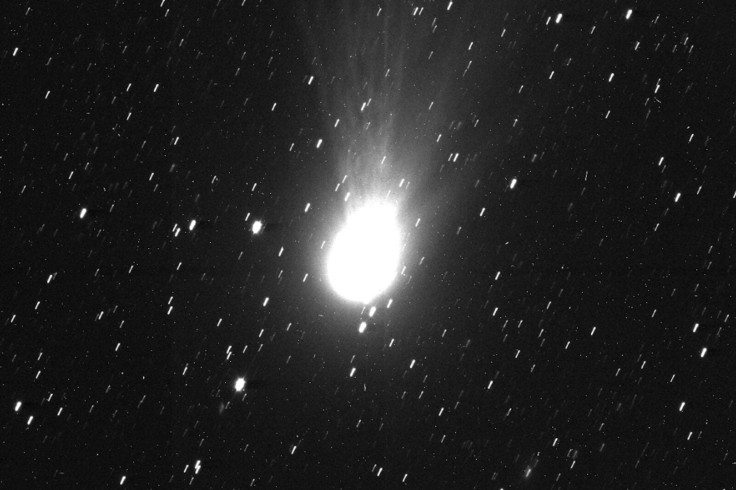
European scientists have revealed that the interstellar comet 3I/ATLAS was captured in unprecedented detail by the European Space Agency's JUICE spacecraft on 6 November 2025, when the mission was en route through the outer Solar System and the object was moving away from the Sun after its closest pass.
For context, 3I/ATLAS is only the third known interstellar comet ever confirmed, first spotted in June 2025 in data from the Asteroid Terrestrial-impact Last Alert System, or ATLAS. The International Astronomical Union's Minor Planet Center later verified that its path could not be explained by any orbit bound to our own star.
JUICE Turns Its Cameras On Interstellar Comet 3I/ATLAS
The JUpiter ICy moons Explorer, better known as JUICE, is supposed to be heading for Jupiter and its frozen satellites, with arrival pencilled in for 2031. Yet on 6 November 2025, mission controllers briefly turned its attention to 3I/ATLAS, which at that point had just looped past the Sun and was on its way back to the dark between the stars.
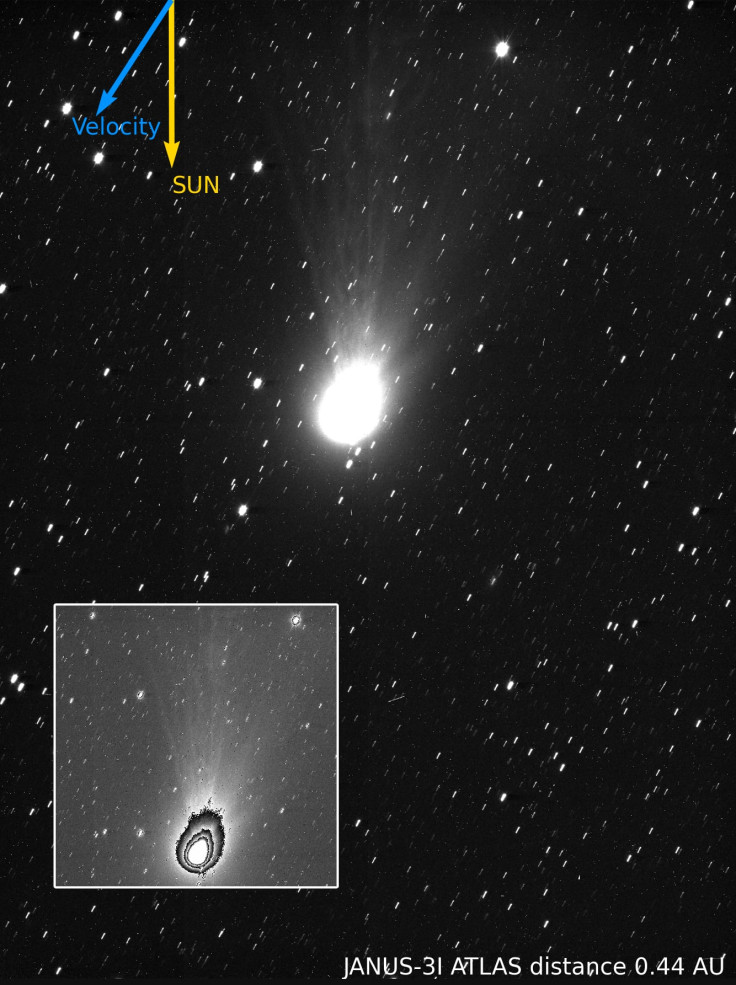
Using its JANUS camera, JUICE took more than 120 images of 3I/ATLAS during that single observing campaign, according to ESA. The session came just seven days after the comet's perihelion, when it made its closest approach to the Sun on 29 October 2025.
In the recently released frames, the tiny nucleus of 3I/ATLAS is wrapped in a bright, fuzzy halo of gas and dust known as a coma. From that envelope, a thin, extended tail can be seen stretching out into space, its orientation marked in ESA's processed images by arrows indicating the comet's motion relative to the Sun.
The detail matters. Mission scientists say the data show hints of jets, rays, filaments and streams within the coma and tail structure, subtle patterns that point to how 3I/ATLAS is venting and how its dust is being pushed and shaped. To squeeze the most from the fly-by, JUICE did not just rely on JANUS. ESA has confirmed that five of the spacecraft's instruments were directed at the comet to record different aspects of its behaviour and composition.
Those raw measurements are now back on Earth. Teams across ESA are working through the material, and the agency has said it will outline the first scientific results in late March. Until that briefing, much of what 3I/ATLAS can tell us about its home system remains locked up in numbers on hard drives and needs to be treated with a degree of caution rather than over‑interpreted.
Why 3I/ATLAS Matters For Alien Star Systems
Interstellar comets like 3I/ATLAS are astronomers' closest available samples of alien planetary systems. Unlike long‑period comets that loop around our Sun on stretched ellipses, an interstellar object barrels through once on a hyperbolic path and then is gone for good, carrying with it the frozen chemistry of the disc of dust and gas that formed its original star.
The history of such visitors is short. Before 3I/ATLAS, only two interstellar objects had been firmly logged: one interstellar asteroid and one interstellar comet. The arrival of a third, and of a type that develops a visible coma and tail, is therefore a rare chance to test whether other planetary nurseries build their comets from the same ingredients and under the same conditions as our own.
3I/ATLAS was first picked out in June 2025 in the automated scans of ATLAS, a survey system set up primarily to spot asteroids that might threaten Earth. Once orbital calculations showed that its trajectory could not be reconciled with a bound Solar System orbit, the Minor Planet Center designated it as an interstellar comet. From that point on, professional and amateur observers rushed to log as much information as possible before it faded.
By the time JUICE turned its gaze towards it in November, 3I/ATLAS had already passed behind the Sun from Earth's point of view and was dimming fast. For ground‑based telescopes, the window was closing. For a spacecraft in deep space, however, the geometry was far kinder. JUICE's vantage point allowed astronomers to see the comet against a dark background, without the glare and atmospheric interference that hamper observations from the ground.
Interstellar comets are also stress tests for theories about how material behaves near a star it has never 'met' before. As 3I/ATLAS plunged towards the Sun and then out again, its ices and dust were subjected to an unfamiliar intensity of light and heat. The way its coma and tail responded, and whether jets switched on and off in particular patterns, can feed into models of how much volatile material it carries and how firmly that material is bound together.
A Jupiter Mission Making Use Of The Long Cruise
JUICE is not designed as a comet chaser. The spacecraft left Earth on 14 April 2023 with a clear brief: study the icy moons of Jupiter, several of which are considered among the most promising places in the Solar System to look for conditions that could support life. It has a long cruise phase before it reaches the Jovian system in 2031.
That extended journey offers windows to look at other targets along the way. ESA's decision to use JUICE to observe 3I/ATLAS is part of a growing trend in planetary exploration, where missions squeeze extra science out of their transit time by diverting cameras and sensors towards opportunistic fly-bys.
For now, the images of 3I/ATLAS are a reminder of how fleeting such opportunities are. The comet is now drifting back towards interstellar space, its brief interaction with the Sun recorded in a few hundred digital frames and instrument read‑outs, waiting for ESA's scientists to tease out what, if anything, it can reveal about star systems far beyond our own.