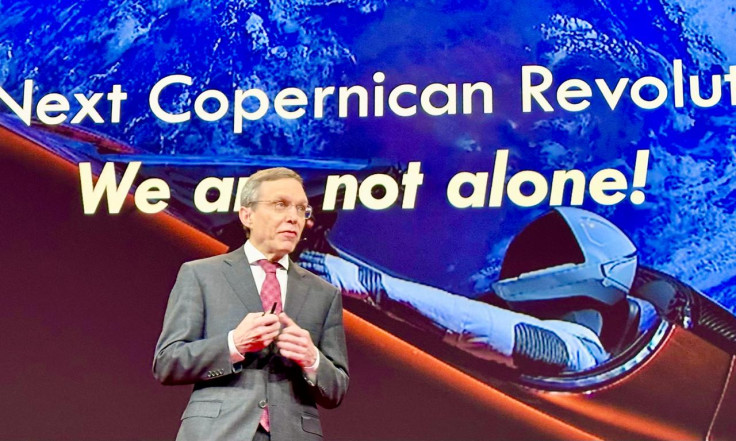
Harvard physicist Avi Loeb is once again pushing back against how the government handles space mysteries. He argues that when it comes to things like the interstellar object 3I/ATLAS, intelligence agencies are getting in the way rather than helping. During a chat on The Chris Cuomo Projecton 9 December 2025, Loeb did not hold back. He critiqued the way Washington keeps a tight lid on information about Unidentified Anomalous Phenomena (UAPs), suggesting that secrecy is hurting actual science.
The core of Loeb's frustration is simple: he thinks the government is trying to handle scientific work that they are not equipped to do. While he acknowledges the necessity of classified operations for terrestrial threats, he insists that objects originating from outside the solar system should not fall under the purview of intelligence agencies. According to Loeb, the silence from these agencies is less about protection and more about an inability to explain the unknown.
Defining the Jurisdiction of Scientific Inquiry
During his appearance on the podcast, Loeb emphasised that the study of the cosmos requires transparency, a quality often incompatible with military protocols. He argued that when the government encounters anomalous objects in interstellar space, they should not attempt to draw conclusions in isolation. Instead, the data should be handed over to experts equipped to understand it.
'They should focus on national security,' Loeb asserted, drawing a hard line between protecting the borders and exploring the galaxy. He made it clear that he does not expect officials to track every single thing happening in deep space, and he doesn't even blame them for not having all the answers. However, he takes issue with their refusal to collaborate.
Loeb believes that space exploration is fundamentally outside the government's 'jurisdiction.' By keeping findings on objects like 3I/ATLAS shrouded in mystery—specifically citing NASA's dissemination methods—agencies are hindering the very understanding they seek. Consequently, he hopes they will cease meddling in scientific affairs and release the data to him and his peers.
The Galileo Project's Eye on The Sphere
Frustrated with the current bureaucratic hurdles, Loeb has taken matters into his own hands by establishing an independent surveillance network. He detailed the progress of the Galileo Project, an initiative designed to bypass government gatekeepers entirely. This project relies on a network of private observatories to gather unclassified data.
'I'm leading the Galileo Project. We built three observatories. The latest one ... is in Las Vegas on top of The Sphere, the entertainment centre there,' he revealed.
This strategic location allows Loeb to monitor the sky with unprecedented autonomy. He explained that over the coming year, the project intends to observe and analyse 'millions of objects' utilising advanced machine learning software. The goal is to identify outliers—anomalies that do not fit standard astronomical models.
Unlike the government's approach, Loeb promised total transparency: 'Because if there are [outliers], we can analyse them in a scientific way, inform everyone, it will not be a secret, it will not be classified.'
Accusations of Embarrassment Over Security
Loeb's critique ventured into sharper territory when discussing the motivation behind the classification of UAP data. He suggested that the label of "classified" is frequently used not to protect state secrets, but to mask institutional failure. In his view, intelligence agencies are hiding the fact that they are 'not fulfilling their job.'
The physicist described the situation as 'embarrassing,' particularly given the massive financial investment in defence. He pointed out the irony of a government that pours roughly £780 billion ($1 trillion) annually into military budgets yet remains unable to identify objects flying within its own airspace.
Although he labelled this practice as 'inappropriate,' Loeb admitted that changing the entrenched culture of government secrecy is unlikely. He noted that without proper resources and openness, these agencies would 'never find anything' of significance.
Future Funding and The 3I/ATLAS Flyby
Looking toward the future, Loeb predicted that the geopolitical landscape of space funding would only shift upon the discovery of undeniable 'alien technology.' He theorised that such a revelation would unite humanity in a common cause.
'All humans on this planet will say, 'Well, we need to allocate a fraction of the military budgets worldwide to this problem, to this potential threat to Earth,' and that would mean a trillion dollars a year going into space exploration,' Loeb stated.
With such a budget, scientists could construct a global 'alert system' to warn of potential threats. This discussion comes at a critical time, as 3I/ATLAS is projected to make its closest approach to Earth on December 19, 2025. While the object will remain a safe 168 million miles away, Loeb insists that while it appears mostly natural, its anomalies warrant serious investigation rather than the government's approach of silence.
Originally published on IBTimes UK