The vast, seemingly empty gulf of space occasionally tosses us a gift — a visitor from beyond the confines of our own Solar System, a true cosmic stranger. These interstellar travellers are the rarest of astronomical sightings, and the recent arrival of 3I/ATLAS represents a gold-plated opportunity for scientists. It is only the third such confirmed object ever detected, following the enigmatic 'Oumuamua and 2I/Borisov.
The object, officially designated 3I/ATLAS, was first detected by the NASA-funded ATLAS (Asteroid Terrestrial-impact Last Alert System) survey telescope in Rio Hurtado, Chile, on July 1, 2025. Even at the point of its discovery, the numbers indicated its truly foreign origin. It was spotted at a heliocentric distance of 4.51 astronomical units (AU), and its astonishing orbital eccentricity of 6.13 immediately proved it was not bound to our sun — it was merely passing through, borrowing the sun's gravity for a brief, spectacular flyby before vanishing back into the void.
Also known as C/2025 N1 (ATLAS) and A11pl3Z, the object arrived from the direction of the constellation Sagittarius, travelling at a blistering radial velocity of around 58 km (36 miles) per second. This extreme speed is a clear sign that the object's trajectory is unperturbed by our local cosmic environment, maintaining the inertia of its journey from a completely alien star system. Think of it as a lone traveller who has spent millennia adrift, only to momentarily graze our orbital path before continuing their epic voyage.
Decoding the Coma: Why the Sun is Shattering 3I/ATLAS
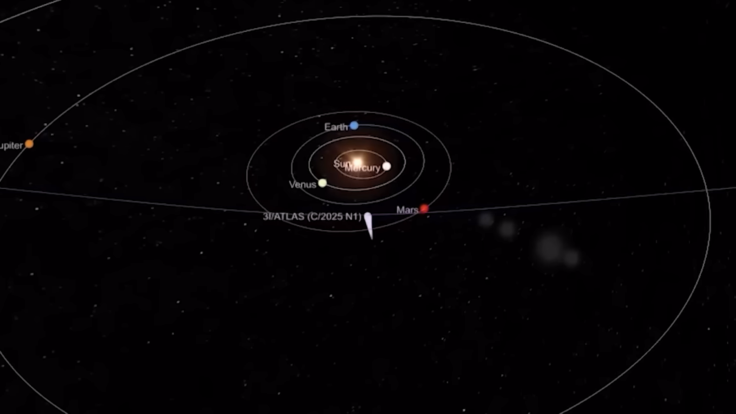
Scientists have been tracking this ethereal visitor's path as it arcs across our neighbourhood, racing towards and then away from the sun. The interstellar comet made a close approach to Mars at a distance of 0.194 AU on Oct. 3 and reached its closest approach to the sun — known as perihelion — on Oct. 30. This rapid transit means the window for observation is fleeting, making every image captured by humanity's most powerful telescopes incredibly precious.
The world's premier space-borne observatory, the Hubble Space Telescope, has been dedicated to this task. After an initial survey shortly after its discovery in July, Hubble returned to the object for a crucial follow-up. On Nov. 30, astronomers deployed Hubble's Wide Field Camera 3 (WFC3) instrument to capture its latest portrait as it headed outwards.
Observing the comet as it moves across the sky is an exercise in dynamic precision; as the space telescope tracked the hurtling object, the background stars blurred into long, tell-tale streaks of light. The scientists, in their statement, said that 'Hubble tracked the comet as it moved across the sky', and 'As a result, background stars appear as streaks of light'.
The current phase of observation is expected to continue for several more months as 3I/ATLAS heads out of the Solar System, giving researchers an unparalleled opportunity to study its final disintegration — a destructive process caused by our own star.
The 3I/ATLAS Teardrop: Is This Proof of Harvard's Radical Theory?
The newest Hubble image reveals a captivating sight that is fuelling feverish scientific debate: a glowing, teardrop-shaped halo surrounding the comet's core. The visual evidence shows that this halo, or coma, extends distinctively towards the sun, a feature known as the 'sunward anti-tail extension'. This extension, according to the highly respected Professor Avi Loeb of Harvard University, was also apparent in the pre-perihelion Hubble image, taken on July 21.
The latest measurements are genuinely staggering. The new radius of the glow is approximately 40,000 km (24,855 miles), and its anti-tail extension stretches out to an incredible 60,000 km (37,282 miles). This unusual, asymmetrical shape is far from typical for a stable comet. Professor Loeb suggested in a recent paper that the teardrop shape is associated with a 'large number of macroscopic non-volatile objects that separated from it' as a result of its measured non-gravitational acceleration away from the sun.
Critically, the shape and size are almost exactly what he predicted. Loeb's hypothesis suggested that by Nov. 30th, the swarm of objects — the fragments shed by the interstellar traveller — would be closer to the sun than 3I/ATLAS itself by about 60,000 km if the smaller objects had overlapped with the main comet at perihelion. He noted that this separation 'is in perfect agreement with the anti-tail extension of the teardrop shape in the new Hubble image'.

This extraordinary alignment between prediction and observation suggests that the intense solar heat near perihelion caused the nucleus of the interstellar comet to shed numerous large, solid fragments, which are now trailing ahead of the main body and distorting the coma's shape.
As the comet rushes past Jupiter, which it will approach at a distance of 0.357 AU on March 16, 2026, the data collected by Hubble provides a unique, high-definition autopsy of a dying comet from another star — a once-in-a-generation glimpse into the building blocks and composition of an alien solar system. It is a powerful reminder that our little corner of the Milky Way is constantly being visited by pieces of other worlds.
The perfect, 60,000 km agreement between Professor Loeb's theory and Hubble's image is a stunning validation that this interstellar visitor is breaking apart. This dying comet offers a once-in-a-generation glimpse into the building blocks of an alien star system.